

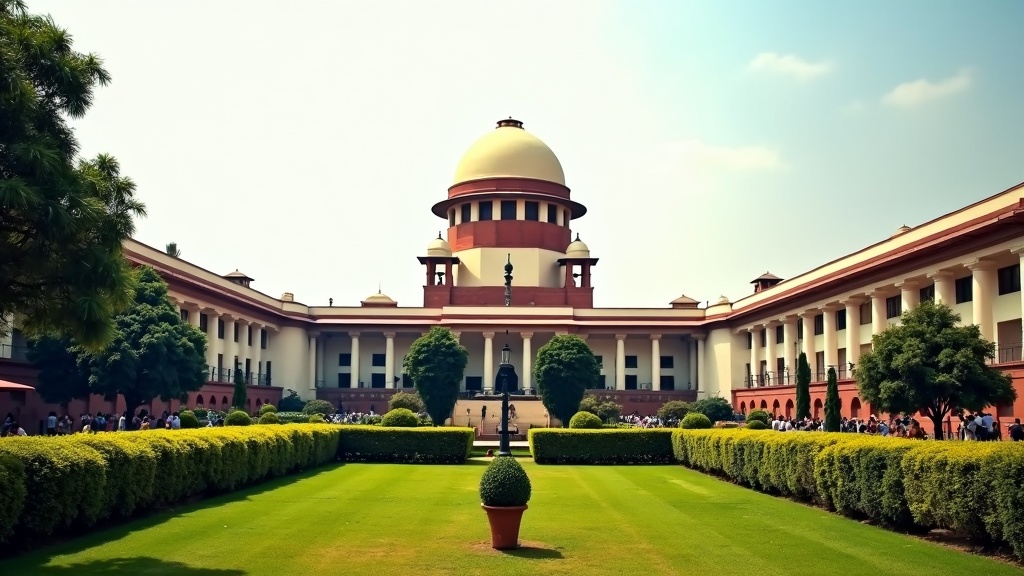
Chief Justice Surya Kant's Supreme Court bench has initiated a constitutional recalibration that extends far beyond any single judgment. Through a series of April rulings, the Court is systematically expanding the fundamental rights framework to address gaps in state obligations — from early childhood education to highway safety to legal representation.
The most significant intervention came through a PIL seeking to extend Article 21A's right to free and compulsory education to children aged 3-6, currently outside the Right to Education Act's 6-14 age bracket. The Court's notice to the Centre, States, and Union Territories signals a potential constitutional expansion that would bring India's early childhood education framework into the fundamental rights chapter.
The Constitutional Architecture Under Review
Article 21A, inserted through the 86th Amendment in 2002, established education as a fundamental right but limited its scope to children aged six to fourteen. The current challenge argues this leaves a critical developmental window unprotected, particularly when neuroscience research demonstrates that 90 per cent of brain development occurs before age five.
This educational rights expansion sits alongside the Court's parallel interventions in infrastructure safety and legal access. The same bench issued suo moto directions to the Ministry of Road Transport and the National Highways Authority following the Phalodi and Rangareddy accidents, treating safe passage on national highways as a constitutional imperative rather than merely a policy preference.
The legal aid reaffirmation under Articles 21 and 39A completes what appears to be a coordinated constitutional project. The Court is defining not just negative rights — freedom from state interference — but positive entitlements that require active state provision.
Institutional Implications
The education extension carries immediate fiscal and administrative consequences. States already struggle with RTE implementation for the 6-14 cohort; expanding coverage to 3-6 year-olds would require substantial infrastructure investment, teacher training programs, and curriculum development specifically designed for early childhood learning.
The road safety mandates similarly impose direct compliance burdens on highway authorities. The Court's interim directions require immediate safety audits and remedial measures on identified high-accident corridors, treating highway maintenance as a constitutional duty rather than discretionary spending.
Legal aid expansion addresses access-to-justice concerns that have long frustrated lower courts. When constitutional rights become meaningless without representation, the Court's reaffirmation of state obligations under Articles 21 and 39A establishes legal assistance as infrastructure, not charity.
The Developmental State Framework
These rulings reflect a broader judicial philosophy that aligns constitutional interpretation with India's development trajectory. Rather than treating fundamental rights as static 1950 commitments, the Court is adapting constitutional text to address contemporary challenges that the framers could not have anticipated.
The early childhood education extension recognizes that India's demographic dividend depends on early investment in human capital. The road safety mandates acknowledge that infrastructure development without safety protocols undermines rather than advances national progress. The legal aid emphasis ensures that constitutional promises reach citizens regardless of economic status.
This approach draws from international jurisprudence while remaining grounded in Indian constitutional text. The Court is not importing foreign rights concepts but extracting fuller meaning from existing constitutional commitments.
Implementation Challenges
The practical impact depends entirely on implementation mechanisms. Article 21A's existing enforcement has been uneven across states, with significant variations in infrastructure, teacher quality, and administrative capacity. Extending coverage to younger children multiplies these challenges exponentially.
The Centre's response will likely emphasize fiscal federalism concerns and implementation timelines. States have consistently argued that unfunded mandates strain their budgets, particularly when constitutional directives require immediate compliance regardless of resource availability.
The Court's approach suggests awareness of these constraints. Rather than imposing immediate universal coverage, the education notice seeks responses on feasibility, timelines, and resource requirements. This indicates potential for phased implementation rather than blanket mandates.
Road safety and legal aid face different but parallel challenges. Highway authorities operate under multiple regulatory frameworks; constitutional mandates could conflict with existing statutory obligations. Legal aid systems require coordination between bar councils, state governments, and judicial administration — coordination that has historically been inconsistent.
Chief Justice Kant's bench is rewriting the social contract between citizen and state. The fundamental rights chapter becomes not just protection from government overreach but a positive agenda for state responsibility. The success of this approach will depend on whether constitutional ambition translates into administrative capacity and political commitment at the implementation level.