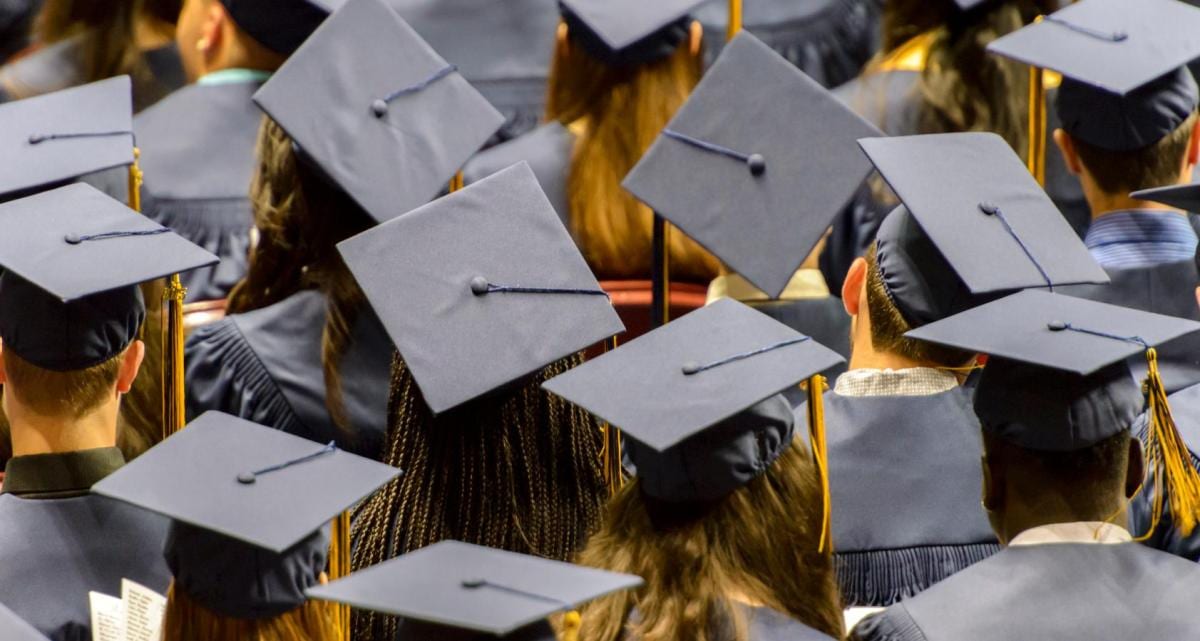
Commencement speakers, take note: talk about artificial intelligence at your own risk.
Former Google CEO Eric Schmidt learned this at the University of Arizona last Friday. When he told graduating students, "You will help shape artificial intelligence," the auditorium erupted in boos—loud enough that Schmidt had to speak over them.
He continued anyway. "You can now assemble a team of AI agents to help you with the parts that you could never accomplish on your own. When someone offers you a seat on the rocket ship, you do not ask which seat, you just get on." More booing followed.
Schmidt wasn't alone. A week earlier, Gloria Caulfield, an executive at real estate firm Tavistock Development Company, pitched a similar message at the University of Central Florida. "The rise of artificial intelligence is the next industrial revolution," she said—triggering immediate boos from the crowd.
Caulfield paused, visibly confused. "What happened?" she asked the other speakers on stage. "Okay, I struck a chord." When she tried to continue, the audience suddenly cheered—but only when she mentioned that "only a few years ago, AI was not a factor in our lives."
Not every AI pitch gets rejected. Nvidia CEO Jensen Huang sailed through Carnegie Mellon's commencement after praising how AI has "reinvented computing" with no audible pushback.
Yet the pattern is clear: Gen Z graduates aren't buying the AI hype. A recent Gallup poll found only 43% of Americans aged 15 to 34 think it's a good time to find a job locally—a nosedive from 75% in 2022. Tech critic Brian Merchant captured the mood: "I too would loudly boo at the prospect of this next industrial revolution if I was in my early twenties, unemployed, and had aspirations for my future greater than entering prompts into an LLM."
The internet is living for these commencement fails. Gen Z's rejection of the AI revolution at its own celebration speaks for itself.