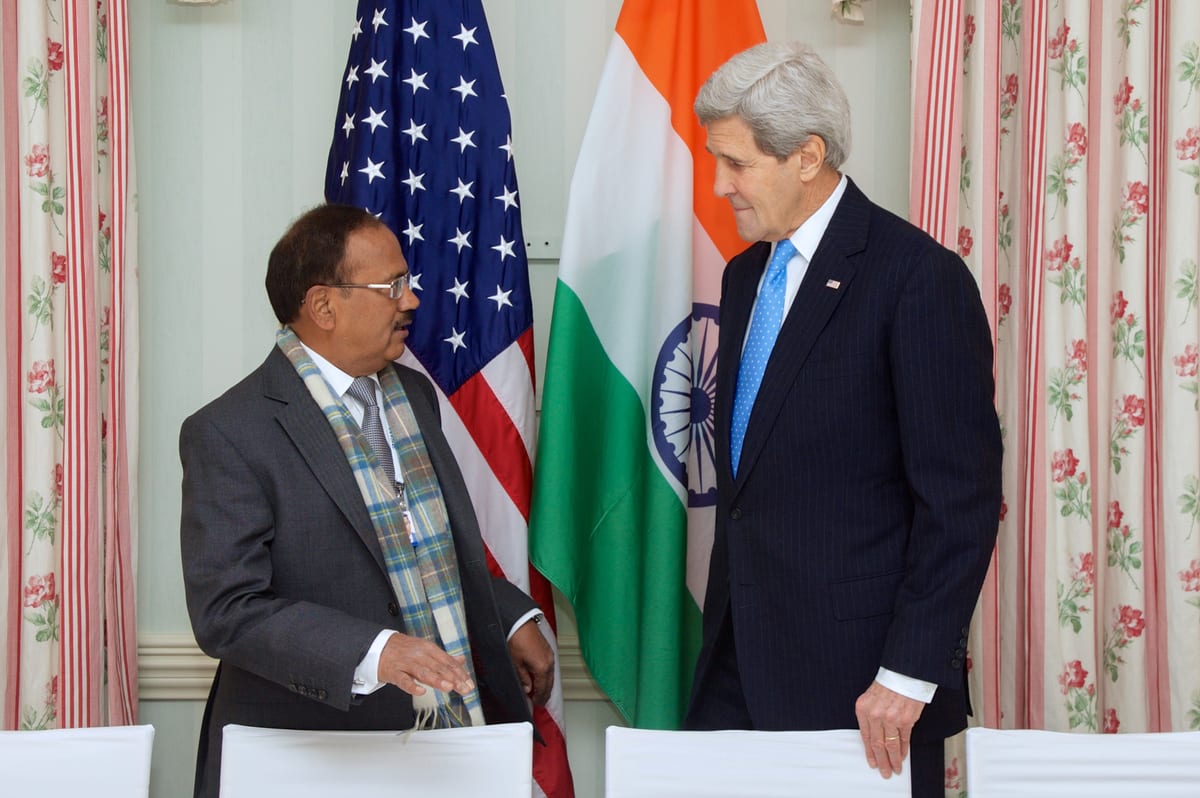
When Narendra Modi took office in May 2014, his first appointment was not his Principal Secretary, not a Cabinet colleague, not a Finance Ministry functionary tasked with managing an economy in transition. It was Ajit Doval as National Security Advisor. That sequence, disclosed by Home Minister Amit Shah at a ceremony in Pune on Saturday, reveals how the Modi government has structured power: security is the precondition, not a downstream concern managed after the political and economic agenda is set. The Lokmanya Tilak National Award 2026, conferred on Doval at that same ceremony, recognizes twelve years of service. It also makes explicit what has long been structurally apparent.
Shah's tribute was unambiguous. "In every decision of PM Modi for national security, Ajit Doval has had a 'role and advice' in the background," he said, adding that whenever the history of this tenure is written, "a 'golden page' will undoubtedly have to be reserved for Ajit Doval." He also offered a personal account: as Gujarat Home Minister following a series of bomb blasts, Shah was directed by then Chief Minister Modi to consult Doval. The Gujarat Police, acting on Doval's analysis, cracked not only the Ahmedabad blasts but thirteen bomb blasts from across the country. The anecdote locates the Doval method — look beyond the immediate incident, map the wider network — as the operating principle that would eventually scale from a state police operation to the architecture of national counterterrorism doctrine.
The NSA as Super-Coordinator
The Doval tenure represents the emergence of the NSA as a super-coordinator across domains that previously operated in parallel silos: the Intelligence Bureau and RAW ran separate intelligence chains; the military and diplomatic establishments shared information with reluctance; backchannel diplomacy was conducted by retired officials with no real-time access to the decision loop. The Doval model collapsed those distances. The NSA office assumed functions that previously resided with the Cabinet Secretary and, in some cases, the Foreign Secretary — a structural shift in how national security decisions reach the Prime Minister. The post-Galwan backchannel with China, the security framework surrounding the Article 370 decision, and the operational coordination attributed to the response following the Pahalgam attack each represent a mode of governance in which the NSA's office served as the integrating node.
Shah's observation that India now has "a foreign policy with a backbone, a fact no one can deny" carries this same institutional logic. Foreign policy backbone is about the credibility of the security signals that diplomatic communication rests upon. When India's partners in Washington, Paris, Tel Aviv, and Riyadh calculate the weight of an Indian commitment or the seriousness of an Indian deterrent signal, they are making a judgment about the coherence of the institution behind it. The NSA's office, under Doval, has been that institution's most legible face.
The Structural Fault-Line the Award Cannot Address
The celebration and the institutional problem converge here. The award is a political act of recognition, and it is fitting. But the very comprehensiveness of what Shah described — Doval's presence in every major security decision for twelve years, across counterterrorism, border management, strategic diplomacy, and intelligence coordination — also exposes a vulnerability that no award ceremony can resolve.
India's NSA office has no statutory basis. It was created by executive order; its authorities, its relationship to the Cabinet Committee on Security, its warrant of precedence relative to the Foreign Secretary and the Cabinet Secretary — all exist in the realm of convention and Prime Ministerial preference rather than law. In practice, the office expands to fit the individual who holds it. Doval, with his IB background, his operational experience, and his direct relationship with the Prime Minister, filled the role with a density that no job description could have anticipated. Institutions built around individuals are arrangements, not institutions. Arrangements do not survive succession.
Manoj Joshi, a Distinguished Fellow at ORF, has analysed this structural shift — the NSA assuming functions that previously resided with the Cabinet Secretary and the Foreign Secretary. India's most consequential security decisions now flow through an informal centre of gravity. When that centre of gravity changes, the decisions may flow differently, or more slowly, or through channels that have atrophied from disuse. Strategic continuity, which India's partners in the Quad, in the Indo-Pacific framework, and in bilateral defence partnerships have built their expectations around, is more personality-dependent than the apparatus of awards and public tributes would suggest.
What Formalisation Would Require
The comparison to other major democracies is instructive. The United States National Security Council was created by the National Security Act of 1947; the NSA's authorities sit within a statutory framework that defines accountability and succession. Britain's National Security Council, established in 2010, operates through Cabinet Office structures that give it institutional memory independent of any single advisor. India's equivalent operates with neither of these supports. The NSA's mandate, the widest of any security official in the country, rests on nothing more durable than a Prime Minister's confidence.
This is not an argument against the Doval model — the model has delivered. The integration of intelligence assessment into diplomatic signalling, the shortening of the decision loop between intelligence input and political decision, and the coherence of India's deterrence posture across its borders are real institutional achievements. The argument is that achievements of this kind deserve a more durable vessel. A formal legislative or executive instrument defining the NSA's mandate, establishing its relationship to the Cabinet Secretary and Foreign Secretary, and creating transparent succession protocols would not constrain the next NSA's effectiveness; it would guarantee that the next NSA begins from an institutional platform rather than from scratch.
Shah's tribute invoked Lokmanya Tilak's legacy — a man who, as Shah noted, transformed nationalism into cultural nationalism, who mobilised through Ganesh festivals and the Kesari newspaper, who understood that durable movements require institutional expression, not just individual charisma. The award's location within that lineage is deliberate. Tilak built structures that outlasted him. The question the Doval recognition implicitly raises is whether the security architecture Doval built will do the same. Public recognition consolidates a legacy; legislation institutionalises it. The first has now been accomplished with considerable ceremony. The second remains undone.