Darpan Jain was appointed chief negotiator for the India-EU Free Trade Agreement on 12 November 2025. The agreement was concluded on 27 January 2026. Eighty-six days to negotiate what would become, in Jain's own words, "the mother of all deals" covering 99.5 per cent of trade value. What does a municipal waste management specialist know about carbon border adjustments?
794 Indian product categories have stopped or show major decline in EU exports since January 2026, with USD 183.5 million in annual trade at risk. The EU's Carbon Border Adjustment Mechanism and Deforestation Regulation have created a de facto embargo that India's negotiators did not anticipate, did not understand, and did not counter.
The Parachute Landing
Jain's curriculum vitae includes roles as Deputy Commissioner Mysuru, Deputy Commissioner Dharwad, Deputy Commissioner Yadgir, and Special Commissioner Bengaluru Solid Waste Management. Seven years at the Department of Commerce negotiating services FTAs with the UAE, Australia, UK, and EFTA produced zero mutual recognition agreements and preserved every partner country's immigration quotas virtually unchanged.
The EU negotiation had been running for years when Jain was inserted as chief negotiator at the fag end. India's Steel Secretary had publicly acknowledged that CBAM posed a bigger threat than US tariffs. India had raised CBAM concerns 29 times at the WTO between 2020 and 2024. The technical complexities were documented, the regulatory threats mapped, the compliance costs calculated.
Jain had eighty-six days to master what China's trade negotiators spend decades studying. The results were predictable.
The CBAM Capitulation
The FTA secured zero CBAM exemptions for India. Indian steel emits approximately 2.6 tonnes of CO2 per tonne produced, compared to the EU's 1.4 tonnes. CBAM adds over EUR 200 per tonne to Indian steel exports, while the EU simultaneously slashed India's tariff-free steel quota by 47 per cent and doubled out-of-quota duties to 50 per cent.
Indian steel exports to the EU fell 31 per cent in 2025 during the transitional phase alone. MSMEs produce 40 per cent of Indian steel but lack the monitoring, reporting, and verification teams required for CBAM compliance. They pay punitive default emission rates that make their products uncompetitive.
Jain's answer to this regulatory strangulation: a Rapid Response Mechanism that is not yet operational and a Non-Violation Complaints clause that requires years to produce a ruling with no enforcement mechanism. Paper safeguards for a carbon tax that took effect on 1 January 2026.
The Smallholder Sacrifice
The EU Deforestation Regulation, effective 30 December 2025, requires geolocation tracking and supply chain traceability that 99 per cent of India's 3-4 lakh coffee farmers cannot provide. Seventy per cent of Indian coffee exports — approximately USD 1.3 billion annually — go to the EU.
The compliance costs for a smallholder in Kerala's Western Ghats are prohibitive: satellite monitoring, digital documentation, third-party certification. The FTA provided no EUDR relief for Indian farmers. Rubber and palm oil derivatives face the same regulatory barriers.
The EU pledged EUR 500 million for India's decarbonisation. This is a rounding error against multi-billion-dollar CBAM costs and smallholder displacement. Jain describes this as securing India's interests.
The IAS Generalist Syndrome
In the British civil service, the honours system produces a telling hierarchy: CMG (Companion of St Michael and St George) — "Call Me God"; KCMG (Knight Commander) — "Kindly Call Me God"; GCMG (Grand Cross) — "God Calls Me God". India's IAS has inherited this institutional arrogance without the institutional memory.
India's trade negotiations are conducted by generalist civil servants trained as district collectors and municipal administrators. The same officer who manages potholes in Bengaluru can negotiate India's relationship with a EUR 758-billion trade bloc. Domain expertise is irrelevant; seniority is everything.
China's trade negotiators are specialists retained in the same portfolio for decades. Wang Shouwen, China's WTO Ambassador and Vice Minister of Commerce, spent over twenty years in trade negotiations before leading China's WTO offensive. Every Chinese negotiator facing the EU understands carbon leakage, border tax adjustments, regulatory harmonisation, mutual recognition frameworks.
India rotates a generalist IAS officer every two or three years, provides no domain training, then expresses surprise when EUR 200-per-tonne carbon costs are not negotiated away in eighty-six days.
The China Reality Check
China-EU bilateral trade reached EUR 758 billion in 2025, with EU imports from China totalling EUR 559 billion. China is the EU's largest single-country source of imports. While India loses 794 product categories to regulatory barriers, China has captured the entire EU market through superior regulatory engagement.
In the Netherlands alone — the subject of Prime Minister Modi's current visit — China exports $117.981 billion compared to India's $9.446 billion. China is 12.5 times larger than India in a single EU member state. China dominates the Dutch market in machinery (57.6 per cent), electrical equipment (69.4 per cent), furniture (80.7 per cent), iron and steel articles (60.5 per cent). India leads China in only one of twenty sectors.
The Commerce Ministry's bilateral briefings do not foreground this competitive gap. They celebrate India's $9 billion in Dutch exports while ignoring China's $118 billion benchmark. The ministry uses inflated DGCIS figures that overstate India's Netherlands exports by 50.1 per cent due to the Rotterdam port-of-entry effect — goods destined for other EU markets are recorded as "exports to Netherlands" when they merely transit through Dutch ports.
India's actual export performance to the Netherlands fell 21.3 per cent from $12.003 billion in 2024 to $9.446 billion in 2025. The ministry's public claims of $27.8 billion "bilateral trade" aggregate goods, services, and FDI flows to mask export decline.
State-Level Wreckage
The 794 stopped product categories translate into specific state-level damage. Odisha, Chhattisgarh, and Jharkhand face direct CBAM exposure. Tens of thousands of jobs are at risk across the steel supply chain.
Kerala and Karnataka coffee farmers confront EUDR compliance they cannot afford. Gujarat and Maharashtra, better positioned with renewable energy infrastructure, still face quota cuts and regulatory barriers that specialist negotiators might have countered.
The pattern extends across 66 EUDR-affected codes worth $2.6 million and 69 CBAM-affected codes worth $29.3 million. The EU's regulatory architecture has created market access barriers more effective than any traditional tariff.
Modi's Corrective Tour
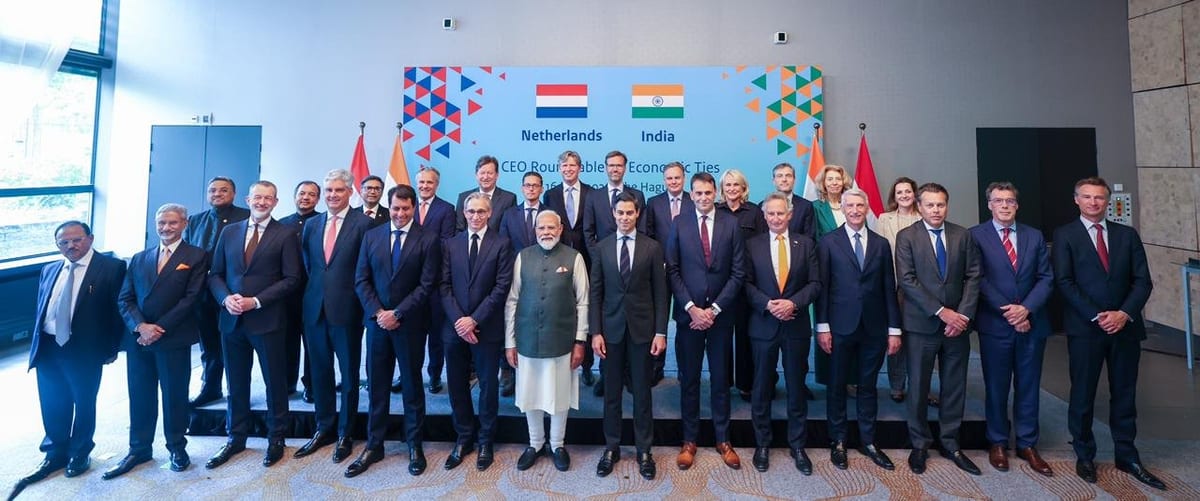
Prime Minister Modi's six-day, five-country European tour from 15-20 May represents the political corrective that generalist bureaucrats could not deliver. The CEO Roundtable in The Hague on 16 May places trade and FTA implementation at the centre of diplomatic engagement.
The EU is accelerating FTA signing timelines ahead of Modi's visit — a tacit admission that the deal Jain concluded requires political intervention to become functional.
Modi understands strategic trade in ways that district collectors turned trade negotiators cannot. His direct engagement with European counterparts offers the opportunity to address regulatory barriers through political channels when technical negotiations have failed.
The alternative is watching China consolidate its EUR 559-billion EU relationship while Indian exporters abandon 794 product categories to compliance costs that specialist negotiators might have anticipated. India's trade diplomacy requires the same institutional seriousness that China brings to every negotiation. The current approach — rotating municipal administrators through complex trade portfolios — produces predictable results: regulatory capitulation disguised as comprehensive partnership.