
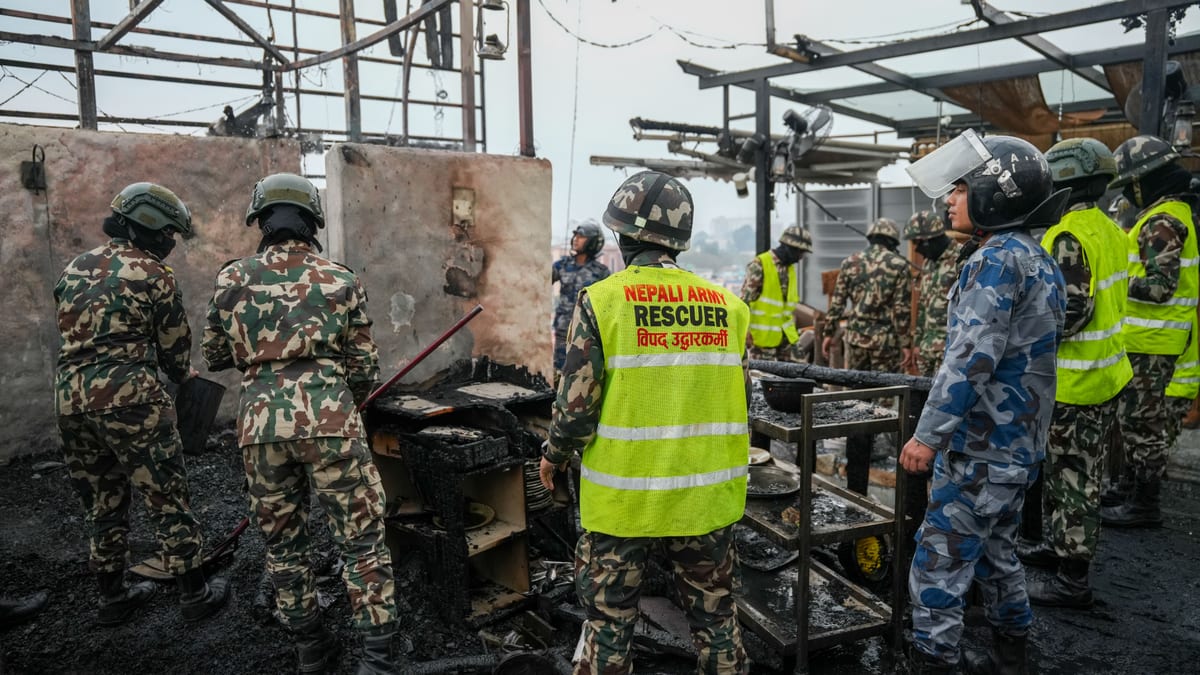
New Delhi: The Union home ministry on Thursday reviewed India's preparedness for glacial lake outburst floods, days after a glacier collapse in Nepal sent a wall of water through Himalayan valleys, killing more than 1,200 people and leaving thousands missing. The review meeting, chaired by Union home secretary Govind Mohan, brought together state government officials and central bodies including the National Disaster Management Authority, Central Water Commission, India Meteorological Department and Defence Geoinformatics Research Establishment.
The meeting assessed the evolving risk of GLOFs, sudden floods that occur when a natural dam holding a glacial lake collapses, across the Himalayan region. Officials examined early warning systems, monitoring of vulnerable glacial lakes and snow-covered areas, identification of high-risk locations, flow path modelling, timely alert dissemination, evacuation preparedness and strengthening of response mechanisms, according to a home ministry statement.
India's Himalayan states and Union territories were the focus, with officials reviewing their readiness for GLOFs and snow avalanches. The government decided to strengthen early warning and response mechanisms to minimise loss of life and property.
"The Union Home Secretary stressed that preparedness for GLOFs and snow avalanches must move beyond response-oriented measures towards risk-informed planning, preventive mitigation and community-level preparedness," the statement said.
The review follows a glacial collapse in the Nepal Himalayas that triggered flash floods across the border region. India and Nepal share a 1,770 km border, with Uttarakhand, Uttar Pradesh, Bihar, West Bengal and Sikkim adjoining Nepal. That proximity makes Nepal's deluge a live warning for Indian river basins fed by the same retreating glaciers.
From response to prevention
The home secretary's emphasis on shifting from response to risk-informed planning marks a change in how the central government frames Himalayan disasters. For decades, flood management in the mountains has meant rescue boats and relief camps after the water arrives. But a glacial lake burst gives little warning: an ice dam or moraine collapses, and within hours a debris-laden flood sweeps down the valley. Waiting to respond is not enough when the first wave can arrive before a siren sounds.
The Indian Himalayan arc holds thousands of glacial lakes, with dense clusters in Uttarakhand, Himachal Pradesh, Sikkim and Ladakh. As temperatures rise, many are growing and becoming unstable. The 2023 glacial lake outburst in Sikkim flattened a hydropower station and forced downstream villages to flee, a reminder that the risk is not hypothetical. Monitoring those lakes in real time, draining the most dangerous ones, and mapping evacuation routes are no longer optional.
Community-level preparedness is the hardest piece to get right. In Uttarakhand and Sikkim, glacier lakes sit far above villages that may have no mobile signal and no siren. Training local residents to recognise warning signs, marking safe assembly points, and running evacuation drills require sustained district administration effort, not just a Delhi review. The home secretary's statement singled out community-level preparedness as an expectation, and the 2023 Sikkim experience showed that villages which received early warnings moved faster than those which did not.
Hydropower, roads and fragile towns
Large hydropower projects sit directly in the path of potential GLOFs. Rivers like the Teesta and Alaknanda are being harnessed for electricity even as their headwaters hold unstable lakes. A major outburst would threaten these installations, damage strategic border roads, and inundate towns such as Joshimath, already grappling with land subsidence. The review's call for flow path identification and evacuation preparedness speaks to that exposure.
Swiss Re's July 2025 research for India quantified the financial stakes: floods accounted for about 67% of all economic losses from natural catastrophes in India over the preceding two decades. A separate 2023 Swiss Re report pegged India's annual economic loss from natural calamities at $12 billion, driven mainly by floods and cyclones. Those numbers explain why the home ministry is treating GLOFs as a national safety priority rather than a seasonal inconvenience.
The review's mention of snow-covered areas and snow avalanches broadens the mandate to winter hazards. Uttarakhand and Himachal Pradesh have lost lives to avalanches in recent years, and the same early-warning architecture that tracks glacial lakes can feed avalanche alerts. Combining GLOF monitoring with avalanche preparedness makes sense for states that face both risks in the same valleys.
Neighbourhood trust and shared warning systems
Nepal President Ram Chandra Paudel thanked India for "generous support and solidarity" after the floods, according to The Times of India. That gratitude reflects a practical reality: India is the first responder for Himalayan disasters in its neighbourhood. But the same transboundary water systems that carry aid downstream also carry glacier burst warnings upstream. A lake that fails in Nepal can send a flood into Bihar or Uttar Pradesh with little notice. Formal data sharing with Kathmandu and Thimphu would be worth more than ad hoc exchanges after the water has moved.
A framework that can travel
India's National Disaster Management Authority already works with the Central Water Commission and the Indian Space Research Organisation on glacial lake inventories. The next step is to convert those inventories into a network of automatic weather stations, lake-level sensors and sirens in high-risk valleys. The home ministry has asked states to expedite the GLOF mitigation project sanctioned in 2024, a sign that funding exists but execution lags.
The technology needed is not exotic. Automatic sensors, camera feeds and community sirens can be installed at a fraction of the cost of rebuilding a destroyed dam. Through the Coalition for Disaster Resilient Infrastructure, India has a platform to share that low-cost approach with other Himalayan countries and with Andean nations facing similar risks. A plan that protects towns like Joshimath can also become an exportable blueprint.
The review ends with a clear instruction: states must speed up their GLOF mitigation work. Whether that translates into drained lakes, mapped evacuation zones and working sirens before the next monsoon will decide how seriously the lessons of Nepal have been absorbed.