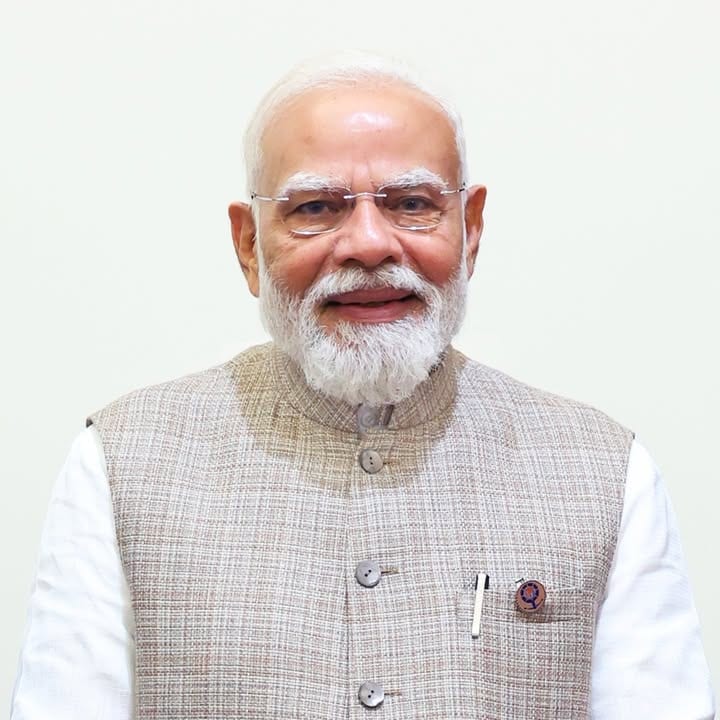
On Sunday, Prime Minister Narendra Modi received the Order of "Oliy Darajali Dustlik", Uzbekistan's highest state honour, from President Shavkat Mirziyoyev during a two-day state visit, according to LiveMint. The prime minister thanked Mirziyoyev as his "brother" and said India and Uzbekistan would work together for the welfare of the Global South and humanity.
Asaduddin Owaisi, the All India Majlis-e-Ittehadul Muslimeen president and Hyderabad MP, turned the diplomatic honour into a pointed question about the Bharatiya Janata Party's historical vocabulary. "I congratulate the BJP; the very country from which Babur came to India has conferred an award upon the Prime Minister. The Fergana Valley is in Uzbekistan. Wherever the Prime Minister goes these days, he returns with an award," Owaisi told ANI, as quoted in the same LiveMint report.
"Congratulations. You used to hurl so many insults in Babur's name, yet the people of that very country are now honoring you with an award. The Sangh needs to reflect on this... We hope that members of the Sangh Parivar and RSS supporters will no longer speak of Babur in that manner," the Hyderabad MP said.
The remark occurs within a long-running contest over how India remembers Zahir-ud-din Muhammad Babur, the Central Asian prince who founded the Mughal Empire in 1526 and whose name became synonymous with the Babri Masjid and the Ram Janmabhoomi campaign. The Mughal Empire lasted over 200 years and at its peak covered modern-day India, Pakistan and Afghanistan, as the LiveMint report notes. The BJP became the political face of the Ram Janmabhoomi movement in the late 1980s and 1990s, with the RSS as its ideological fountainhead and Babur repeatedly invoked as a political target.
The LiveMint report carried no response from the BJP or the RSS to Owaisi's comment. Neither did India Today's coverage of the exchange.
A diplomatic honour on a historical faultline
State honours between countries are routine instruments of diplomatic reciprocity. They mark a relationship, not a verdict on figures from centuries past. But Owaisi's intervention forces a different frame: if the BJP and RSS have spent decades casting Babur as a symbol of invasion and temple destruction, what does it mean when the leader of that political formation accepts an award from the Fergana Valley, the very geography Babur left behind?
The question is not one New Delhi will answer, and it need not. Foreign policy operates in a register that rarely engages with domestic historical debate. India's engagement with Uzbekistan rests on connectivity, trade, and shared security concerns; the prime minister's own statement framed the recognition as a commitment to the Global South. That is the diplomatic register. The political register works differently, and Owaisi knows it.
His jab has a specific logic. By linking the honour to Babur's homeland, he exposes a tension that opposition voices can exploit: the coexistence of a national political narrative that treats Babur as an invader with India's active diplomatic engagement with Uzbekistan. The government has no obligation to reconcile those two positions, but the opposition can still make the contradiction visible. The award itself does not change India's strategic partnership with Tashkent, nor does it alter the domestic contest over Ayodhya. But it offers a ready-made rhetorical opening.
The strategic partnership Tashkent and New Delhi are building
For New Delhi, Uzbekistan's value lies in its location, its energy reserves, and its role in connectivity corridors linking South Asia to Central Asia and beyond. The two countries have maintained regular diplomatic contact, and Modi's visit reinforced a relationship that has grown steadily over the past decade. In that context, the state honour is a marker of mutual goodwill.
The prime minister thanked Mirziyoyev for the warmth extended to his delegation and said the visit would remain memorable. That is standard diplomatic language. But the fact that an award from Uzbekistan can become a political weapon inside India shows how foreign policy achievements can be reframed by domestic political messaging. The government is unlikely to dignify Owaisi's comment with an official rebuttal. Doing so would elevate a marginal political jibe into a diplomatic issue.
The political cost of a historical shard
Owaisi's comment is effective precisely because it does not need to be factually original. It recycles a long-standing tension: the BJP-RSS movement built part of its mass appeal on a historical argument about Babur and the Babri Masjid, while the Indian state now engages the Central Asian nations that produced those rulers. For the AIMIM chief, the honour is useful in two ways. It lets him congratulate the prime minister while simultaneously challenging the ideological consistency of the Sangh Parivar.
India's foreign policy achievements are increasingly open to domestic reinterpretation. A state honour from a Central Asian capital can be turned into a question about historical memory, and the BJP-RSS will have to defend its historical vocabulary even while it collects diplomatic recognitions from the very geographies it once used as shorthand for invasion. Whether that defence comes or not, the exchange has already reset the optics of Sunday's award for a large domestic audience.
For Indian readers, the takeaway is not that the honour has anything to do with Babur. It does not. The award reflects Uzbekistan's recognition of Modi's leadership and the two countries' shared interests. But Owaisi has reframed it, and that reframing will travel further than the original diplomatic statement. The government is right to treat the honour as a routine bilateral gesture. The opposition is entitled to treat it as political material. The historical shard Babur left behind continues to cut both ways.