On the morning of December 23, 2025, Union Commerce Minister Piyush Goyal walked into Kamalalayam — the BJP's modest state headquarters tucked behind the commercial chaos of T. Nagar, Chennai — and sat down with a room full of people who had been waiting for exactly this kind of operator. Union Minister of State L. Murugan was there. State President Nainar Nagenthran. Former Telangana Governor Tamilisai Soundararajan. The veteran organiser H. Raja. And Co-Incharge Arjun Ram Meghwal, who had flown in alongside Goyal from Delhi. The Core Committee meeting that followed was less a pep talk than an audit — booth-level readiness, constituency-wise assessments, feedback from district units across all 234 seats. The Chartered Accountant was doing what Chartered Accountants do: counting.
That afternoon, Goyal crossed town to meet AIADMK General Secretary Edappadi K. Palaniswami at a Chennai hotel. The two men spoke for ninety minutes. What emerged from that meeting — and from the weeks of negotiation that followed — was the NDA's seat-sharing architecture: AIADMK would contest 178 seats, BJP would take 27, PMK would get 18, and TTV Dhinakaran's AMMK, which had formally rejoined the alliance on January 21, would field candidates in 11. "It happened like it happens in a family," Goyal told the press, a line that masked months of backroom arithmetic over constituencies like Coimbatore North, Mylapore, and Nagercoil.
Fifteen Days on the Ground
By April 2026, with Tamil Nadu's 62 million voters weeks away from casting ballots on April 23, Goyal stationed himself in the state for a continuous fifteen-day stretch. This was not symbolic. He toured constituencies, addressed cadre, and managed the delicate egos of an alliance that included everyone from a former chief minister to a film-industry defector.
On April 6, he stood beside Tamilisai Soundararajan in Mylapore as she filed her nomination papers. "No sun, only lotus will bloom," Tamilisai told reporters, invoking the party symbol. Goyal used the occasion to go after the DMK's Mylapore MLA, alleging failures on housing promises. But his sharper knife was reserved for actor-politician Vijay, whose Tamilaga Vettri Kazhagam party threatened to fracture the anti-DMK vote. "Joseph Vijay and the DMK have a tacit alliance," Goyal told the Mylapore gathering. "He has been brought in to split votes against them. Popularity alone is not enough for leadership — film star crowds don't translate to electoral votes."
Three days later, on April 9, Goyal was four hundred kilometres southwest in Coimbatore, leading a roadshow through the Saibaba Colony area for Vanathi Srinivasan — the BJP Mahila Morcha president who had famously defeated Kamal Haasan in Coimbatore South in 2021 and was now contesting Coimbatore North. Party cadres from both BJP and AIADMK garlanded the leaders with lotus flowers. Goyal, characteristically, turned the roadshow into an economic argument: he praised Coimbatore's industriousness, accused the DMK of blocking Metro Rail documentation, and warned voters that "if by mistake anybody votes for DMK, you are voting for Udhayanidhi Stalin as Chief Minister."
The Madurantakam Moment
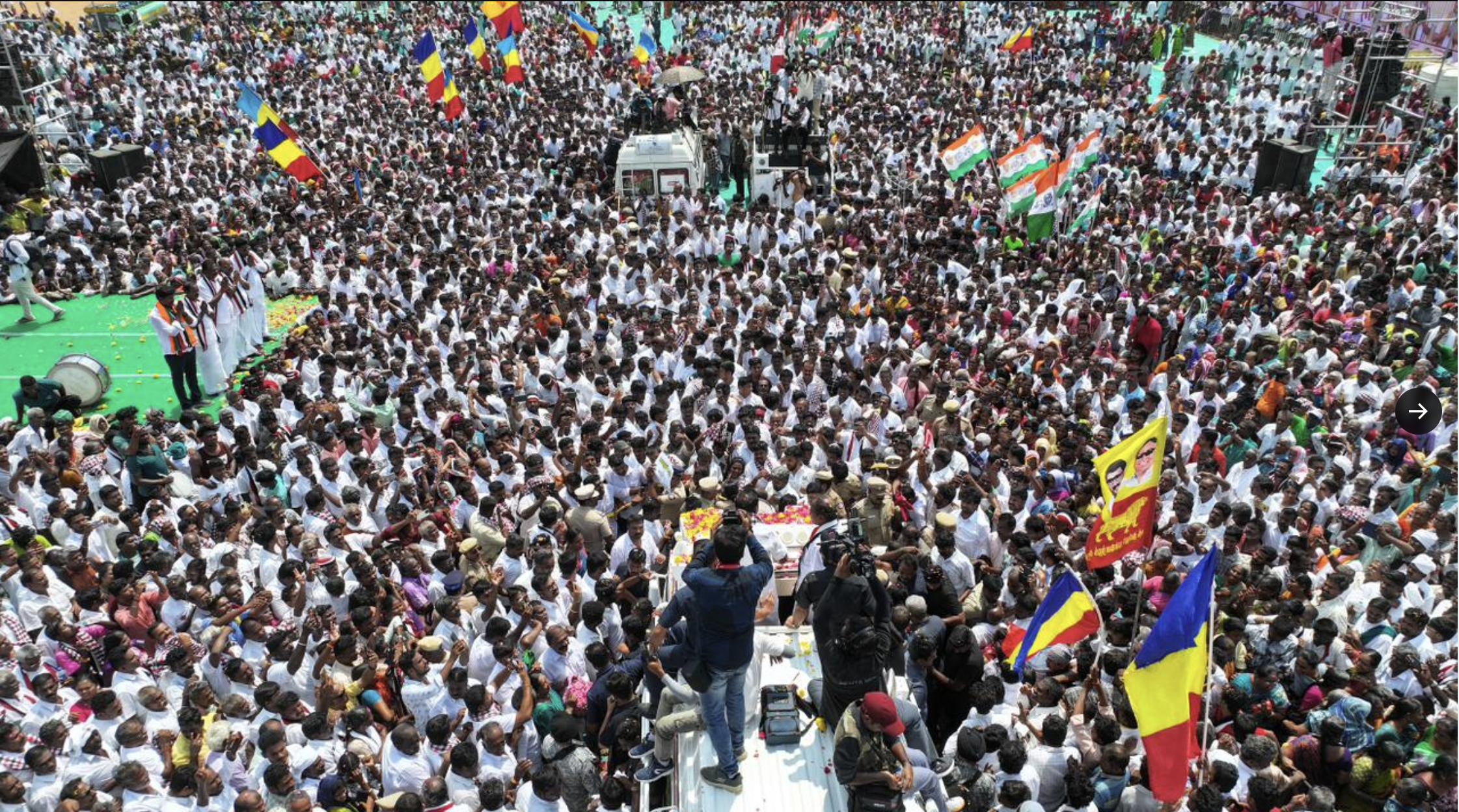
The campaign's inflection point came earlier, on January 23, when Prime Minister Modi addressed a massive rally at Madurantakam in Chengalpattu district. Goyal, who had orchestrated the logistics alongside state leaders, called it "Tamil Nadu's biggest mega rally" and "the first step towards ending the DMK's corruption-ridden government." Modi himself coined the acronym that would define the NDA's attack line for the next three months: DMK stood for "Corruption, Mafia, and Crime." The rally was designed as a show of NDA unity — BJP, AIADMK, AMMK, PMK, all sharing the stage — and it served notice that the alliance was no longer just an electoral arrangement but a campaign machine.
What Goyal brought to that machine was something BJP's Tamil Nadu unit had historically lacked: process discipline. His campaign reviews at Kamalalayam focused on measurable indicators — booth committee strength across 27 constituencies, voter registration numbers, door-to-door contact ratios. He directed cadre to visit every household. He tracked which districts had completed their outreach targets and which had not. The man who once negotiated the India-UAE CEPA with trade ministers in Abu Dhabi was now negotiating voter contact targets with mandal presidents in Thanjavur.
The Trade Minister's Tamil Nadu Dividend
Goyal's credibility in Tamil Nadu rests partly on a record that precedes his political appointment. As Commerce and Industry Minister — the longest-serving holder of that portfolio — he presided over policy decisions that materially shaped the state's industrial landscape.
The numbers are not abstract. Tamil Nadu exported $7.99 billion in textiles in FY 2024-25, a 12 percent jump over the previous year, contributing 26.8 percent of India's total textile exports. Tirupur's knitwear cluster alone clocked Rs 44,747 crore in exports — roughly 55 percent of national knitwear shipments. The India-UAE CEPA that Goyal negotiated slashed duties on ready-made garments, driving 7.6 percent export growth in the first half of FY 2024-25. He called the free trade agreements a "golden opportunity" for Tirupur's branded knitwear manufacturers and urged the cluster to double exports and generate five lakh new jobs within three years. The South India Hosiery Manufacturers' Association met him specifically to discuss how FTAs could accelerate Tamil Nadu's knitwear sector.
Then there is electronics. Foxconn committed Rs 15,000 crore to Tamil Nadu in October 2025, its largest India investment, focusing on AI-driven manufacturing and R&D integration at its Sriperumbudur plant — which now assembles the iPhone 16 Pro and Pro Max. A separate $1.5 billion Foxconn facility for display modules is under construction in Oragadam. Tata Electronics acquired a 60 percent stake in Pegatron's Tamil Nadu iPhone plant. The Production-Linked Incentive schemes that Goyal championed across electronics, auto components, and textiles created the policy scaffolding for these investments. A dedicated "Foxconn Desk" at Guidance Tamil Nadu now processes approvals in under 60 days, down from 180.
The India-Australia Economic Cooperation and Trade Agreement, also negotiated under Goyal, opened additional market access for Chennai's automotive sector and Tamil Nadu's gems exporters. The Districts as Export Hubs initiative identified Tirupur as a model cluster — one of 75 that Goyal wants replicated nationally.
The Long Road from Two Percent
Context matters. In the 1990s, BJP's vote share in Tamil Nadu hovered around two percent. In 2016, it was 2.62 percent. In 2021, contesting 20 seats in alliance with AIADMK, BJP won four — Nagercoil (M.R. Gandhi, winning by a commanding margin of over 40,000 votes), Modakurichi (Dr Saraswathi, by 77,653 votes), Tirunelveli (Nainar Nagendran, by 23,402), and Coimbatore South (Vanathi Srinivasan, scraping through by just 1,540 votes). It was BJP's first representation in the Tamil Nadu Assembly in twenty years.
The RSS infrastructure underlying this growth is real but often misunderstood. The Sangh has operated in Tamil Nadu since the 1940s, with an estimated 2,060 shakhas as of 2015 — a number that has expanded significantly since. Hindu Munnani, founded in 1980 by Ramagopalan after the Meenakshipuram mass conversions of 1981, has served as the Sangh Parivar's Tamil face. Forty-six affiliated organisations now operate across the state — Vidya Bharati schools, Seva Bharati medical camps, VHP chapters. This ecosystem generates social capital, but translating it into votes in a state dominated by Dravidian identity politics for seven decades requires something more than cultural presence. It requires the kind of seat-by-seat, booth-by-booth organisational work that Goyal was appointed to impose.
His appointment itself reflected political logic. BJP sources told The Print that Goyal was chosen because "in the 2019 Lok Sabha elections, it was because of him that BJP was able to contest in about five seats, and he is said to have a good rapport with the AIADMK leadership." The party's internal assessment identified 65 constituencies where it could credibly compete, with 40 aligned to strong performances in the 2024 Lok Sabha polls — concentrated in western Tamil Nadu (Coimbatore belt), southern districts (Kanyakumari), and select Chennai seats.
The Annamalai Question
Not everything went smoothly. The most visible tension involved K. Annamalai, the combative former state president whose aggressive social media campaigns had raised BJP's profile but also strained the AIADMK alliance. When Goyal convened a crucial core committee meeting to finalise candidates for the 27 BJP seats, he called Annamalai back to Chennai by helicopter. The high command considered fielding him from Modakurichi in the Kongu belt. Annamalai refused — he didn't have a strong base there and wanted a "winnable" seat. He eventually communicated in writing that he would not contest the 2026 elections at all. His name was absent from the final candidate list released on April 3.
That list told its own story of Goyal's strategic calculations. Tamilisai Soundararajan in Mylapore. L. Murugan in the reserved Avanashi constituency. Vanathi Srinivasan in Coimbatore North. Nainar Nagenthran in Sattur. Four seats clustered in Kanyakumari district — Nagercoil, Colachel, Padmanabhapuram, Vilavancode — where the RSS has its deepest Tamil roots. Candidates spread from Avadi in Chennai's northern outskirts to Ramanathapuram on the southeastern coast. The geographic diversity was deliberate: this was not a party retreating to safe pockets but one contesting across the state's length.
The Verdict Awaits
Tamil Nadu's 62 million voters cast their ballots on April 23, 2026. Exit polls are divided — some place the DMK-led alliance at 112-129 seats, others project the AIADMK-BJP NDA as high as 127-148. The majority mark is 117 in the 234-member Assembly. Goyal himself has predicted "over 200 seats" for the NDA, a number most analysts consider aspirational. At the campaign's close on April 21, he delivered his final message: "Tamil Nadu will not forgive or forget the DMK leadership for hurting Tamil interests."
Whether the numbers vindicate Goyal's organisational investment will be clear on May 4, when votes are counted. But the campaign itself — from the Kamalalayam core committee on that December morning to the Coimbatore roadshow in April's heat — represents something that transcends any single election cycle. This was BJP's most systematic attempt to build durable political infrastructure in India's most resistant southern state. The accountant counted every booth. The question is whether Tamil Nadu's voters did the same arithmetic.