The Indus flows where it has always flowed. The mountains stand where they stood when Alexander turned back. But the map drawn in haste by a British civil servant in the summer of 1947 created something unprecedented: a state carved not from the logic of geography or the pull of shared culture, but from the anxious calculations of a departing empire. Pakistan emerged from Partition bearing the deepest wound a nation can carry — the knowledge that it exists only in opposition to what it was torn from.
For five millennia, the subcontinent had absorbed conquerors and integrated them into a civilisational matrix that bent but never broke. The Indus Valley civilisation of the third millennium BCE established patterns of urban organisation and cultural synthesis that would endure through Mauryan expansion, Islamic conquest, and Mughal consolidation. Each wave of invasion left deposits — architectural, culinary, linguistic — but the civilisational bedrock remained intact. This was the India that produced the Mahabharata's strategic treatises and the Arthashastra's statecraft principles, texts whose insights into power and governance retain their relevance in an age of great power competition.
When Lord Mountbatten arrived in Delhi in March 1947, he carried instructions to transfer power while preserving Britain's strategic interests. The Raj had governed for less than two centuries, yet its departing administrators presumed the authority to vivisect a civilisation that had survived Alexander, Mahmud of Ghazni, and Nadir Shah. Sir Cyril Radcliffe drew his lines in five weeks, creating a state from territories that shared little beyond religious identity and geographic separation from the Hindu-majority heartland. Pakistan was born not from organic political evolution but from imperial surgery — a fact that would haunt its politics for eight decades.
India inherited continuity. Its independence movement had deep roots, its territorial boundaries reflected cultural and historical logic, its leadership commanded legitimacy across regional and linguistic divides. Pakistan inherited fragments — West Punjab and East Bengal separated by a thousand miles of Indian territory, Sindhi merchants and Pathan tribesmen, Urdu speakers and Bengali poets united mainly by what they opposed rather than what they shared. This was the original anxiety: how does a state built on negation — not India, not Hindu, not undivided — construct a positive identity?
The 1971 Reckoning
The question found its answer in catastrophe. When East Pakistan's Awami League won a crushing electoral victory in 1970, West Pakistan's establishment faced a constitutional crisis that revealed the hollowness of Pakistan's founding myths. Rather than transfer power to representatives of the majority population, the military launched Operation Searchlight — a campaign of systematic killing that drove ten million refugees across India's borders and exposed Pakistan's democracy as a facade masking Punjabi military dominance.
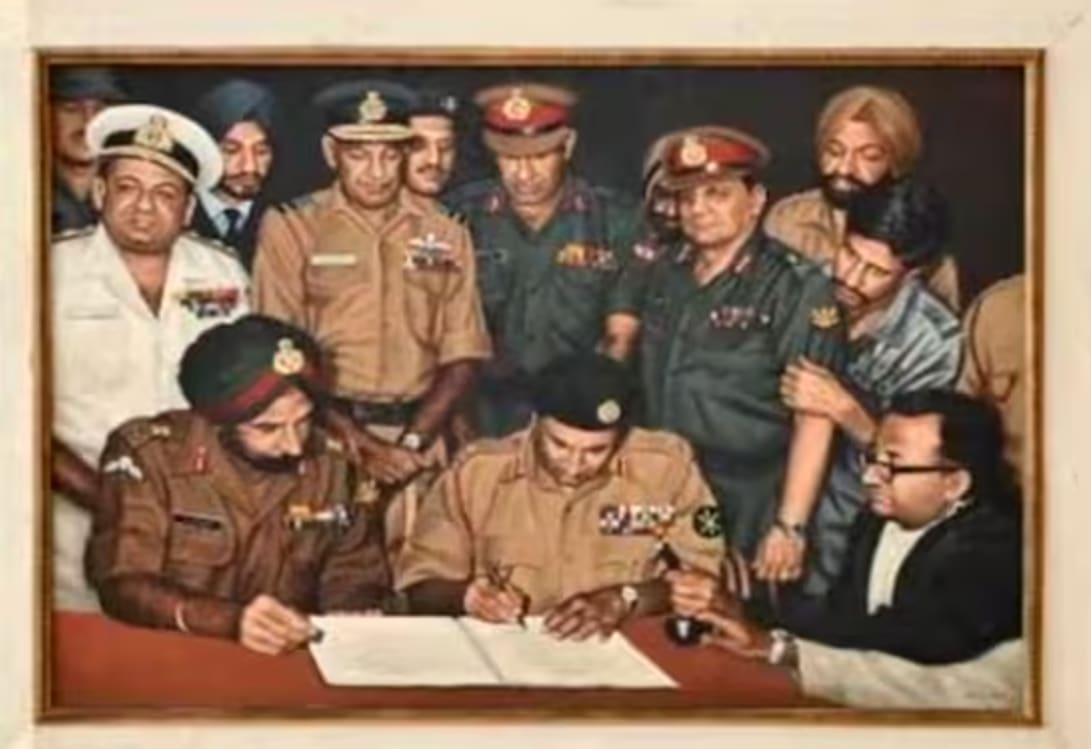
India's response under Indira Gandhi was swift and decisive. The campaign began on 3 December 1971 when Pakistan's air force struck Indian airfields. It ended thirteen days later when Lieutenant General A.A.K. Niazi surrendered 93,000 personnel to Lieutenant General Jagjit Singh Aurora in Dhaka's Ramna Race Course — the largest military capitulation since 1945. Bangladesh emerged as an independent nation. Pakistan lost half its population, its more prosperous eastern wing, and any lingering pretense that religious identity could paper over ethnic and economic contradictions.
The trauma should have triggered reflection. Instead, it deepened pathology. The Simla Agreement signed by Indira Gandhi and Zulfikar Ali Bhutto in 1972 committed both sides to bilateral resolution of disputes. But Bhutto returned to Pakistan with a different message, his promise that Pakistanis would "eat grass" before allowing India's nuclear monopoly revealing the lesson Islamabad drew from defeat: not that partition had created an unviable state, but that Pakistan needed the ultimate equaliser.
Terrorism as State Policy
Unable to match India's conventional strength or economic dynamism, Pakistan's security establishment developed what General Zia-ul-Haq euphemistically called "bleeding India by a thousand cuts." The Inter-Services Intelligence directorate became the world's most sophisticated state sponsor of cross-border terrorism, training militants in camps from Muridke to Mansehra, providing weapons and targeting intelligence, then maintaining plausible deniability when the attacks occurred.
This strategy reflected deeper weakness, not strength. India's economy was expanding, its democratic institutions consolidating despite their imperfections, its military modernising with each defense budget. Pakistan cycled through military coups and dysfunctional civilian governments, each transition leaving the country more dependent on its army and its army more invested in the narrative of permanent Indian hostility. The proxy war became both justification for military dominance and substitute for economic development.
American Cold War requirements provided the oxygen this system needed. Washington's military and economic assistance, eventually exceeding $33 billion after September 2001, allowed Pakistan to maintain forces far beyond its economic capacity. First in Afghanistan against the Soviets, later against al-Qaeda, Pakistan's generals took American money and diverted portions to the anti-India campaign. The arrangement suited Washington's short-term needs while creating long-term instability that would eventually consume the region.
The Kargil Miscalculation
In 1999, Pakistan's military leadership under General Pervez Musharraf attempted a more direct approach. Pakistani soldiers and militants infiltrated positions across the Line of Control in Kashmir's Kargil sector, occupying strategic heights in a bid to internationalise the dispute and demonstrate India's vulnerability.
Operation Vijay — India's response — methodically recaptured every occupied position by July. Pakistan found itself diplomatically isolated, condemned even by China and forced by American pressure to withdraw. The pattern established at Kargil would repeat: Pakistani provocation, Indian military response, Pakistani international isolation. Each cycle demonstrated the fundamental asymmetry — India could afford to respond with measured force; Pakistan could not afford the consequences of escalation.
The Modi Doctrine: Ending the Free Ride
For decades, India had absorbed terrorist attacks with what policymakers called "strategic restraint." After militants struck Parliament in 2001, India mobilised but did not attack. After the Mumbai massacre of 2008 killed 166 civilians, India pursued diplomatic channels. This restraint was interpreted by Pakistan's strategists as proof that nuclear weapons provided immunity for sub-conventional warfare.
Narendra Modi's government shattered this calculus. When terrorists struck an Indian Army base near Uri in September 2016, India launched surgical strikes across the Line of Control — the first acknowledged military operation on Pakistani soil since 1971. The message was unmistakable: terrorism would no longer be cost-free.
The doctrine faced its greatest test after Pulwama. In February 2019, a Jaish-e-Mohammed suicide bomber killed forty Central Reserve Police Force personnel in Kashmir's deadliest attack in three decades. Twelve days later, Indian Air Force Mirage 2000 jets struck deep inside Pakistan, targeting the Jaish training facility at Balakot. Pakistan's attempted retaliation failed; its F-16 was shot down and its pilot captured, then returned under intense international pressure that revealed Pakistan's diplomatic isolation.
Operation Sindoor: The Final Answer
The Pahalgam massacre of April 2025 triggered Operation Sindoor — India's most comprehensive strike against Pakistani terror infrastructure. Nine facilities across Pakistan-administered territory were destroyed using indigenous weapons systems including BrahMos cruise missiles, demonstrating both military capability and the success of India's defense indigenisation drive.
Sindoor represented more than retaliation. It announced a permanent policy shift: any terrorist attack traceable to Pakistani soil would trigger military response calibrated to eliminate the infrastructure that enabled it. India's diplomatic groundwork — strengthened relationships with Washington, Tel Aviv, Paris, and Gulf capitals — had created the international space for such action. Pakistan's protests found no sympathetic ears.
Pakistan's response exposed the bankruptcy of its decades-long strategy. Military communiques claimed victory while the Karachi Stock Exchange collapsed. Diplomatic appeals yielded empty statements. China offered verbal support but no military commitment. The economic reality was stark: a nation surviving on International Monetary Fund bailouts, with debt ratios exceeding 70 percent of GDP and negative growth rates, possessed no capacity for sustained confrontation with an economy eight times its size.
The Structural Impossibility
The gap between India and Pakistan has become structural and irreversible. India's defence budget of $82.63 billion dwarfs Pakistan's $11.9 billion — a ratio approaching seven-to-one. India allocates $19.4 billion to modernisation alone, capital expenditure for the three services reaching $23.1 billion, with $17.3 billion reserved for domestic defence industries that now export $2.4 billion annually. This spending is sustained by a $4.115 trillion economy growing at seven percent. Pakistan's military establishment consumes resources from a stagnating economy, crowding out investment in education, health, and infrastructure.
Pakistan has reached the endgame of its born anxiety. Created by colonial partition, traumatised by the loss of Bangladesh, addicted to American subsidies that have dried up, dependent on Chinese support that does not extend to fighting India, it faces a choice between transformation and continued decline. The era when Pakistan could export violence without consequence has ended.
India has arrived where its civilisational trajectory always pointed: a nuclear-armed democracy of 1.4 billion people, commanding the world's fifth-largest economy and a diplomatic network spanning continents. The state that emerged from Partition's surgery spent eight decades defining itself through opposition to the civilisation it was carved from. Whether Pakistan's establishment can find purpose beyond perpetual hostility — or whether the born anxiety will consume the state itself — remains the subcontinent's unfinished question. But the answer grows clearer with each passing year. Civilisations endure. Colonial cartography does not.