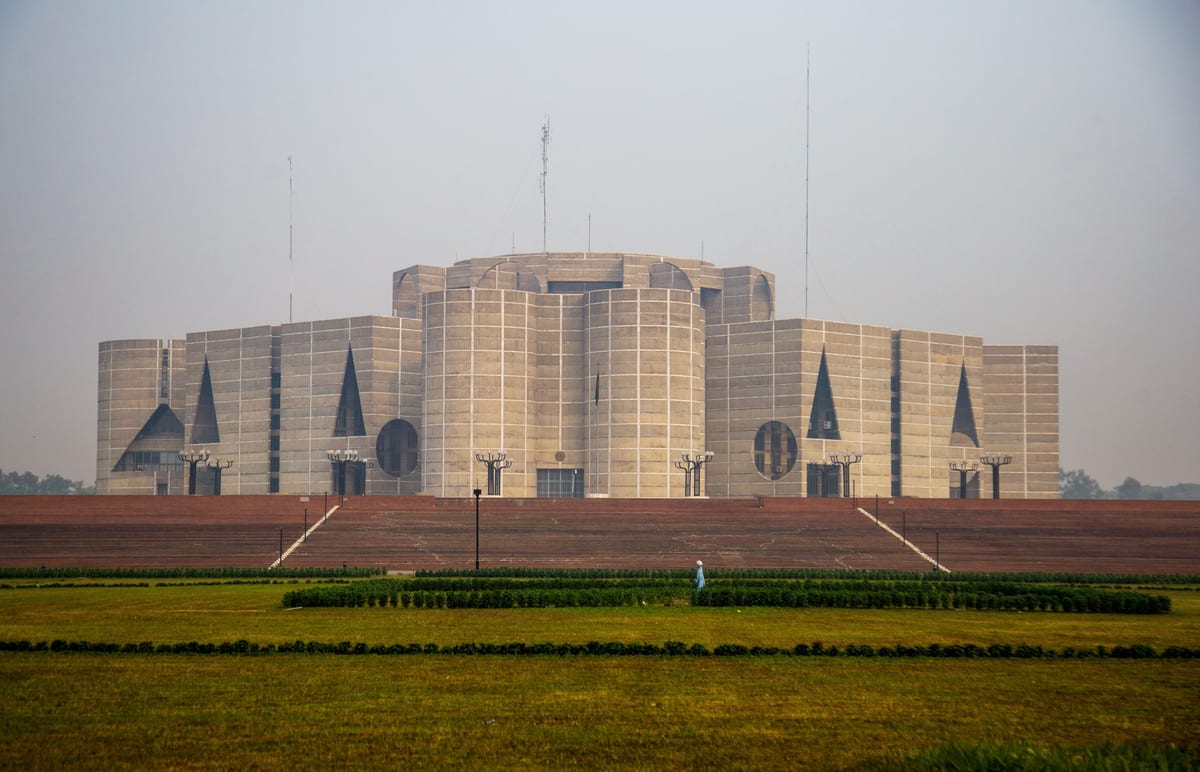
Mohammed Shahabuddin, Bangladesh's 76-year-old president, has resigned citing health reasons — a departure that arrives wrapped in timing too convenient to read as purely medical. The largely ceremonial post he vacated had one non-ceremonial weight: Shahabuddin was a former ally of Sheikh Hasina, whose government student-led protests swept from power in August 2024. His exit closes the last institutional door to that era.
What remains in Dhaka is Muhammad Yunus's interim government, an administration navigating a fragile political transition without an electoral mandate, without a permanent head of state, and with a neighbourhood that is watching.
The Ceremonial Post That Wasn't Ceremonial Enough
Presidential systems often vest enormous symbolic power in figures who wield little operational authority. Shahabuddin's office was, by constitutional design, largely decorative. Bangladesh's executive power runs through the prime ministerial office — or, in its current absence, through the Chief Adviser's chair that Yunus occupies. But symbols matter. A Hasina-affiliated president sitting atop the constitutional architecture of a post-Hasina order created a visible tension that the interim government could not indefinitely absorb. His resignation — whatever its medical sincerity — resolves that tension in favour of the new dispensation.
The question for the region is what replaces him. A successor aligned with the Bangladesh Nationalist Party or Jamaat-e-Islami would signal that the post-August 2024 political order is consolidating along an axis that has historically been less accommodating of Indian interests: on transit agreements, on counterterrorism cooperation targeting groups operating across the northeastern border, and on the unresolved Teesta water-sharing framework that both countries have debated for over a decade without finalising.
India's Exposed Architecture
The diagnosis that India over-invested in Hasina as a strategic personality rather than building durable institutional ties with Bangladesh is not new. C. Raja Mohan at Carnegie India articulated this plainly after August 2024, arguing that New Delhi needed to shift from personality-based engagement to a more resilient framework that could survive electoral turbulence in Dhaka. The Shahabuddin resignation sharpens that prescription into something closer to an instruction.
Consider what India's engagement with Bangladesh actually rested on during the Hasina years. The bilateral relationship generated genuine depth — transit corridors, power grid connectivity, joint counterterrorism mechanisms, and a trade relationship measured in tens of billions of dollars annually. But much of that architecture was politically sustained by Hasina's dominance of Bangladeshi politics and her government's strategic preference for close ties with New Delhi. Strip out the personality, and what remains is a set of agreements whose continuity depends on their successors' willingness to honour them.
That willingness is not guaranteed. Sreeradha Datta of the Vivekananda International Foundation has noted that the interim Yunus government has signalled a strategic diversification — warming to China, engaging the IMF — that suggests Dhaka is deliberately widening its external options. Anti-India sentiment in Bangladeshi civil society, flagged by IDSA's Smruti Pattanaik as intensifying since August 2024, provides the political atmosphere in which a successor government could justify renegotiating or deprioritising arrangements that were negotiated during the Hasina period.
India's northeastern states are the most immediately exposed. The border runs for over 4,000 kilometres. Insurgent groups that found sanctuary across that border during earlier BNP-Jamaat governments did not disappear — they went dormant under the bilateral security arrangements that Hasina maintained. A Dhaka that is less committed to those arrangements, or that uses them as leverage in broader negotiations with India, changes the security calculus for Assam, Meghalaya, Tripura and Mizoram in ways that cannot be offset by any amount of trade credit.
The Hasina Problem Sitting in New Delhi
There is an additional complication that diplomatic protocol tends to understate. Sheikh Hasina has been in India since her departure from Dhaka in August 2024. Her presence on Indian soil is a political fact that Dhaka's interim government — and its domestic audience — cannot ignore. Every statement New Delhi makes about respecting Bangladesh's sovereignty lands in a context shaped by that fact. External Affairs Minister S. Jaishankar stated that India wishes to work with whichever government is in place in Bangladesh, and that position is the right one to hold publicly. But it is harder to make that posture credible while hosting the deposed leader who the current Dhaka administration holds responsible for the political crisis it inherited.
Former Foreign Secretary Shyam Saran has argued that India must resist being cast as a spoiler in Bangladesh's domestic political transition — a warning that implies the risk is real, not hypothetical. Hasina's continued presence in India feeds a narrative in Dhaka that New Delhi is banking on her return, or at minimum is uncomfortable with a post-Awami Bangladesh. That narrative, whether accurate or not, gives the Yunus administration and its successors a ready reason to keep India at diplomatic arm's length.
A quiet resolution of Hasina's status — one that removes her as a visible irritant in bilateral relations without turning her departure into a humiliation — would reduce that friction. It would also demonstrate that India's stated commitment to working with Bangladesh's current political reality is something more than a press briefing position.
Building Without Familiar Handles
The structural challenge India faces in Bangladesh is not unique to this bilateral relationship. Across its neighbourhood, New Delhi has found that deep engagement with a particular government does not automatically convert into durable influence over a country's strategic direction. The lesson that institutions outlast individuals is one that Indian foreign policy has absorbed theoretically — the practice of applying it in real time, when a friendly government collapses and an unfamiliar one takes its place, remains genuinely difficult.
What India controls in this situation is the economic relationship. Power connectivity, trade credit lines, infrastructure investment — these function across political transitions in ways that security arrangements tied to particular governments do not. They create constituencies for stable bilateral relations that extend beyond ruling parties. A Dhaka business community that depends on Indian trade infrastructure has a material interest in stability that no political transition can easily override. That is the lever New Delhi must now work, not as a substitute for diplomatic engagement, but as its foundation.
Shahabuddin's exit is a single event in a longer transition whose direction is not yet fixed. Bangladesh will hold elections eventually. The political order that emerges from those elections will define the neighbourhood India navigates for the following decade. The time between now and that electoral resolution is not a waiting period — it is the window during which India either builds the institutional relationships that will survive the vote count, or arrives at election night with nothing but memories of the Hasina years to show for its engagement. The resignation of a ceremonial president is a small moment. What India does with the space it creates is not.