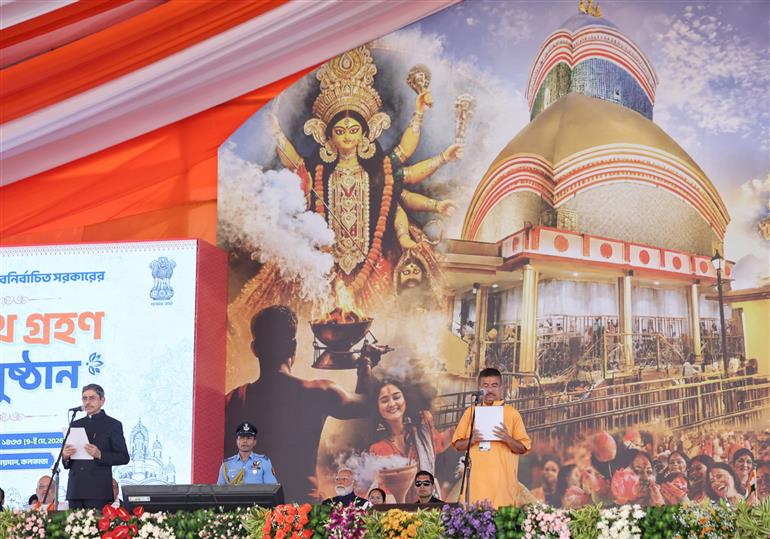
There is a moment in the life of every civilisation when a long-subjugated people look upon the machinery of their own oppression and say: enough. Thomas Paine, writing to the American colonies in 1776, called this the exercise of "common sense" — the plainest faculty of reason applied to the plainest of truths. On 9 May 2026, at the Brigade Parade Grounds in Kolkata, the people of Bengal exercised that same faculty. Suvendu Adhikari took the oath as West Bengal's first-ever BJP Chief Minister, and forty-nine years of Left and TMC rule ended — not with a whimper, but with a mandate of 207 out of 294 seats and a record 92.93% voter turnout.
"Bhoi out, bharosa in," the new Chief Minister declared. Fear out, trust in. Five words that carry the weight of centuries.
Consider, reader, what Bengal once was.
The Land That Built Universities
The Pala Empire (750–1161 CE) made Bengal the intellectual capital of the known world. Emperor Dharmapala founded Vikramashila monastery and granted 200 villages to Nalanda — a university that drew scholars from China, Tibet, Nepal, and Southeast Asia. The Palas maintained diplomatic relations with the Srivijaya Empire, the Tibetan Empire, and the Arab Abbasid Caliphate. Somapura Mahavihara, a 27-acre complex built by Dharmapala, influenced Buddhist architecture from Bengal to Cambodia and stands today as a UNESCO World Heritage Site.
The Sena dynasty that followed produced Jayadeva, author of the Gita Govinda, and became the first power in history to unite all of Bengal under a single ruler. Bengal's muslin was prized from Rome to China — mentioned in the Periplus of the Erythraean Sea as early as 40 AD, traded for Roman bullion and gold coins. The Ganges delta was, by any measure, one of the most prosperous regions on earth.
This was not some borrowed glory. This was Bengal's own. Built by its own people, on its own soil, through its own intellect and labour.
The First Subjugation: Bakhtiyar Khilji and the Destruction of Learning
Then came the sword. In 1202 CE, Muhammad Bakhtiyar Khalji swept through Bengal and Bihar, expelling the last Sena king from Nadia. His armies committed mass massacres of monks at Odantapuri and destroyed Vikramashila. Nalanda was burned. The last throne-holder, Shakyashri Bhadra, fled to Tibet in 1204, carrying surviving manuscripts with him. Buddhism — Bengal's intellectual and spiritual tradition — was displaced from the land of its greatest flowering.
The Sultanate and Mughal periods that followed were not without their complexities. Mughal Bengal became the wealthiest province of the empire, contributing more than half the funds flowing into the imperial treasury in Delhi. Emperor Aurangzeb called it the "Paradise of Nations". Dhaka had over 80,000 weavers and was the muslin capital of the world. But the wealth was Bengal's; the sovereignty was not. Bengal produced. Others ruled.
The Second Subjugation: Plassey and the British Drain
The Battle of Plassey on 23 June 1757 was not a battle — it was a transaction. Robert Clive bribed Mir Jafar and purchased Bengal for the East India Company. By 1765, Clive had secured the diwani — the right to collect Bengal's tax revenues — and Indian taxes were used to buy Indian goods for export to Britain.
The scale of extraction was staggering. Between 1758 and 1765, Company servants sent home nearly £6 million from Bengal — more than four times the total land revenue collected by the Nawab in 1765. By the end of the 19th century, this drain constituted nearly 6% of India's national income and one-third of its national savings.
Bengal's muslin weavers — who had clothed the Roman Empire and the Mughal court — were systematically destroyed. The British enforced the Dadni system of forced contracts, binding weavers to produce cloth at prices far below market value. British imports into Bengal surged from 25% to 93% between 1811 and 1840, crushing local production. By the 19th century, the muslin tradition — millennia old — was dead.
Then came 1943. The Bengal Famine killed an estimated 2.1 to 3 million people. A 2019 study in Geophysical Research Letters found it was the only major Indian famine not caused by drought — rainfall was above normal, and rice supply was only 5% below the five-year average. The famine was man-made. Churchill's War Cabinet repeatedly rejected food import requests; the colony was not permitted to spend its own sterling reserves, or even use its own ships, to import food. This was not neglect. This was policy.
The Third Subjugation: Thirty-Four Years of Communist Decay
Independence in 1947 brought Partition, which severed Bengal's integrated economy — the fertile East from the industrialised West). But West Bengal still entered the new republic as an industrial powerhouse. In 1950-51, the state accounted for 27% of India's total industrial production. The Hooghly industrial belt — power, steel, jute, paper, chemicals — was the manufacturing engine of the nation. Bengal had 1,493 registered factories, more than Maharashtra and Gujarat combined.
Then came the Left Front in 1977, and 34 years of elected communist rule — one of the longest anywhere in the world.
What did they build? Ask the numbers.
West Bengal's share of India's industrial output fell from 24% in 1955-56 to under 10% by the 1980s. By 1991, it was 6%. By 1999-2000, it was 3.9%. The state accounted for 85.6% of nationally lost man-days from political closures despite having only 7% of India's industrial workers. Between 1980 and 2005, factory-sector employment declined at an annual rate of 2.1%.
The most emblematic wound was Singur. In 2008, after sustained political agitation, the Tatas pulled out their Nano factory and relocated to Sanand, Gujarat. Eighteen years later, the Singur site remains largely a wasteland. This was not an accident of history. This was the deliberate consequence of an ideology that preferred the slogan to the factory floor.
The Freight Equalisation Policy — a central government policy from 1952 to 1993 that subsidised mineral transport nationally — removed Bengal's natural competitive advantage of proximity to coal and iron ore. But while other states adapted, Bengal's communists ensured there was nothing left to adapt with. As West Bengal's own Commerce Minister admitted in 1996: "The removal of the freight equalisation and licensing policies cannot compensate for the ill that has already been done."
Compare the factory growth: between 1977-78 and 2007-08, West Bengal grew its factory count by 64%. Gujarat grew by 135%. Tamil Nadu by 233%. Bengal did not merely fall behind. Bengal was held back.
The Fourth Subjugation: Fifteen Years of TMC
Mamata Banerjee's TMC replaced the Left in 2011 with a promise of change. What followed was worse.
Between 2011 and 2025, approximately 6,688 companies relocated their registered offices out of West Bengal — to Maharashtra, Delhi, and Uttar Pradesh. Factory closures under TMC reached 177, compared to 83 under the previous government. The investment realisation rate collapsed to approximately 4% of announced proposals.
State debt grew from ₹1.92 lakh crore in 2011 to a projected ₹7.7 lakh crore by FY 2025-26 — a fourfold increase in fifteen years. The debt-to-GSDP ratio reached approximately 38%, the highest among major Indian states. Interest payments alone consumed 19% of revenue receipts — the state was borrowing to pay interest on borrowings.
Bengal's per capita income ranking fell from 3rd among Indian states in 1960-61 to 24th by 2023-24. From 127.5% of the national average to 83.7%. The state's share of national GDP shrank from 10.5% at independence to 5.6%. An estimated 22.4 lakh Bengali workers migrated to other states for employment — the sons and daughters of the state that once employed the nation.
Then came the horror of R.G. Kar on 9 August 2024 — a 31-year-old doctor raped and murdered at a government medical college, the investigation so bungled that the Calcutta High Court transferred the case to the CBI. Thousands of women marched through Kolkata in "Reclaim the Night" protests. The state that produced Vivekananda and Tagore could not protect a woman in its own hospital.
The People Speak
Paine wrote in Common Sense: "A long habit of not thinking a thing wrong, gives it a superficial appearance of being right." Bengal had been told — for decades, by Left intellectuals and TMC functionaries alike — that decline was destiny, that the state's industrial collapse was someone else's fault, that this was simply how things were.
On 4 May 2026, the people of Bengal rejected this with 92.93% turnout — the highest in the state's electoral history. BJP won 207 of 294 seats with 45.84% of the vote. TMC was reduced to 80 seats. Mamata Banerjee lost her own Bhabanipur stronghold to Suvendu Adhikari by approximately 15,105 votes. This was not a swing. This was a verdict.
The swearing-in at Brigade Parade Grounds on 9 May 2026 — with Prime Minister Narendra Modi, Home Minister Amit Shah, Defence Minister Rajnath Singh, and BJP President Nitin Nabin in attendance — was not merely a political ceremony. It was the end of an era. Governor R.N. Ravi administered the oath. Five ministers — Dilip Ghosh, Agnimitra Paul, Ashok Kirtania, Nisith Pramanik, and Kshudiram Tudu — took office alongside the new Chief Minister. The era of "Sonar Bangla" — Golden Bengal — had, at last, a mandate to begin.
Adhikari pledged to "fulfil every promise made in the BJP manifesto" and stated his administration would prioritise development, stability, and governance reforms. These are promises. History will judge their fulfilment. But the precondition for renewal — the democratic assertion of a people's will against the inertia of decades — has been met.
Bengal's Unfinished Business
The road ahead is measured not in rhetoric but in the distance between where Bengal is and where it was. A state that once produced 27% of India's industrial output now produces approximately 4%. A state that ranked 3rd in per capita income now sits 24th. A state whose GSDP is ₹20.32 trillion carries ₹7.7 lakh crore in debt — 38% of GSDP. Its credit-deposit ratio of 46-52% runs 30 percentage points below the national average — capital raised in Bengal flows out of Bengal.
These numbers are not abstract. They are the accumulated cost of governance that chose ideology over industry, patronage over investment, and slogans over factories. Reversing them will take a decade of disciplined governance, industrial policy that welcomes capital rather than driving it away, and a state machinery that serves rather than extracts.
But the essential first step — what Paine called "the simple voice of nature and of reason" — has been taken. The people of Bengal, with the highest turnout in their electoral history, have said what they want. They want the Bengal that built Nalanda, that wove muslin for emperors, that stood at the vanguard of India's industrial revolution at independence. They want Sonar Bangla — not as nostalgia, but as policy.
A people who built universities when Europe was in darkness need no one's permission to rebuild their future. Bengal's common sense has, at last, prevailed.
Views expressed are those of the author.