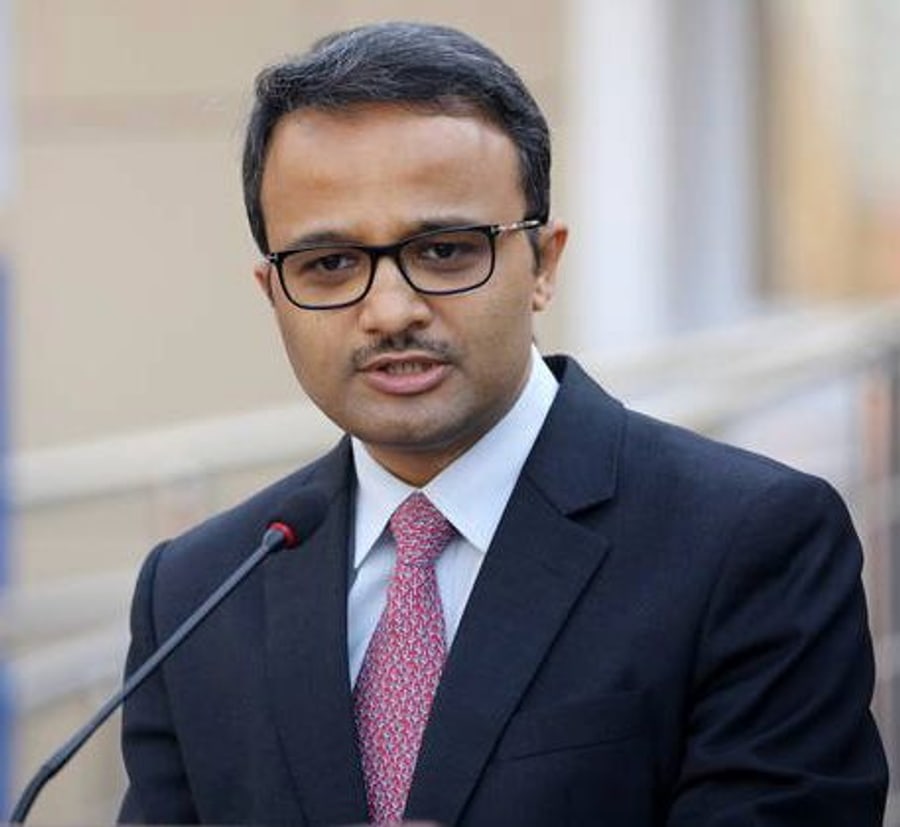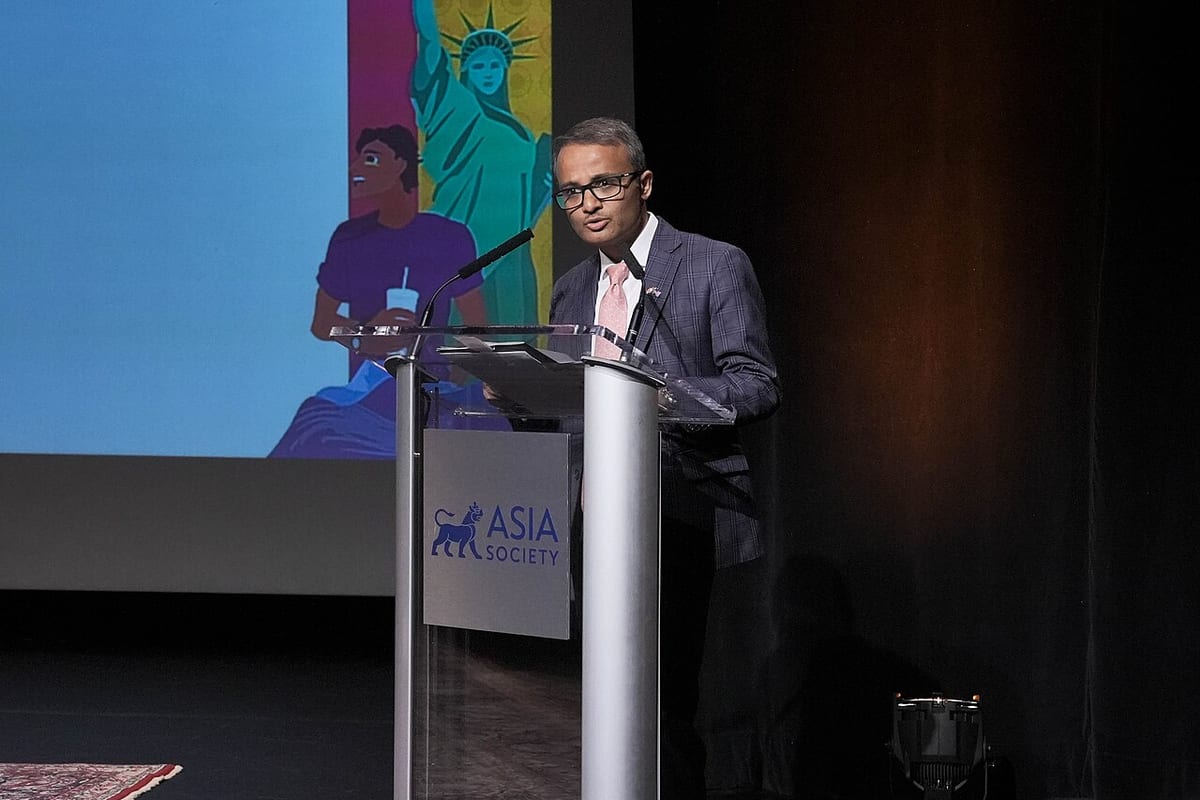
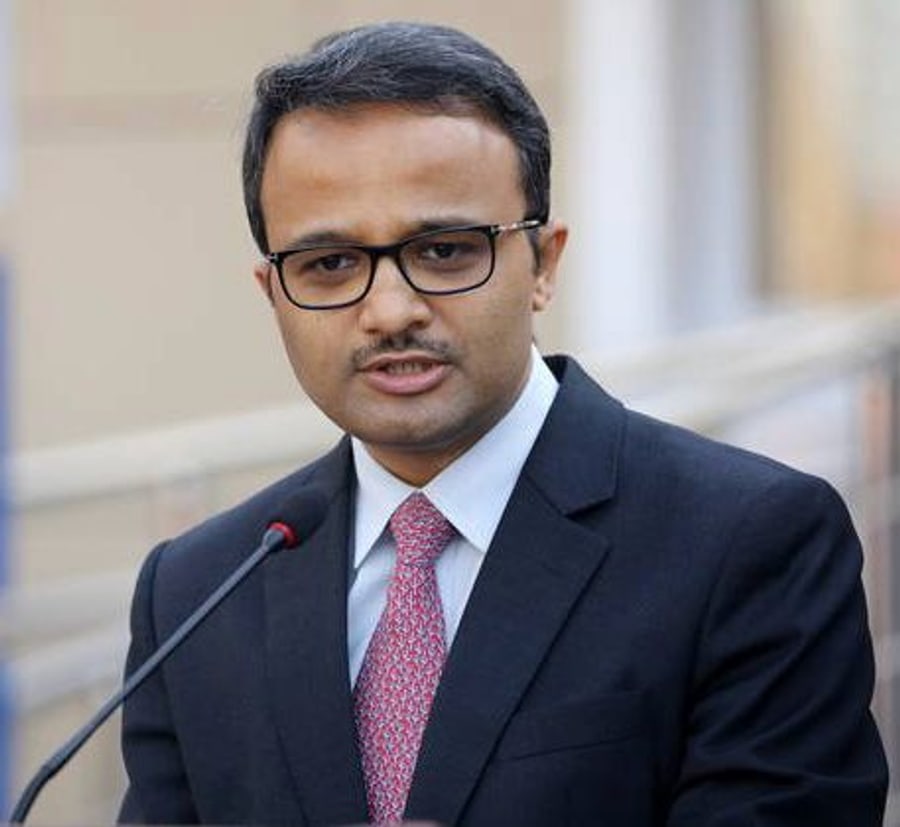
Times Square did not happen by accident. When Bharat Mahotsav lit up one of the most watched intersections on earth, it was the product of institutional will — the kind that decides, in advance, that Indian civilisation belongs on the largest available stage, not in a community hall off the subway map. The event, reported this season by News India Times, planted Indian music, colour, and cultural presence at the crossroads where the world comes to look. For Amb. Binaya Srikanta Pradhan, Consul General of India in New York since January 2024, such moments are not incidental to the mission. They are the mission — running parallel to the visa queues, the trade delegations, and the congressional meetings, and at times running ahead of all three.
Pradhan's jurisdiction is no small canvas. The Consulate General of India in New York covers ten U.S. East Coast states and a diaspora of more than 2.3 million people, with some 117,000 Indian students moving through its orbit at any given time. One-third of India–U.S. merchandise trade originates in the region. By almost any measure, New York is India's most consequential diplomatic address in America. The temptation, in a posting of that scale, is to let culture become garnish — something scheduled after the harder work. Pradhan has made the opposite choice.
Yoga as Foreign Policy
Every June, the International Day of Yoga hands consulates around the world a readymade occasion. Many settle for a mat and a photograph. Pradhan has treated it as infrastructure. Under his watch, the Consulate General has anchored yoga programming into the fabric of its public engagement — not as a wellness gesture but as a statement about what India brings to the world that no trade balance sheet can capture.
The logic predates the United Nations resolution that created International Yoga Day, but Pradhan inhabits it with the conviction of a diplomat who has watched, across four continents, what Indian soft power can and cannot do. Moscow, Ashgabad, Islamabad, Dar es Salaam — his career has run through postings where India's cultural weight opened doors that formal démarches could not. In Tanzania, as High Commissioner from 2021 to 2024, he helped elevate the bilateral relationship to a Strategic Partnership and was part of the effort that brought IIT Madras's first overseas campus to Zanzibar. The lesson he seems to have drawn: institutions travel — but someone must carry them.
In New York, he carries them through a diaspora that is itself a kind of institution: dispersed, divided by state of origin and generation and profession, united by the pull of a shared civilisational memory. Yoga, in that context, is no soft-power cliché. It is a gathering point.
The Regional Festival as Diplomatic Act
Bihar Diwas is the detail that reveals the method. To celebrate the founding of Bihar — a state whose sons and daughters have seeded the East Coast with engineers, doctors, academics, and small-business owners — a consulate must see its diaspora not as a monolith but as a constellation of regional identities, each with its own pride and its own political meaning back home. Pradhan sees it. By placing Bihar Diwas on the Consulate's calendar, he signals something specific: New York is not a waystation for a generic Indian-American identity but a place where being Bihari, or Odia, or Gujarati, or Bengali deserves celebration on its own terms.
That granularity matters in a jurisdiction where a Gujarati Samaj, an Odia association, a Tamil cultural group, and a Punjabi gurdwara may sit within fifteen minutes of one another and seldom share a room. Under Pradhan, the Consulate positions itself as the one institution that can hold them all — not by flattening their differences but by honouring each in turn. The Gujarati Samaj of New York, for instance, has its cultural festival of Gujarat; it finds in the Consulate a natural institutional ally. The pattern repeats across the regional calendar.
Pradhan brings a personal dimension to this. A 2002-batch Indian Foreign Service officer who speaks Odia alongside English, Russian, and Hindi, he is no stranger to regional identity. He knows what it means to carry a specific culture inside a larger national one. That is no small thing in a diaspora that can feel seen only when it serves a statistic.
The Arts and the Long Game
Cultural diplomacy in New York does not stop at festivals. The city is one of the world's serious arts capitals, and an India that arrives with folk dance and food stalls alone leaves something on the table. Pradhan has met that reality. The Consulate's programming has touched Indian classical music — a tradition that demands audiences who listen, not just attend — alongside the broader range of what India produces as art.
Events like those mounted by Chhandayan, the Indian classical music organisation that News India Times has covered through its concert series in the city, exist in an ecosystem the Consulate sustains through presence and legitimacy. When the Consul General appears at a classical music concert or a Diwali celebration — and Times Square this past Diwali drew that kind of institutional energy, as indica News reported — it tells the Indian-American community something that matters: their cultural life is not marginal to what India wants in America. It is the centre of it.
Diwali has become a barometer of Indian cultural confidence in the United States. The Times Square celebrations — Indian music, light, the full register of the festival — amount to an assertion at once cultural and political. India is not asking for a corner of the American calendar. It is arriving in the middle of it.
The Bigger Architecture
Pradhan runs these programmes alongside a consular operation that is, by any measure, demanding. The Pramit digital query portal handles the volume of a diaspora exceeding 2.3 million. Visa, passport, and OCI services run without pause. Political outreach to Congress and state legislatures fills his schedule. Economic delegations — IT, gems and jewellery, textiles, ceramics — move through his office. Welfare programming for Indian students and diaspora members, including legal aid and community counselling, runs in parallel. The cultural calendar lives inside all of that, not apart from it.
What distinguishes Pradhan's approach is the refusal to treat culture as a residual category — the thing done after the grown-up work. For a diplomat who has watched Indian institutions take root in Zanzibar, who helped negotiate a Strategic Partnership in East Africa, civilisational confidence is not rhetoric. It is operation. India's culture is not an adjunct to its foreign policy. In Pradhan's New York, it is a tool of it — precise in aim, pointed at something larger than any single event.
The calendar ahead carries more. Regional festivals, yoga programming, arts engagements, community celebrations across ten states — the work compounds. Each event adds a layer. Each appearance by the Consul General at a cultural programme sends the same signal in a different register: India is here, it has been here, and it intends to be remembered.
That is no small ambition for a consulate in Midtown Manhattan. It is one of the more serious acts of diplomacy under way in America right now. Follow the Consulate General of India in New York at indiainnewyork.gov.in.