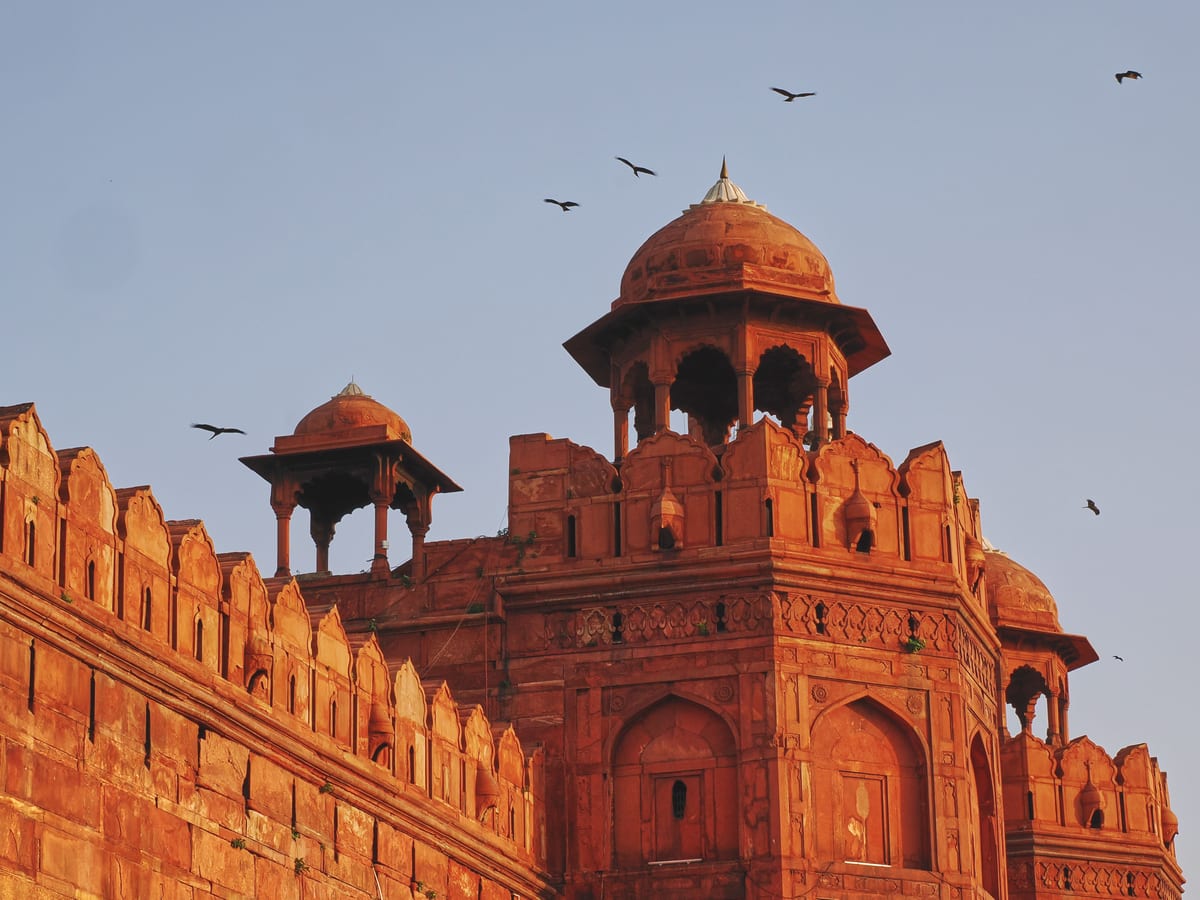
There is a moment — and every traveller who has stood on Tripolia Bazaar will know it — when the morning light turns Jaipur's Hawa Mahal into something that defies easy description. The sun catches the latticework of nearly a thousand windows, and the entire facade seems to exhale. Pink and amber, shadow and gold. For a few breathless seconds, you understand why they called it the Palace of Winds.
A Palace Born of Vision and Ingenuity
Hawa Mahal was commissioned in 1799 by Maharaja Sawai Pratap Singh, a poet-king of the Kachhwaha Rajput dynasty who ruled Jaipur with both military resolve and artistic sensibility. Designed by the architect Lal Chand Ustad, the palace was built as an extension of the City Palace complex. Its purpose was specific: the royal women of the zenana — the queen's quarters — could observe the vibrant street festivals, processions, and everyday life of the city below without being seen.
The structure rises five storeys, each floor stepping back slightly so that the whole building tapers like a crown — or, as many have noted, like the headgear of Lord Krishna himself, to whom Pratap Singh was devoted. The 953 small casement windows, each intricately carved in sandstone with geometric and floral jali screens, serve a dual purpose. They look beautiful, but they also create a natural ventilation system: the wind enters through the latticed openings, circulates through the chambers, and keeps the interior remarkably cool even during the fierce Rajasthan summer. This was not accident. This was civilisational intelligence encoded in stone.
Reading the Architecture: More Than Meets the Eye
The palace is built almost entirely as a facade — a theatrical screen of red and pink sandstone that from the street appears to be a grand edifice of many rooms, but is in fact largely a series of small chambers and corridors stacked behind the ornamental front. The ground plan is relatively shallow. Yet every inch of the exterior surface speaks a sophisticated visual language: arched canopies, miniature domes, carved pillars, and the signature jali screens that are as much engineering as they are art.
Mughal architectural influence is unmistakable — the arched niches and delicate inlay work echo the refinements of the imperial aesthetic that had permeated Rajput courts for over a century. But Hawa Mahal is unambiguously Rajput in spirit. The bold use of local red and pink sandstone, the tiered silhouette resembling a royal crown, and the sheer exuberance of its ornamentation all declare a cultural confidence that borrowed without surrendering its own identity. This pattern recurs throughout India's architectural heritage: synthesis as strength.
Visitors who venture inside — accessed through a side entrance rather than the famous street-facing facade — discover a small museum within the palace complex. Artefacts, miniature paintings, and architectural details contextualise the building within Jaipur's royal history. From the upper galleries, the view across the Pink City is extraordinary: a roofscape of terracotta and rose, with the formidable Nahargarh Fort watching from the Aravalli ridgeline above. Learn more about planning your visit through the official Incredible India page for Hawa Mahal.
A Living Monument in a Living City
Hawa Mahal has never been allowed to become a ruin or a museum piece cordoned off from daily life. It sits directly on one of Jaipur's most energetic commercial streets. Vendors sell bangles and block-printed fabrics a few metres from its base. Auto-rickshaws weave past. Schoolchildren on field trips press their faces against the entrance gates. The palace does not stand apart from the city — it stands within it, as it always has. This continuity is what sustains India's civilisational heritage: it is not preserved in amber but lived alongside.
Jaipur's old walled city, of which Hawa Mahal is the most recognisable symbol, was inscribed as a UNESCO World Heritage Site in 2019. The city's grid plan, laid out in 1727 by Maharaja Sawai Jai Singh II according to principles drawn from the ancient Vedic treatise Shilpa Shastra, is one of the earliest examples of planned urban design in the world. Hawa Mahal is the jewel on this crown — the building that tourists reach for their cameras the moment they arrive, but that rewards those who stay long enough to understand its context.
When to Visit and How to Get There
The ideal time to visit Hawa Mahal and Jaipur more broadly is between October and March, when the Rajasthan winter softens the desert heat into something genuinely pleasant. Mornings are crisp and golden, the light is magical for photography, and the bazaars around the palace are at their most animated. Avoid the peak summer months of May and June, when temperatures in Jaipur climb steeply — though even then, those jali windows do their ancient job admirably.
Jaipur is exceptionally well-connected. Jaipur International Airport receives flights from all major Indian cities as well as several international destinations. The city sits on the Delhi–Mumbai railway corridor, making it easily reachable by train from Delhi (roughly four to five hours), Mumbai, and Agra. By road, Jaipur is about 280 kilometres from New Delhi on the NH48 expressway — a comfortable four-hour drive. Once in the city, the palace is located on Badi Chaupar on Tripolia Bazaar, easily reachable by auto-rickshaw, cab, or the heritage walking routes that the Jaipur city authority promotes.
Beyond the Facade: What to Explore Nearby
Hawa Mahal is the entry point to an entire world of Jaipur heritage. A short walk brings you to the City Palace complex, still partly occupied by the royal family of Jaipur, with its magnificent courtyards and museum collections. The Jantar Mantar observatory, another UNESCO World Heritage Site and the largest of the five astronomical observatories built by Sawai Jai Singh II, is nearby — a reminder that 18th-century Jaipur was a centre of scientific inquiry, not just royal splendour. Amber Fort rises above a lake twelve kilometres north of the city, its amber-hued ramparts offering perhaps the most dramatic Rajput fortification in all of India. The step-well Panna Meena ka Kund near Amber is a quieter, hauntingly beautiful discovery.
Why Hawa Mahal Matters
When the conversation about heritage slides into nostalgia or nationalism, Hawa Mahal offers something different: evidence of a civilisation that was always in motion, always building, always thinking about how to live beautifully and intelligently. The palace was not built to impress foreign visitors or to mark military conquest. It was built so that women could watch a festival. So that a breeze could cool a chamber. So that a king who loved poetry could honour his god with architecture. That is a heritage story worth telling — and worth travelling to experience in person.