
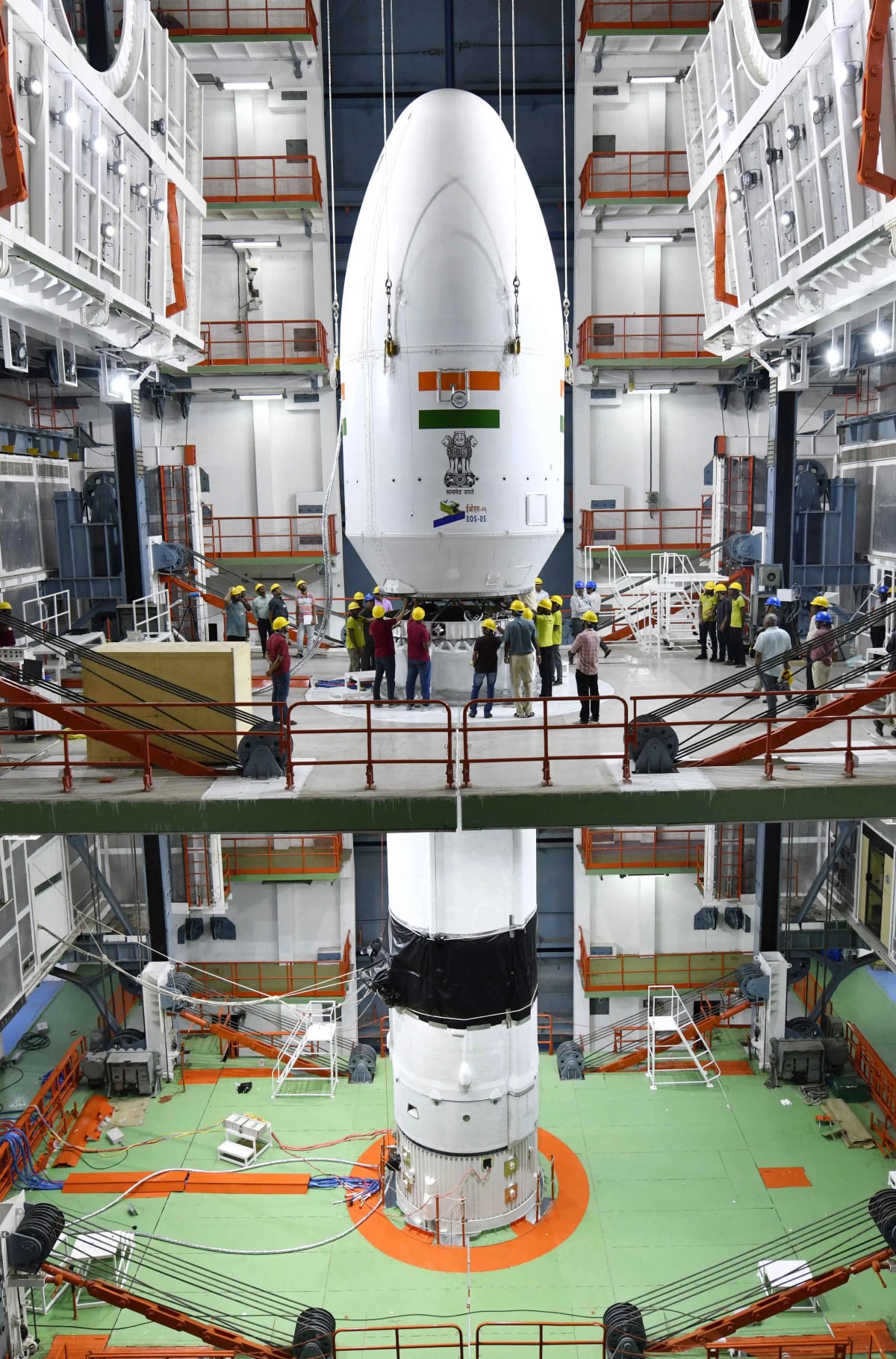
A Geosynchronous Satellite Launch Vehicle lifted off from the Sriharikota spaceport in Andhra Pradesh before dawn on Friday, carrying the EOS-05 earth-observation satellite into orbit, NDTV reported. The mission, designated GSLV-F17, is routine, indigenous, and increasingly relevant to how the state monitors its territory.
There were no dramatic countdowns released to the public, no high-profile guests at the viewing gallery. The launch was an operational event, the kind ISRO has normalised over two decades of satellite missions. A spacefaring nation that launches on schedule has solved a set of engineering and logistics problems most governments cannot.
The Payload Is the Point
EOS-05 is an earth-observation satellite in the series ISRO uses to refresh and expand its remote-sensing fleet. Once it completes orbit-raising and begins operations, its imagery will feed into systems used for disaster response, agricultural planning, urban expansion studies and defence reconnaissance. India has long maintained optical and radar-imaging spacecraft; each new satellite adds sensor capacity and reduces the time between revisits over a given area.
The strategic value of such a satellite is not in the launch but in the data loop it closes. Indian agencies that need timely imagery of coastal zones, crop health, flood extents or border infrastructure have historically relied in part on foreign vendors. A domestic launch of a domestic sensor changes the chain of custody. The imagery is generated, downlinked, processed and archived entirely within Indian systems. This matters when the subject is a sensitive border sector or a disaster response in a contested region.
GSLV's Record and the Case for Cadence
The GSLV programme has not always commanded the confidence its PSLV sibling does. The cryogenic upper stage, which India had to develop without imported technology after the early 1990s, took years and failed in flight before the design matured. GSLV-F17 is a data point in the vehicle's recovery: a clean flight, on schedule, for a payload that matters beyond prestige.
A launch vehicle that flies frequently becomes a business asset. India's commercial launch offering rests on cost and reliability; satellite operators who once looked only to American, European or Russian rockets now treat the Indian range as a viable alternative. Every GSLV success strengthens the sales pitch for the state-run launch provider and for the private suppliers who have moved into component manufacturing, integration support and mission services.
Sovereign Access as a Design Principle
Space self-reliance is not an abstract goal for India. Communications, navigation, meteorology and reconnaissance payloads cannot always ride on borrowed rockets, especially when the mission is time-sensitive or classified. GSLV-F17 demonstrates that Indian engineers can sustain the cryogenic-stage lineage that the country had to invent after technology-denial regimes closed off foreign engines. The launch restates a simple proposition: India can place a reconnaissance-class satellite in orbit without asking permission from any other government.
In border areas, satellite imagery reduces the lag between activity on the ground and institutional awareness. When the imagery comes from an Indian satellite launched on an Indian rocket, the entire chain of custody is sovereign. That is the argument ISRO and its political stewards have made in budget documents and parliamentary replies for years. The Friday launch puts that argument into orbit.
The Private Ecosystem Follows the Launch Cadence
India's private space sector has begun to move beyond assembling parts and into mission-critical services. The more frequently ISRO flies, the more demand flows to fabrication shops, testing centres, ground stations and data analytics firms. GSLV-F17 is one launch in a queue that now spans earth observation, communications and navigation. The supplier base grows with each flight.
There is a parallel opportunity in the data. EOS-05 will produce imagery that has commercial value if the distribution framework is nimble enough. Indian agriculture, insurance, infrastructure and logistics companies can use satellite data for crop yield estimates, damage assessment and route planning. The gap between a successful launch and a functioning domestic market for space-derived services remains wide, but each new satellite narrows it.
What Follows the Launch
The next steps are less glamorous than a rocket rising through a pre-dawn sky. ISRO must move EOS-05 through standard in-orbit testing and then push the data into the institutions that need it. That integration is where many space programmes falter, not at liftoff. The satellite's value will be measured by how quickly its imagery reaches disaster managers, agricultural planners and security agencies.
At the same time, the launch programme faces a structural question. The GSLV can carry this class of payload, but heavier satellites wait for the semi-cryogenic engine that India has been developing for years. The faster that engine is flight-qualified, the less India will need to rely on foreign launch providers for its heavier communication and earth-observation spacecraft. GSLV-F17 does not answer that question; it keeps the question open by demonstrating that the current vehicle works.
The GSLV-F17 launch will not dominate the news cycle, and it was never meant to. It builds a spacefaring nation's credibility in increments: one pre-dawn ignition, one orbital insertion, one more sensor looking back at the subcontinent. The question that follows is whether India's policy machinery can convert this competence into faster decision-making on next-generation engines, bigger private-sector roles and a data marketplace that turns orbital imagery into ground-level advantage. That conversion is the harder, less visible launch still waiting to happen.