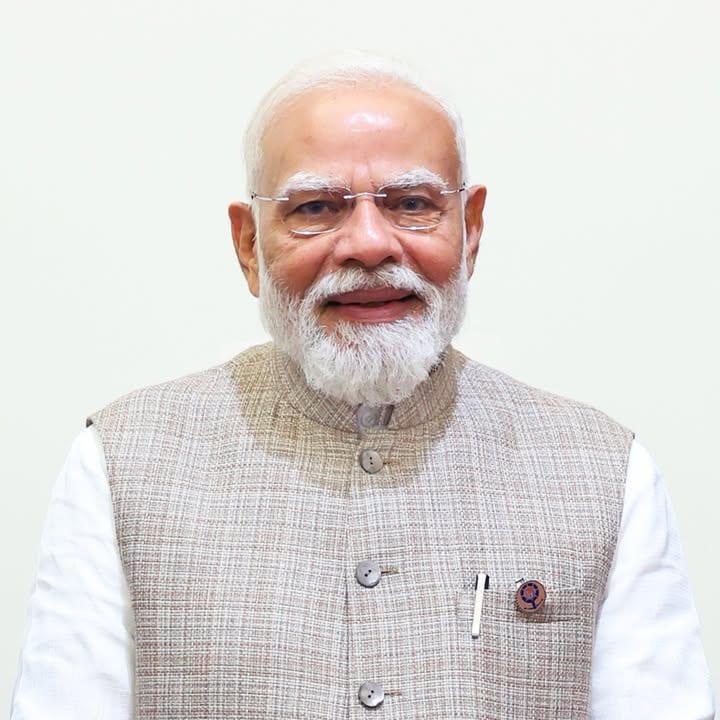
Prime Minister Narendra Modi and Iranian President Masoud Pezeshkian met on the margins of the Shanghai Cooperation Organisation summit in Bishkek on Monday, Iran's state-run IRNA news agency reported. Pezeshkian had travelled to the Kyrgyz capital to address the SCO summit and the SCO Plus meeting, while Modi had already arrived in Kyrgyzstan for the summit and a series of bilateral meetings, LiveMint reported.
The exchange was the first face-to-face meeting between Modi and Pezeshkian since the outbreak of the US-Iran war earlier this year. The two leaders have held several telephone conversations during the conflict; the latest, on June 30, saw Pezeshkian brief Modi on developments in West Asia, while Modi reiterated the need for continued efforts toward lasting peace and stability, according to the same report.
A War That Has Reached the Gulf's Narrowest Artery
The diplomatic engagement took place as the battlefield moved dangerously close to the Strait of Hormuz, the waterway through which much of India's crude oil imports transit. US forces struck Iranian rocket launchers for the first time in weeks on Sunday, hitting two Islamic Revolutionary Guard Corps positions on Larak Island, a US official told Reuters. The strike came after IRGC units were observed preparing to launch rockets fitted with sea mines toward the Strait of Hormuz. In response, Iran fired ballistic missiles at US forces based in Jordan, according to a Fox News report citing a US source; nearly all incoming fire was reportedly intercepted with no major damage. Iran's Revolutionary Guards said the initial US strike had left several soldiers and civilians dead or wounded and vowed response and punishment for those it holds responsible, state broadcaster IRIB reported.
The SCO Table and India's Parallel Channels
India has been a member of the SCO since 2017; Iran is one of ten member states, alongside Belarus, China, Kazakhstan, Kyrgyzstan, Pakistan, Russia, Tajikistan and Uzbekistan. The US-Iran war was expected to figure in the discussions, not least because Tehran sits at the same table as Washington's principal adversaries and partners at once. Modi's Bishkek itinerary includes a scheduled meeting with Russian President Vladimir Putin and a likely exchange with Chinese President Xi Jinping, situating the Iran conversation inside a wider pattern of Indian diplomacy: direct bilateral lines maintained simultaneously with capitals that do not speak easily to one another.
Why New Delhi Cannot Afford a Detached Posture
The meeting carried concrete stakes beyond summit protocol. Iran anchors two Indian connectivity projects that New Delhi has pursued for more than a decade: the Chabahar port, which opens a route to Afghanistan and Central Asia without crossing Pakistani territory, and the International North-South Transport Corridor, which offers a shorter freight path to Eurasia. Neither tolerates a prolonged West Asian war. Chabahar's operational continuity depends on Iran's stability and on India's ability to keep its engagement with Tehran insulated from third-country hostilities. The Strait of Hormuz, meanwhile, is not an abstraction; a closure or sustained harassment of tankers would force Indian refiners to pay higher freight and insurance costs almost immediately, and the large Indian workforce in the Gulf would face renewed security uncertainty.
The Meeting Itself: A Signal, Not a Shift
After the talks, Modi posted on X that the two leaders had discussed the prevailing situation in the region and that India would continue to support all efforts aimed at ensuring lasting peace, as LiveMint reported. The two had earlier spoken on March 21, during which they discussed in detail the security situation in West Asia, NDTV noted. The continuity of these conversations, from March through June to Bishkek, matters. India did not wait for a ceasefire to reopen a channel; it kept the line live through the escalation, and now gave it summit-level visibility.
Strategic Autonomy as Practice, Not Platitude
The Bishkek meeting was an exercise in what Indian foreign-policy discourse calls multi-vector engagement. India maintains deepening ties with the United States, Israel, and the Gulf states while preserving its relationship with Tehran. This is not balancing between blocs; it is the deliberate management of separate interests. The Chabahar investment does not conflict with India's defence partnership with Washington, because the port serves Indian commercial access to Central Asia, not Iranian military capacity. The same logic applies to the SCO, where India sits with Russia and China on security questions even as it expands technology and trade cooperation with Europe. Diplomacy at this level is not about choosing sides once; it is about holding multiple conversations at once and ensuring that none of them forecloses the others.
What Comes Next
The meeting creates no guarantee of de-escalation. Washington and Tehran remain in a cycle of strike and response, with the Strait of Hormuz the most exposed point in the confrontation. India's role is not mediation in any formal sense; it is the preservation of a route, a port, a corridor, and a large expatriate community whose safety turns on the same geography. New Delhi will press for the Strait to remain open, for Chabahar to remain operational, and for Iranian restraint that keeps insurance premiums and freight rates from spiking. The meeting also provides a venue to press for consular access and the safety of Indian nationals in Iran. The Bishkek conversation, short as it may be, gives India the standing to make those arguments directly rather than through third parties.