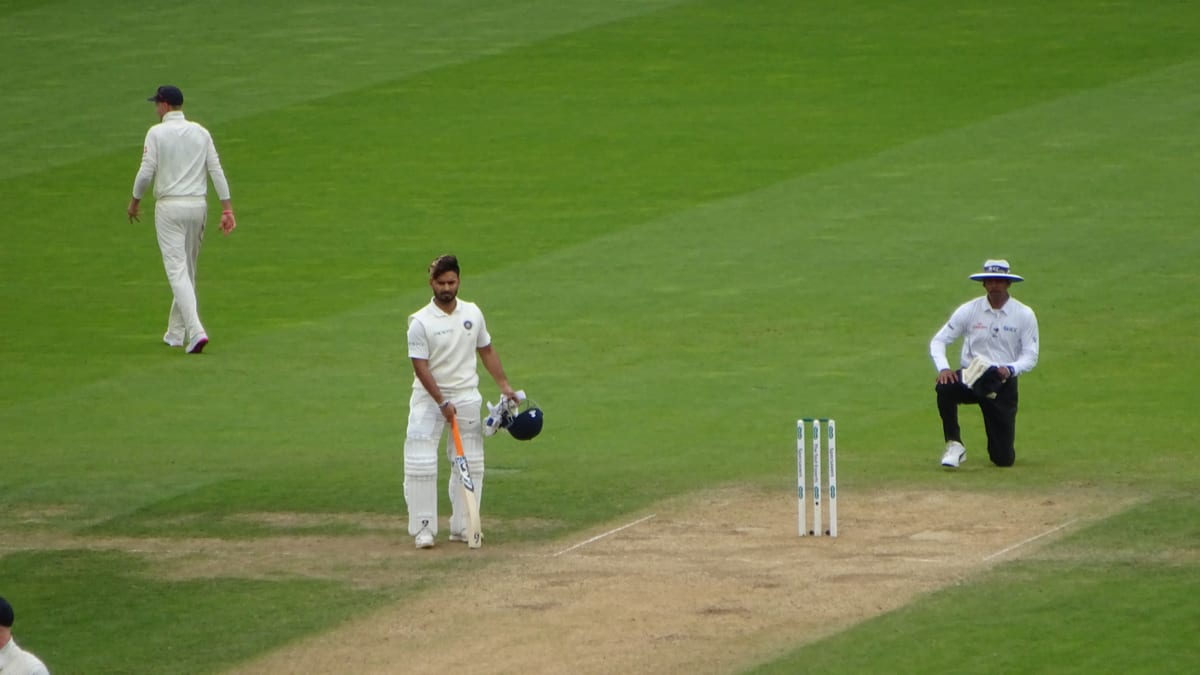
Devdutt Padikkal walked off unbeaten on 142, and the conversation India's selectors have been trying to defer walked straight back in with him. According to ESPNcricinfo, Padikkal's century anchored India's reply in the tour fixture, with Ravindra Jadeja scoring a half-century and both KL Rahul and young spinner Akshar Suthar adding runs to build depth through the order.
The match itself, a warm-up fixture on the Sri Lanka tour, counts for nothing in the standings and everything in the margins of a selector's notebook. Padikkal's 142 not out is precisely the kind of innings that does not let the committee look away.
The Number Five Problem
India's middle order, specifically the No. 5 slot in Tests, has been a revolving door for long enough that the phrase itself has acquired a weary quality in Indian cricket writing. It is not for want of candidates. There have simply been too many plausible ones, none of them quite imposing themselves over a sustained run of matches.
Padikkal has the profile that suits the position. He is a left-hander with a compact technique, providing the batting variety selectors value in a long middle order. He bats deep into innings without visible anxiety about his place in the squad. What he has lacked, until recently, is the kind of extended, match-shaping knock that forces a conversation rather than merely keeping it alive. An unbeaten 142 in a tour game, built while others around him contributed without dominating, is precisely that conversation-starter.
The timing sharpens the point. IWE's own recent coverage noted that Sai Sudharsan's injury has forced selectors to think again about the top order ahead of the Sri Lanka Tests. Selection pressure from multiple directions tends to accelerate decisions that might otherwise drift across several more rounds of discussion. Padikkal batting himself into undeniable form at this moment is not coincidence, it is the nature of touring cricket, where opportunity and readiness occasionally coincide.
What Jadeja's Bat Adds to the Equation
Ravindra Jadeja's half-century is the secondary subplot that quietly changes the arithmetic. When Jadeja bats freely, and a warm-up fifty suggests someone who has arrived at the crease without defensive calculation, India's effective lower-order ceiling rises sharply. A No. 7 who routinely contributes thirty-plus runs in Tests transforms how aggressively Nos. 5 and 6 can play. It creates the kind of cushion that allows a Padikkal at No. 5 to play his natural game rather than the compressed version a brittle tail demands.
Jadeja returning to form with the bat is, in this sense, almost as important to India's Test selection thinking as Padikkal's century. A fit, run-scoring Jadeja at seven means the middle order does not need to hoard every run; it can express itself. Whether that combination holds into the Test matches is a different question, warm-up form and Test-match execution are related but not identical, but as indicators go, this one points in the right direction.
Akshar Suthar and the Spin-Bowling All-Rounder Slot
Akshar Suthar's contribution in the same innings adds a third strand. IWE's earlier coverage of the opening tour game noted that Suthar, alongside Jadeja and Kuldeep, had provided the meaningful late relief when India's seamers toiled. In that piece, his emergence was read primarily as a bowling observation. The fact that he also made runs here refines the picture: Suthar is a spin-bowling all-rounder with batting depth, exactly the profile that subcontinental conditions reward.
India on home pitches, and on Sri Lankan pitches that behave similarly, have historically found value in the spinning all-rounder who holds the lower order together while delivering overs in helpful conditions. The slot is not vacant in the squad, but it is competitive, and every innings in which Suthar demonstrates batting utility alongside his spin makes the competition sharper.
The Architecture of a Batting Performance
What distinguishes this particular tour innings is less any individual score in isolation and more the architecture of the batting effort as a whole. Padikkal anchored. Jadeja accelerated. Rahul contributed. Suthar added depth at the tail-end of the order. That is a batting performance running through six or seven positions in the lineup, each one providing something different in character, the long anchor, the experienced middle-order presence, the all-rounder cameo.
Selectors reading a scorecard like this are not merely counting runs. They are reading the temperament of an eleven working together on an unfamiliar surface. Tour games exist precisely for this purpose: to show whether a lineup has the internal coherence to bat through difficulty and build partnerships across unfamiliar combinations. This one appears to have done exactly that.
The technical read on Padikkal specifically is worth dwelling on. Long-form innings against touring attacks, even in warm-up fixtures, require a batter to solve problems that short-form cricket does not present. Staying in for long enough to reach 142 not out means navigating spells from different bowlers, adjusting to changing pitch pace as the ball softens, and managing concentration across a session and a half. These are the quiet skills of Test cricket, and they are not visible in T20 returns or ODI cameos. Padikkal's knock is evidence that he can sustain the mental contract Test batting requires.
What the Selection Committee Reads Next
The Duleep Trophy and India A fixtures that follow this tour will now carry extra weight. Padikkal has set a marker. The question is whether he can replicate the consistency, not the single knock, but the habit of innings, that convinces a selection committee to stop the rotation and settle on a name.
India's approach to the No. 5 debate in Tests has oscillated between backing experience and gambling on youth. The evidence is that neither approach alone resolves the problem. What resolves it is a batter who makes the argument self-evident over enough games that the committee runs out of reasons to delay. Padikkal has not yet done that. An unbeaten 142 in a tour game is a necessary step, not a sufficient one. But necessary steps, accumulated in the right order, have a way of arriving at sufficiency before anyone quite decides they should.
For now, the innings sits in the record. The selectors have seen it. The home season is approaching. The No. 5 slot waits, as it has waited through several incumbents, for someone to make it their own, and the difference this time is that Padikkal appears to be actively trying to close the argument rather than simply participate in it.