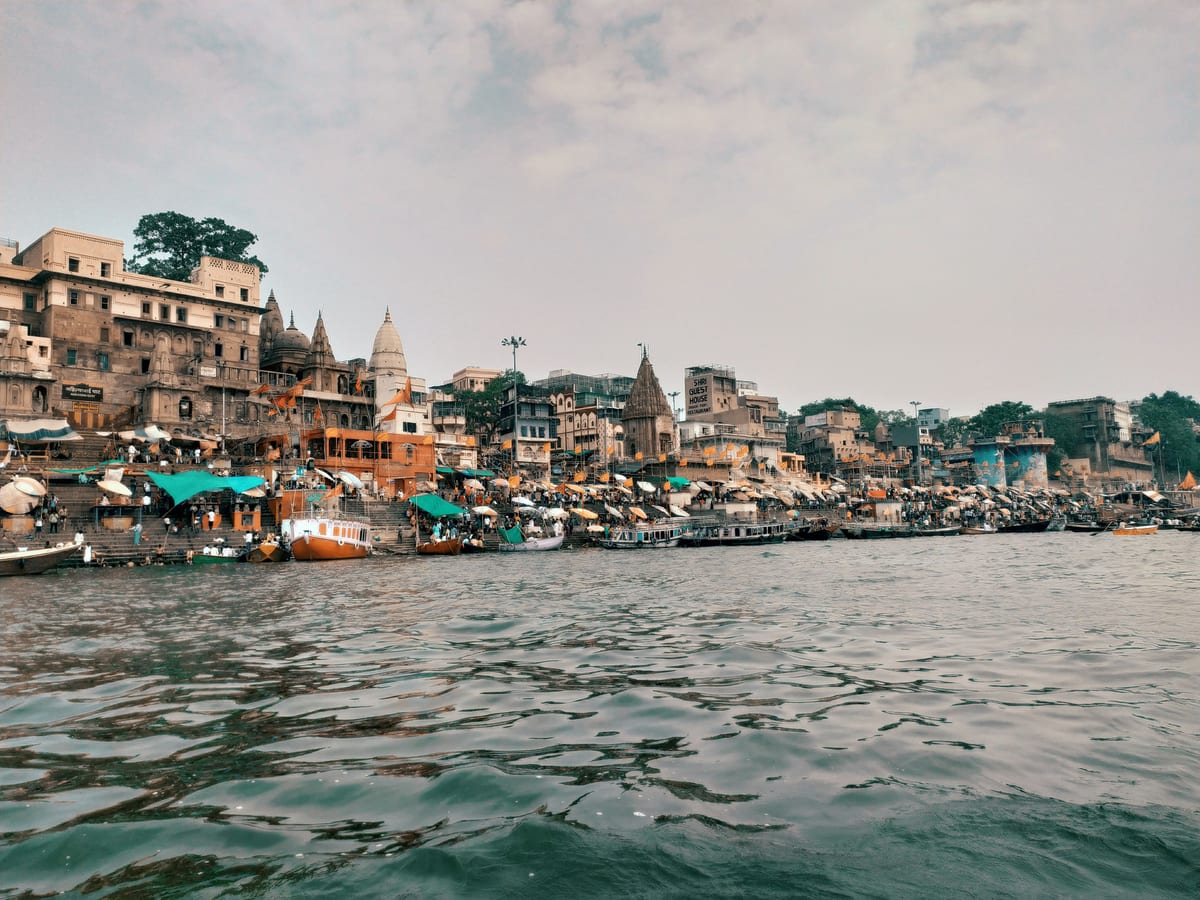
There is a quote attributed to Mark Twain that I have carried with me since I first read it as a student: "Benares is older than history, older than tradition, older even than legend." I thought it was poetic exaggeration until I stood at Dashashwamedh Ghat just before sunset, the river Ganga stretching before me like a passage of time made liquid, and suddenly understood that Twain had, if anything, understated it. Varanasi does not merely contain history. It is history — still breathing, still chanting, still burning.
A City Born Before Time Had a Name
Varanasi — known across centuries as Kashi, Banaras, and the City of Light — traces its roots back over 3,500 years, placing it among the oldest continuously inhabited cities on Earth. But its significance in Hindu mythology reaches even further than archaeology. According to ancient legend, Varanasi is the very place where the world was created, the soil upon which the first ray of divine light fell, igniting the spark of life and illuminating the long road of human civilisation. That is not a metaphor locals use lightly. It is a belief that permeates every ritual, every prayer, every earthen diya set afloat on the sacred waters.
Situated in the state of Uttar Pradesh in northern India, Varanasi sits along the crescent-shaped western bank of the Ganga. The city's geography is itself spiritual — the river here flows northward, an anomaly that ancient sages interpreted as Ganga turning back toward the heavens. Along this blessed curve, the famous ghats — stone-stepped riverbanks — form a continuous amphitheatre of devotion stretching for kilometres. Pilgrims come to bathe, to pray, to mourn, to be reborn. Some come to die, believing that to breathe one's last in Kashi is to attain moksha — liberation from the cycle of rebirth.
The Ganga Aarti: Fire, Faith, and the River
If Varanasi has a single defining spectacle — and it has many — it is the Ganga Aarti performed each evening at Dashashwamedh Ghat. As the sun bleeds into the horizon and the sky turns the colour of marigold and ash, the ghat transforms into something that defies easy description. Priests in saffron robes take their positions, brass cymbals begin their rhythmic clang, and radiant brass lamps are raised in sweeping, synchronised arcs toward the river goddess Ganga. The air thickens with the fragrance of sandalwood. Mantras roll across the water like waves. Thousands of devotees and visitors stand, sit, lean from boats, pressed together in collective reverence.
The Ganga Aarti is not a performance staged for tourists. It is an unbroken ritual, enacted every single evening regardless of season or audience. Varanasi does not dress up for visitors. It simply continues being itself, and if you are fortunate enough to be present, you are absorbed into its continuity. This, more than anything, is what distinguishes Varanasi as a living civilisation rather than a preserved monument.
The Lanes, the Temples, and the Silk
Beyond the ghats, Varanasi reveals itself through its impossibly narrow galis — alleyways so tight that two people must turn sideways to pass. Temple bells echo off ancient stone walls. Ash-covered sadhus in saffron robes sit in quiet contemplation, offering glimpses into spiritual traditions that have remained largely unchanged for millennia. The Kashi Vishwanath Temple, dedicated to Lord Shiva — the presiding deity of this city — is one of the most sacred shrines in all of Hinduism, drawing millions of pilgrims each year.
Banarasi silk sarees are among the finest textiles produced anywhere in the world, woven with gold and silver zari thread in patterns of extraordinary delicacy. Browsing the fabric markets of Varanasi is a sensory immersion — bolts of crimson, ivory, and deep violet cascading from shelves, weavers hunched over ancient handlooms in workshops barely larger than a closet. A Banarasi saree carries a piece of living craft history.
The street food culture of Varanasi is equally legendary. The fragrance of freshly prepared chaat, the warm sweetness of malaiyo on a winter morning, the crisp perfectionism of a kachori — the city feeds the body as rigorously as it tends to the soul. Do not leave without sampling the famous Banarasi paan, a betel leaf preparation as much ritual as refreshment.
Best Time to Visit
According to Incredible India's official Varanasi page, temperatures in the city range from a cool 4.5°C in January to a scorching 45.2°C in May. The most comfortable window for visiting is between October and March, when the weather is mild and the city hosts some of its grandest festivals. The Dev Deepawali celebration in November — when the ghats are lit with hundreds of thousands of oil lamps — is among the most breathtaking sights in all of India. The Ganga Mahotsav cultural festival draws classical musicians and performers to the riverbank, making it a particularly rich time for those interested in India's performing arts heritage.
Getting There
Varanasi is well connected to the rest of India. The city is served by Lal Bahadur Shastri International Airport (VNS), which handles domestic flights from major Indian cities and select international connections. For those who prefer rail, Varanasi Junction Railway Station (BSB) is a major hub on the Indian Railways network, with direct trains from Delhi, Mumbai, Kolkata, and beyond. Once in the city, auto-rickshaws, cycle-rickshaws, and boat rides on the Ganga are the most evocative — and practical — ways to navigate.
Why Varanasi Matters
India has no shortage of ancient sites, sacred rivers, or cities of historical renown. What makes Varanasi singular is that it refuses to be any of those things in the past tense. The rituals performed at the ghats today are the same rituals performed a thousand years ago. The handloom weaver threading gold zari into silk belongs to a craft lineage stretching back centuries. The pandit reciting Sanskrit shlokas at dawn has inherited a living oral tradition that predates the written word. Varanasi is not a museum of Indian civilisation. It is the civilisation itself, still in session.
To travel to Varanasi is to understand that India's relationship with time is fundamentally different from the rest of the world's. Here, the ancient is not old. It is simply present — washing its face in the Ganga each morning, lighting its lamps each evening, and continuing, as it always has, without apology or interruption. Come with an open heart, comfortable shoes, and no great attachment to schedules. Varanasi will take care of the rest.