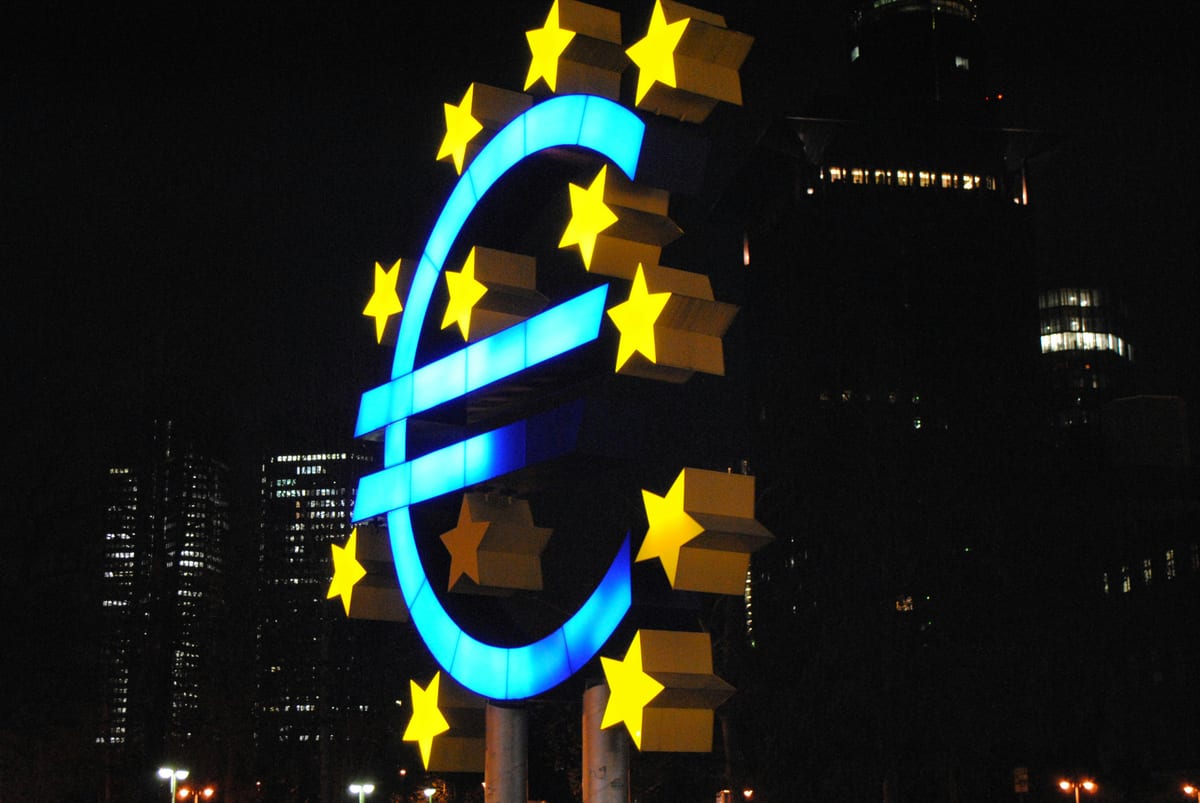
When Christine Lagarde and ECB Vice-President Boris Vujčić stepped to the podium in Frankfurt on July 23, the Governing Council's verdict was a single word dressed in bureaucratic caution: unchanged. All three key ECB interest rates stay where they are, the statement confirmed — a pause that carries its own argument in a moment when the Middle East conflict has sent European energy prices well above pre-conflict levels and left the eurozone's inflation trajectory genuinely uncertain. Lagarde did not pretend otherwise. The full inflationary impact of the energy shock, she said, has yet to play out.
That sentence deserves to sit alone for a moment. Europe's central bank — the institution that sets the cost of money for a $15-trillion economy — is explicitly acknowledging that it cannot yet measure the damage from a shock still unfolding. The Governing Council is monitoring the intensity, the duration, and the second-round effects of the energy disruption, committing to a 2% medium-term inflation target while refusing to pre-commit to any rate path. This is honest central banking in a fog. Honest central banking in a fog still moves capital markets, and the tremors reach Mumbai well before they resolve in Brussels.
What Frankfurt's Pause Communicates Beyond the Rate Table
Read the ECB statement carefully and a picture of a eurozone economy in managed anxiety emerges. Services activity has partly recovered from the immediate aftermath of the energy shock — though surveys suggest the recovery is uneven. Manufacturing is holding up, supported by stockpiling against supply-chain risks and by higher defence spending, which has become Europe's fastest-growing fiscal category. Digital services are robust, with AI-related activity cited as a specific growth contributor — a detail that matters well beyond Frankfurt's remit.
Unemployment at 6.2% in May sits close to historical lows. But job postings are declining, and both firms and households expect the labour market to weaken relative to its pre-conflict state. Low current unemployment alongside deteriorating forward expectations is the eurozone's central economic tension right now. The ECB must calibrate against an inflation threat that is energy-driven and supply-side, not demand-driven. The orthodox rate-hike response becomes dangerous; the hold-and-watch approach is defensible, even if uncomfortable.
Lagarde's language was precise on process: data-dependent, meeting-by-meeting, no pre-commitment. This is the vocabulary of optionality — Frankfurt keeps all doors open because the energy shock's second-round effects (wage demands, transport costs, input prices feeding through manufacturing supply chains) will determine whether a rate move becomes necessary. An ECB that moves too early risks tipping a fragile recovery; one that moves too late risks embedding energy-driven inflation into expectations. The hold is the least-bad choice in a genuinely uncertain landscape.
Infosys Results Week and the European Revenue Question
Here is where the ECB's opaque language becomes concrete for the Indian investor sitting with a brokerage screen open today. Infosys Q1 results are among the most searched financial topics in India right now — and Europe is a substantial chunk of what Infosys, TCS, and Wipro actually sell. The collective European revenue exposure across India's large IT exporters is significant enough that eurozone growth signals translate into deal pipelines, discretionary technology spending by European corporates, and ultimately into the quarterly guidance numbers that move Indian IT stocks by single-digit percentages in either direction within hours of announcement.
The ECB's statement on AI-related activity driving digital services growth is a subtler signal — it suggests that even as European corporates pull back on discretionary spending in response to energy costs and uncertainty, AI-driven technology contracts may prove stickier than the broader IT spend cycle. That is a useful data point for anyone trying to understand whether Indian IT exporters face a demand cliff in Europe or a recalibration toward higher-value engagements. The ECB did not intend its statement as an IT sector earnings guide; the data happens to function as one.
Capital Flows, the Rupee, and the RBI's Quiet Advantage
The structural capital-flow logic runs like this: a static or dovish ECB compresses European yields; compressed European yields push institutional investors toward assets offering better returns; emerging markets — India prominently among them — receive that overflow as foreign portfolio investment into equities and government securities. The relationship is noisy across short windows, but across monetary cycles it holds well enough that the RBI's Monetary Policy Committee explicitly monitors ECB decisions as part of its global spillover assessment.
What makes the current moment interesting is the energy-shock context. The ECB is not holding rates from a position of comfort — it is holding because the inflationary threat is supply-side and the growth trajectory is uncertain. That differs from the ECB holding because inflation has been tamed and a rate-cut cycle is imminent. The capital-flow dividend to India from this pause may be more modest than a clean dovish pivot would produce, because global risk appetite is itself suppressed by the same Middle East conflict that triggered Frankfurt's energy shock. Investors do not flood emerging markets when geopolitical uncertainty is the reason yields are low in Europe.
The RBI, under Governor Sanjay Malhotra, has been consistent that domestic inflation and growth conditions drive Indian monetary policy — not ECB or Federal Reserve cycles. That independence is both principled and practical. As a recent IWE analysis on the RBI's money market data noted, India's overnight rates and liquidity conditions have been remarkably stable — the RBI is running a calibrated steady state while global central banks navigate genuine turbulence. That divergence in policy clarity is itself a competitive advantage for Indian financial markets: foreign portfolio investors looking for a relatively predictable rate environment in Asia find India more legible than many alternatives.
The Trade Channel That Runs Deeper Than Capital Flows
Capital flows get the attention, but the trade channel is slower and arguably more consequential. The EU is India's largest trading bloc partner, and the health of European demand — which ECB policy directly influences over a 12-to-18-month horizon — shapes Indian export volumes across pharmaceuticals, engineering goods, textiles, and chemicals. An ECB that successfully steers the eurozone through an energy shock without tipping into recession is far better for Indian exporters than one that miscalibrates and engineers a hard landing in European consumer demand.
Lagarde's forward-looking indicators suggest growth will remain muted — her word, essentially, though framed diplomatically. Muted European growth is not catastrophic for Indian exports, but it does constrain the upside in sectors that had been counting on European demand recovery as a tailwind. Indian pharmaceutical exporters, in particular, had positioned for European healthcare spending to normalise post-pandemic disruptions; an extended period of European household caution over energy bills changes that calculus.
The ECB's acknowledgment that the energy shock's inflationary impact has yet to fully play out is the most important sentence in the entire July 23 statement. It signals that Frankfurt will remain in monitoring mode for at least another quarter — and probably longer, depending on how the Middle East conflict evolves. For Indian investors, that means the ECB-driven tailwind for FPI inflows exists but is muted by risk-off dynamics; the IT sector's European revenue visibility remains clouded but not collapsing; and the RBI retains the space to run domestic monetary policy on its own terms, without ECB noise forcing its hand. In a global environment where central bank independence is under pressure from multiple directions, that space is worth defending carefully.