

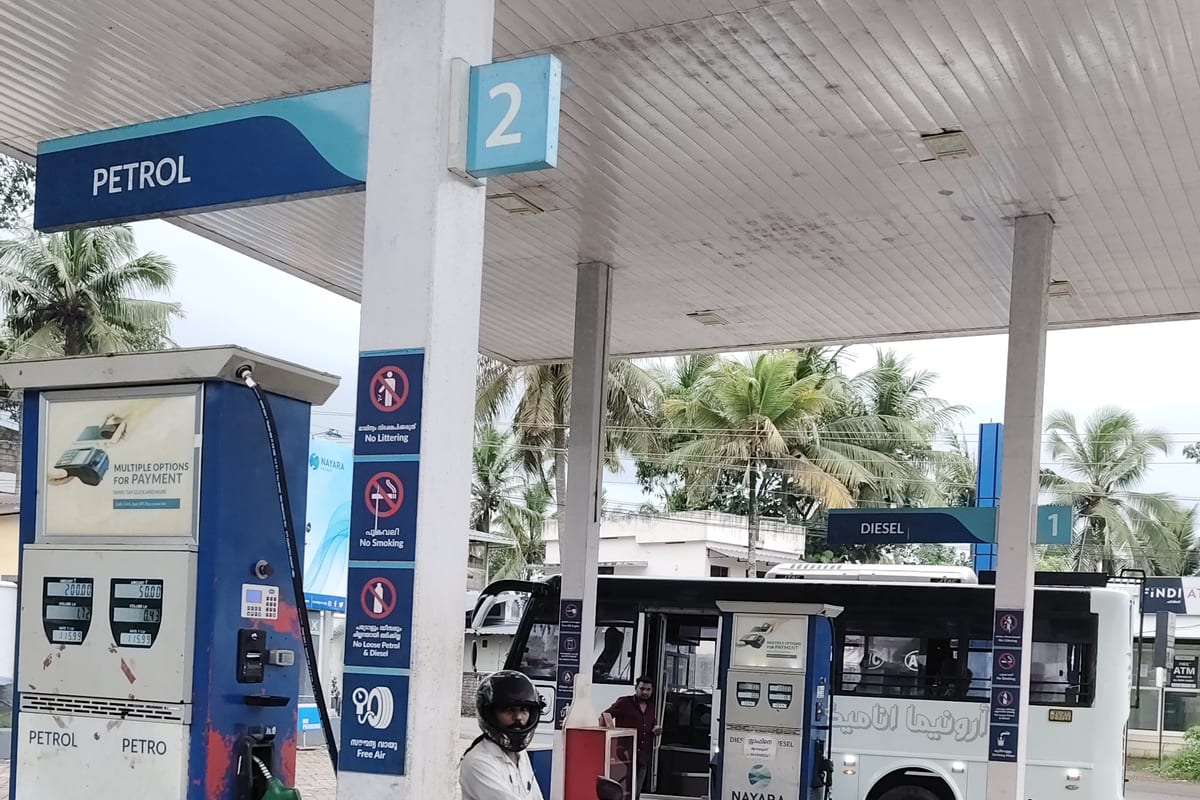
State-owned oil marketing companies left pump prices unchanged on Tuesday, October 6, after the 6 am daily revision, according to LiveMint. The decision held across all major metros even as the US-Iran war keeps crude markets unsettled and private retailers begin passing through higher costs.
In Mumbai, petrol stood at ₹111.21 per litre and diesel at ₹97.83, unchanged from the previous day, as per data from the publication. Delhi consumers paid ₹102.12 for petrol and ₹95.20 for diesel. Kolkata recorded the highest metro petrol price at ₹113.51, while Bengaluru's petrol price was ₹111.68 and diesel ₹99.56. Hyderabad remained the steepest among tracked cities at ₹116.15 for petrol, and Thiruvananthapuram was close behind at ₹115.49. Chandigarh's diesel was the only city in the list below ₹90, at ₹89.47.
Fuel rates have held steady since June despite the disruption that followed the outbreak of the US-Iran war in late February. A day earlier, the same state retailers also kept rates steady. LiveMint reported that OMCs only began passing on higher international prices in May through staggered increases.
Nayara Energy, India's largest private fuel retailer, took a different path. On Saturday it raised petrol by ₹5 per litre and diesel by ₹3 per litre, becoming the first fuel retailer to pass the impact of higher international oil prices to consumers earlier this year. Public-sector companies are absorbing cost pressure, while private operators are pricing it through. For a market where state retailers control most outlets, Nayara's move does not immediately shift the average pump price. It changes the competitive signal. Private capital will not sit on inventory when crude stays above $100, and every week of OMC stillness widens the margin squeeze that eventually forces a catch-up, either through price rises or government compensation.
Crude oil finds a patch of calm
Brent crude futures lost 4 cents to $100.28 a barrel by early Tuesday, while US West Texas Intermediate fell 11 cents to $89.33, LiveMint reported. The decline followed a G7 emergency stockpile release and shipping data showing Middle East crude exports exceeded pre-war levels on four days during the last week of September.
Tim Waterer, chief analyst at KCM Trade, told Reuters the numbers point to easing supply-side anxiety. "The pickup in Saudi export numbers and the G7 decision to release strategic reserves are helping keep a lid on prices for now, even while Brent remains anchored around the $100 level," Waterer said.
That calm is fragile. Attacks by Yemen's Houthis on Saudi targets kept traders wary of risks to Gulf supplies. Oil traders are not betting on a sustained fall. The G7 release is a short-term tool; inventories cannot offset repeated attacks on Saudi loading infrastructure. Shipping data shows resilience, but resilience in September does not guarantee October. A single disruption to loading terminals in the Arabian Gulf would hit India harder than most major economies, because much of the country's seaborne crude moves through the Strait of Hormuz.
Why pump-price steadiness matters
India imports the overwhelming share of its crude requirement. Fuel prices sit at the intersection of external vulnerability and domestic politics. State OMCs have frozen retail prices during a period of high volatility, a choice that protects households now but shifts pressure onto refining margins and, eventually, fiscal accounts. The freeze began when crude was lower, which means it was not a reaction to one shock but a longer retail strategy. Extending it year-round while crude stays above $100 turns an operational choice into a political one.
Retail fuel costs feed transport inflation, which moves through the wholesale and consumer price baskets the Reserve Bank of India tracks. A prolonged freeze at the pump can contain one source of price pressure, but if crude stays above $100, the accounting cannot remain deferred indefinitely. City-level variation explains part of the consumer experience. State taxes differ sharply, which is why Hyderabad and Thiruvananthapuram sit above ₹115 for petrol while Chandigarh's diesel remains below ₹90.
LiveMint reported that India has widened its crude sourcing to 43 countries, citing a government official. That broadening addresses the risk this week's headlines expose: the more suppliers an importer has, the less a single Gulf disruption can dictate prices in Delhi, Mumbai, or Chennai.
The reserves gap
India's strategic petroleum reserves remain a small buffer relative to International Energy Agency norms, a gap independent analysts have flagged repeatedly. When global prices soften, as they did on Tuesday, the window to replenish those caverns at lower cost opens. India has planned additional storage capacity in the east and south; the current price dip is the moment to fill it, not after a disruption sends prices higher.
The gap between India's reserves and the IEA benchmark has been discussed in policy circles for years. Construction timelines stretch, and storage cannot be conjured in a fortnight. A coordinated purchase now, while Brent hovers near $100, would be cheaper than emergency buying during a full disruption. The G7's coordinated stockpile release shows how older economies treat emergency reserves as a tool of price management. India does not sit in that room, and its own reserve capacity limits how much it can respond in kind. That asymmetry is a scheduling problem with a technical solution. Indian policy has treated crude sourcing as a sovereign choice, not a geopolitical signal.
What the week tells us
The fuel-price data for October 6 looks static. Underneath it, three forces are moving: private retailers are repricing, global crude is testing $100 rather than running past it, and Gulf supply routes remain under intermittent attack. For Indian consumers, the state-run freeze has kept pump costs predictable through a period that could have been far worse.
The longer question is whether the country uses the current softening to strengthen the buffers that make the next disruption less consequential. That means filling strategic reserves, pressing forward with supplier diversification, and treating any lull in Gulf shipping as time to build, not just to wait. Price stability at the pump is a downstream artefact of choices made upstream: how much crude is stored, how many suppliers ship it, and whether the route from the Gulf stays open.