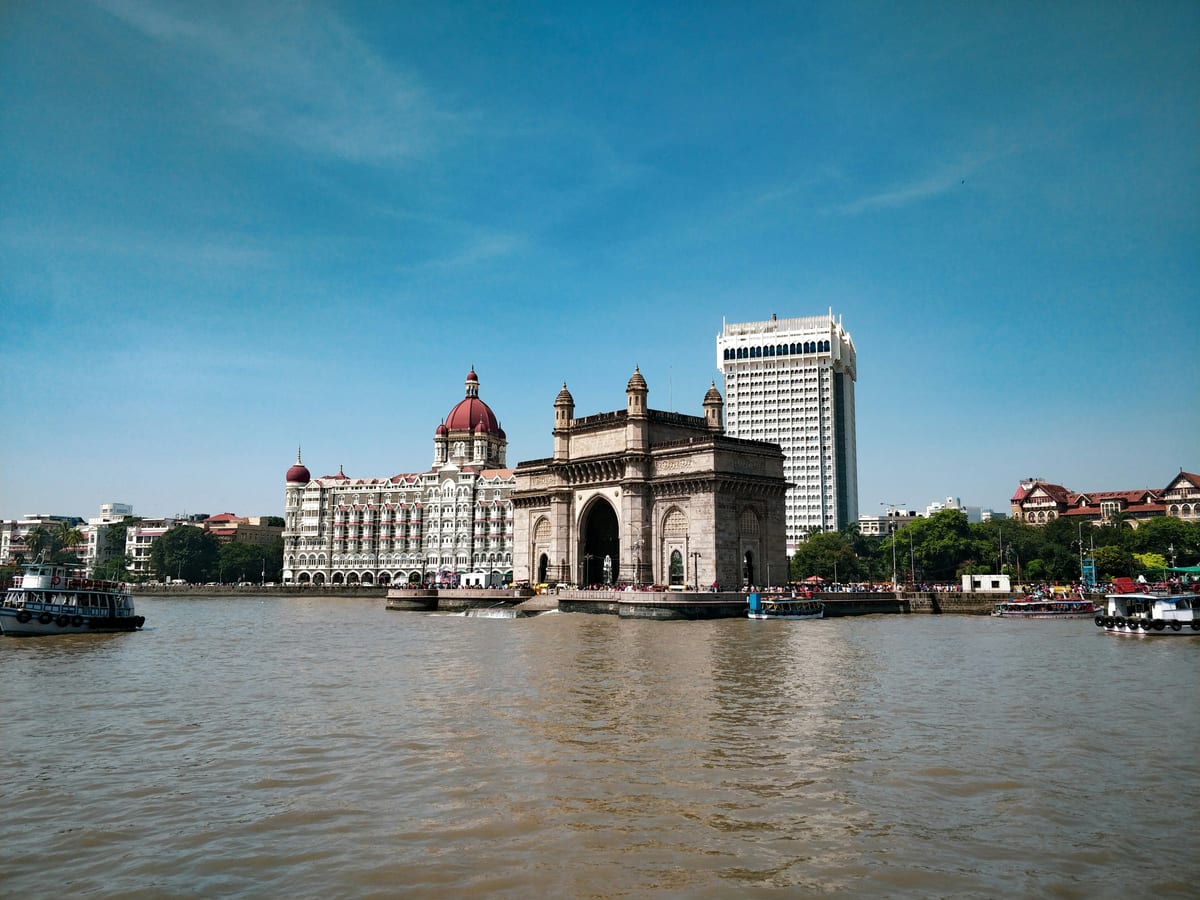
There is a moment, if you time it right, when the sun drops behind the Taj Mahal Palace Hotel and casts the Gateway of India in a wash of amber and rose gold. The arch glows. The fishing boats on the harbour become silhouettes. The entire waterfront of Mumbai feels suspended in stillness. In that light, you understand something that no history book quite captures: this is not a ruin, not a relic, and not merely a tourist attraction. This is a living threshold — a place where India's past and present stand shoulder to shoulder and look out together at the sea.
A Monument Born of Empire, Claimed by a Nation
The Gateway of India was conceived to mark the arrival of King George V and Queen Mary in December 1911 — the first visit by a British monarch to India. Initial plans were drawn up immediately, though the grandeur of the eventual structure far outpaced the occasion that inspired it. Designed by architect George Wittet in the Indo-Saracenic style, the arch draws from the traditions of 16th-century Gujarati architecture, blending pointed arches and latticed screens with the ambitions of colonial monumentalism. Construction was completed in 1924, and the arch was formally inaugurated on 4 December of that year.
The Gateway rises 26 metres above the harbour of Mumbai, crafted from yellow Kharodi basalt quarried locally. Its four turrets frame a central archway wide enough to feel like an invitation — and that, historically, is precisely what it was. For decades, ships carrying administrators, soldiers, and travellers entered India through this symbolic frame. On 28 February 1948, the last British troops to leave independent India marched through the Gateway in a formal withdrawal ceremony. The monument built to announce imperial arrival became the door through which empire departed.
Architecture as Civilisational Dialogue
What makes the Gateway of India extraordinary is not its colonial origin story but its architectural grammar. George Wittet did not simply impose a European triumphal arch on Indian soil. He reached into the subcontinent's own traditions — specifically the stone-lattice work of Gujarat and the pointed arches of Indo-Islamic design — and wove them into a structure that belongs unmistakably to India. The decorative jali screens that frame its upper sections, the carved medallions in the spandrels, the symmetry of its turrets: all of these speak a language that predates the British presence in India by centuries.
This is what Indian civilisation has always done. It receives, it transforms, and it makes its own. The Gateway of India, whatever its commissioners intended, is a monument to that synthesising genius. It is not evidence of colonial power but proof of India's capacity to absorb any influence and ultimately author its own meaning from it. As the Government of India's official tourism portal notes, the Gateway is one of Maharashtra's most iconic landmarks and a proud symbol of India's heritage on the world stage.
What the Visitor Experiences
Arriving at the Gateway of India is, in itself, an event. The Chhatrapati Shivaji Maharaj Marg waterfront — known widely as the Apollo Bunder — opens suddenly after the narrow streets of Colaba, and the arch appears with theatrical inevitability. Around it, Mumbai is in full motion: balloon sellers and photographers, families on Sunday outings, young couples sharing roasted peanuts, and tourists from across the world photographing the harbour. The scene is warm, chaotic, and entirely human.
Ferries depart from the jetties beside the Gateway to Elephanta Island, home to the UNESCO World Heritage-listed cave temples dedicated to Lord Shiva — sculptures of breathtaking scale and spiritual depth that date to the 5th and 8th centuries CE. Within a short boat ride of a colonial-era arch, one finds some of the finest examples of ancient Indian civilisation's sacred artistry. The Gateway and Elephanta together tell the arc of India's story: the deep spiritual roots and the complex, layered modern history that grew from them.
The Taj Mahal Palace Hotel, which faces the Gateway across a plaza of paving stones, adds another layer to the experience. Built by Jamsetji Tata in 1903 — reportedly after he was refused entry to a European-only hotel — it is a monument to Indian entrepreneurial defiance, its domes and arches in quiet conversation with the Gateway's own silhouette.
Best Time to Visit
The ideal season to visit the Gateway of India is between November and February, when Mumbai's coastal climate is at its most accommodating. The humidity eases, the sea breeze off the Arabian Sea is cool and steady, and the light in the early morning and at dusk is extraordinary for photography and quiet contemplation. Monsoon months — June through September — bring dramatic skies and high tides that transform the waterfront, though the rain and crowds can be challenging. Summer months, from March to May, are hot and humid, though the Gateway never truly empties regardless of season.
How to Reach the Gateway of India
The Gateway of India is located in the Colaba neighbourhood of South Mumbai and is accessible from across the city. The nearest railway station is Chhatrapati Shivaji Maharaj Terminus (CST), approximately 3 kilometres away, well connected by local train to the rest of Mumbai. From CST, taxis and auto-rickshaws reach the waterfront in under 15 minutes outside peak hours. The Mumbai Metro network continues to expand, making South Mumbai increasingly accessible. For those arriving by air, Chhatrapati Shivaji Maharaj International Airport is roughly 26 kilometres away, with taxi and app-based cab services running to Colaba throughout the day and night.
Nearby Attractions Worth Your Time
The neighbourhood around the Gateway rewards slow exploration. The Chhatrapati Shivaji Maharaj Vastu Sangrahalaya — formerly the Prince of Wales Museum — is a short walk away and houses one of India's finest collections of art, natural history, and archaeology. The Colaba Causeway market stretches south from the Gateway, offering everything from street food to antiques. The Afghan Memorial Church of St John the Evangelist, built in 1858, stands in quiet contrast nearby. Elephanta Island, reachable by ferry from the Gateway's own jetties, remains one of the subcontinent's essential spiritual and artistic pilgrimages.
Why the Gateway Still Matters
India has countless monuments of greater antiquity, greater scale, and greater architectural ambition. But the Gateway of India occupies a unique position in the national imagination because it is the point where India's ancient civilisational story met its modern political history — and where that modern history was ultimately resolved on India's own terms. When the last troops departed in 1948, they left through a door that India had already redecorated with its own meaning. The arch remained. The empire did not.
To stand at the Gateway of India today, watching the ferries cross to Elephanta as they have for decades, is to feel the weight and lightness of that history simultaneously. This is what civilisational continuity looks like: not a preserved ruin behind glass, but a living waterfront where children eat ice cream in the shadow of an arch that once watched empires come and go, and where the sea remains unchanged, indifferent, and entirely Indian.