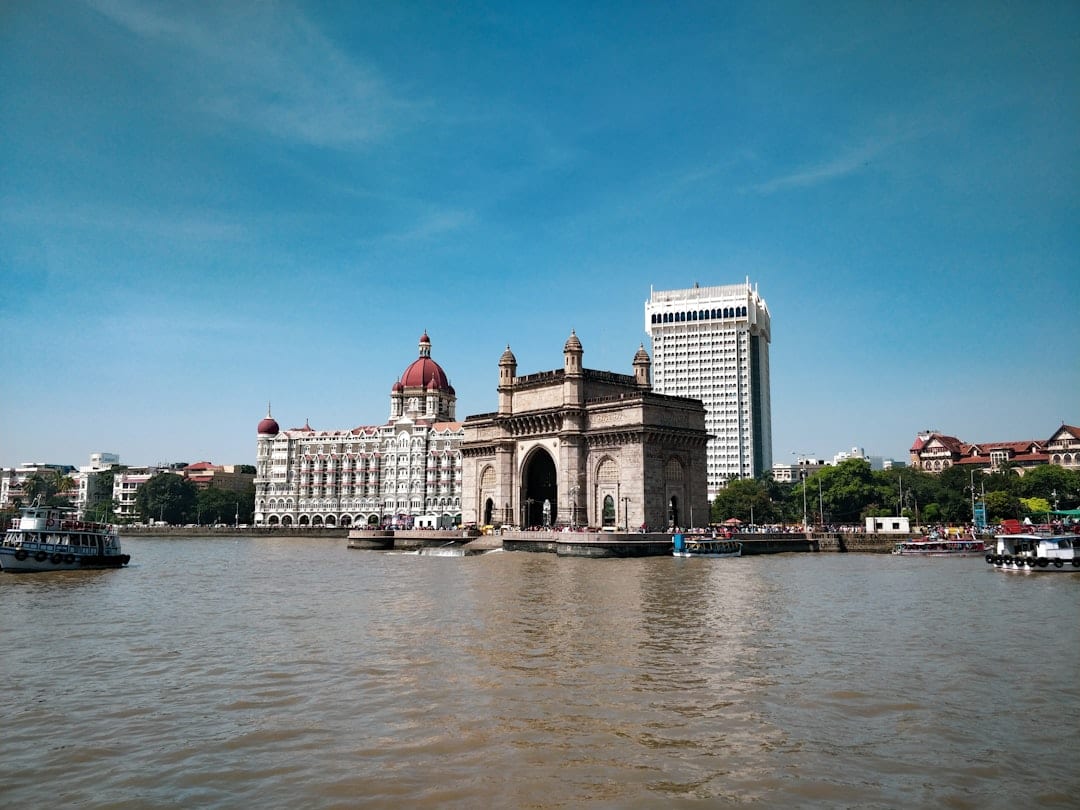
There is a moment, just before sunrise, when Mumbai holds its breath. The sea off Apollo Bunder turns the colour of old copper, the first fishing boats cut silently through the harbour, and the Gateway of India stands exactly as it has for over a century — massive, composed, and utterly indifferent to the passage of time. It is one of the most photographed monuments in India, and yet no photograph has ever fully captured what it feels like to stand beneath its 26-metre arch and look out at the Arabian Sea, feeling the whole civilisational weight of this country pressing gently against your spine.
A Monument Born of Empire, Reclaimed by a Nation
The Gateway of India was commissioned to commemorate the arrival of King George V and Queen Mary in December 1911 — the first visit of a reigning British monarch to India. Designed by Scottish architect George Wittet in the Indo-Saracenic style, the structure draws on 16th-century Gujarati architectural traditions, blending pointed arches, latticed screens, and ornamental detail with a grand ceremonial scale. Construction began in 1913, though the foundation stone had been laid a year earlier, and the monument was formally opened in 1924. It was built from yellow Kharegaon basalt, quarried locally, as if the land itself had consented to be shaped into this form.
But history, in India, rarely stays still. In February 1948, the last British troops stationed in India — the Somerset Light Infantry — marched through the Gateway and boarded their ships homeward. The arch built to announce imperial arrival became, in that single ceremony, the portal of imperial departure. Few monuments anywhere in the world have undergone so complete and poetic a reversal of meaning. As the Incredible India portal notes, the Gateway today is one of India's most iconic landmarks, drawing visitors from every corner of the country and the world.
The Living Waterfront: What Visitors Experience
To visit the Gateway is not to enter a museum — there are no roped-off corridors, no hushed reverence, no admission fee to stand beneath the arch. This is India's heritage at its most democratic. On any given morning, you will find a retired Maharashtrian schoolteacher explaining the monument's history to his grandchildren in Marathi, a group of college students from Bihar taking selfies with the Taj Mahal Palace Hotel glowing behind them, a vendor selling chai from a battered aluminum flask, and a lone traveller from abroad sitting on the stone steps watching the harbour ferries churn toward Elephanta Island.
The esplanade around the Gateway is perpetually animated. Street photographers offer to take your portrait against the arch. Balloon sellers drift past. The smell of bhel puri mingles with salt air. In the evenings, the entire promenade transforms — illuminated against the night sky, the Gateway becomes a stage, and Mumbai's citizens become its most enthusiastic audience. It is impossible to feel like a passive observer here. The city insists on including you.
Elephanta Caves: The Ancient World Waiting Offshore
One of the most profound journeys a visitor can make from the Gateway is the ferry ride to Elephanta Island, roughly 10 kilometres across the harbour. Here, carved into the living rock of a hillside, is the Elephanta Cave complex — a UNESCO World Heritage Site dating to approximately the 5th to 8th centuries CE. The centrepiece is the magnificent Trimurti, a three-faced sculpture of Shiva standing over six metres tall, regarded as one of the finest examples of rock-cut sculpture anywhere in the world. You step away from a 20th-century colonial arch and arrive at a civilisation that was already ancient when the British Empire was still a distant future. This is the civilisational depth that India carries with it everywhere — the Gateway is merely the newest layer.
The Taj Next Door: A Hotel That Holds Its Own History
No visit to the Gateway is complete without pausing to acknowledge the Taj Mahal Palace Hotel, which faces the monument from across the esplanade. Built by Jamsetji Tata in 1903 — reportedly, the story goes, after he was refused entry to a European-only hotel in the city — it represents India's industrial and cultural self-assertion at the very moment of colonial dominance. Together, the Gateway and the Taj form one of the most symbolically charged architectural pairings on the subcontinent: empire and Indian enterprise, standing face to face across a Mumbai pavement for well over a century.
When to Go and How to Get There
The best time to visit the Gateway of India is between November and February, when Mumbai's coastal humidity gives way to cooler, more forgiving weather. Mornings are ideal for photography and quiet contemplation; evenings bring energy, light, and the full theatrical spectacle of the waterfront. The monsoon months of June through September bring dramatic skies and crashing waves that transform the harbour into something almost elemental — not the most comfortable season, but undeniably atmospheric for those willing to get a little wet.
Getting there is straightforward from anywhere in Mumbai. The nearest railway station is Chhatrapati Shivaji Maharaj Terminus (CSMT), roughly 3 kilometres away, and the well-connected local train and metro networks make the journey easy. From South Mumbai, taxis, auto-rickshaws, and app-based cabs reach Apollo Bunder directly. The Elephanta ferry service operates from the Gateway jetty and is a strongly recommended addition to any visit.
Why the Gateway Still Matters
India is a civilisation that has always absorbed what arrives at its shores — trade winds, invaders, pilgrims, ideas — and transformed them into something distinctly its own. The Gateway of India is a perfect emblem of that process. Built by one empire, emptied of that empire's meaning within a generation, and then filled again with the irreducible noise and warmth of Indian life, it is not a relic but a threshold. It does not simply survive its history. It keeps walking through it.