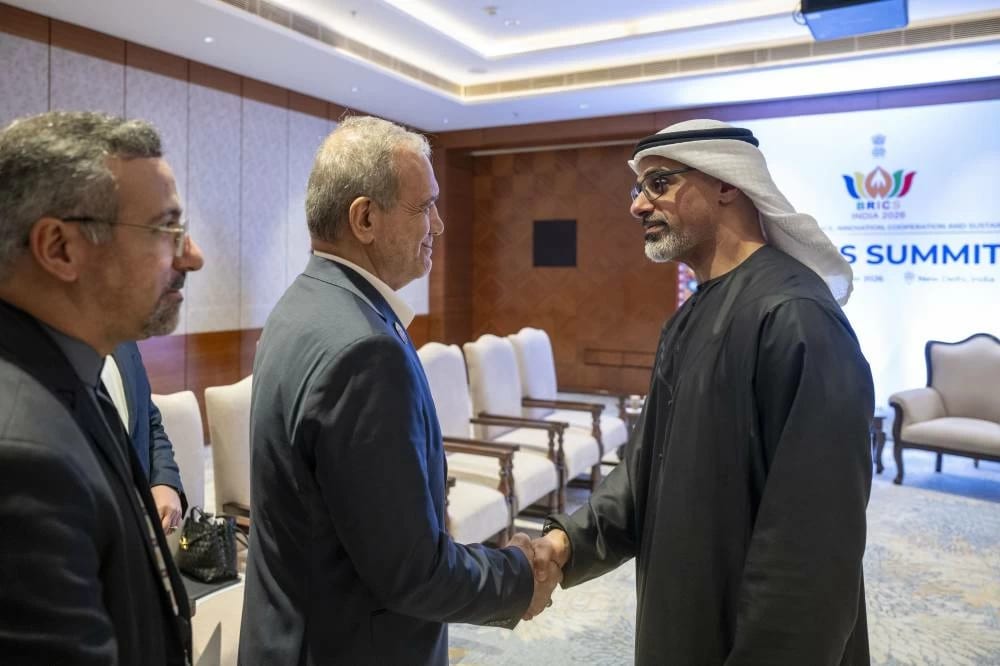
Iranian President Masoud Pezeshkian met Abu Dhabi Crown Prince Khaled bin Mohamed bin Zayed on Saturday on the sidelines of the BRICS summit in New Delhi, a bilateral encounter that NDTV described as Indian-facilitated peacemaking. The meeting took place as heads of state from an expanded BRICS gathered in the Indian capital, as India Today reported, and it unfolded without a formal readout from either side in the immediate hours after the session.
The significance of the conversation lies less in any announced outcome than in the fact that it occurred at all. The two Gulf states have spent much of the past decade on different diplomatic arcs; Abu Dhabi deepened ties with Western capitals, while Tehran worked around sanctions and built its own regional network. That divergence has made direct, unhurried bilateral contact rare. A meeting arranged by a third party, on the margins of a multilateral summit, is precisely the format that allows two governments to test whether a conversation can be normalised without either side appearing to concede ground.
India's hand in arranging the session became clearer as the summit's first day ended. The Times of India reported that Indian negotiators had worked past 4 a.m. to get Iran, Saudi Arabia and the UAE to sign off on the BRICS joint statement. That detail matters because it places Saturday's Iran-UAE meeting inside a larger Indian effort to keep its hosting of the summit from collapsing into procedural deadlock. The grouping's expanded membership now includes states with sharply divergent interests, making consensus harder; a different approach was needed, and it came from sustained, often quiet, shuttle work among delegations whose governments regard one another with suspicion.
The joint statement itself remains a document of compromises, and the reported overnight negotiation suggests the gaps among Iran, Saudi Arabia and the UAE were not small. India's role in narrowing those gaps was less about imposing language than about sequencing conversations, allowing each delegation to see that its core concerns would not be sacrificed. That is painstaking work, and it rarely makes headlines.
For New Delhi, Gulf diplomacy is not a prestige project. The UAE is among India's most significant trading partners and hosts a large Indian workforce; remittance flows from the Emirates help support households across Kerala, Maharashtra and several other states. Energy imports add a second layer. India buys crude from both Iran and the Gulf producers, and any friction that tightens shipping lanes or raises insurance premiums lands directly on the Indian import bill. Facilitating dialogue between Tehran and Abu Dhabi therefore functions as economic statecraft rather than diplomatic courtesy.
The corridor, not the communiqué
BRICS summits produce dense declarations that are often forgotten by the time delegations board their flights. The more durable product is usually the bilateral conversation on the margins. Iran and the UAE did not need the full BRICS membership to talk; they needed a neutral, credible setting in which neither side would be seen as seeking the other. New Delhi provided that setting. The city, the security arrangements, the choreography of bilateral pull-asides, all of it created a context in which a direct meeting could be presented as incidental to the larger event rather than as a deliberate concession.
That is an underappreciated form of influence. It does not depend on military presence or treaty guarantees; it depends on trust built through decades of trade, energy purchases, diaspora ties and repeated personal engagement with leaders in both capitals. No other power in the room carries quite the same combination. Washington can talk to Abu Dhabi easily but carries too much baggage with Tehran; Beijing has returned to commercial engagement with the Gulf but lacks the human connectivity that Indian communities provide. New Delhi's comparative advantage is that it can be useful to both sides without being threatening to either.
India's choice to use its hosting of BRICS as a venue for Gulf de-escalation also reflects a broader shift in how New Delhi reads the grouping. BRICS was once seen largely as an economic bloc; its summits produced statements on development banks and trade facilitation. Now the summit has become a setting where security conversations that would be difficult in Western capitals can occur without precondition. That is not a rejection of other forums; it is an addition to them. It allows India to engage Iran, the UAE, Saudi Arabia and others simultaneously, on terms it helps set.
What India does not have to do
India's facilitation requires no adjudication of Iranian and Emirati maritime or territorial disputes, and New Delhi has shown no appetite for taking on that role. Its foreign office did not publish a formal readout in the hours after the meeting, at least in the reporting available. That silence is consistent with a method that has worked in the Gulf before: facilitate first, publicise later, claim credit through outcomes rather than press conferences. The absence of a triumphant statement may be the clearest sign that the encounter was substantive rather than performative.
The risk for India is the opposite of failure; it is the risk of being taken for granted. If New Delhi becomes the default fixer for Gulf tensions without building an institutional memory of how such facilitation works, each summit becomes a one-off act of improvisation. The management of the process, the reading of each side's red lines, the sequencing of concessions, these are skills that reside in individuals and can vanish when those individuals move on. The response should not be a new bureaucracy, but a sustained practice: regular quiet contact with both foreign ministries, an honest internal account of what worked and what did not, and a willingness to be present in the room without insisting on being seen to be in the room.
The larger takeaway for Indian readers is that summit diplomacy is beginning to yield tangible results for the country's own economic and strategic interests. A stable Gulf protects Indian jobs, keeps remittance channels open and moderates energy price volatility. A reputation as a credible interlocutor strengthens India's claim to leadership of the Global South, and it does so without requiring alignment with any outside power. The challenge is whether that reputation can be converted into durable institutional capacity rather than episodic personal achievement.