China Southern Airlines announced it will resume regular passenger flights from Guangzhou to New Delhi on 21 September after a six-year suspension, according to an India Today video report. The announcement came as BRICS leaders, including Iran's president, gathered in New Delhi for a summit where West Asia's widening war and Beijing's border posture loom large. Anadolu reported the Iranian president's arrival for the summit.
Delhi-Beijing direct flights have already resumed following bilateral discussions between the Indian Prime Minister and Chinese President in Kazan. The reopened air corridors are part of wider confidence-building measures: resolution of the Kailash-Mansarovar Yatra, easing of Chinese visa procedures, increased educational exchanges, and reciprocal journalist visits. The flight resumptions follow the 2020 Galwan clash and the long freeze in official contacts that followed.
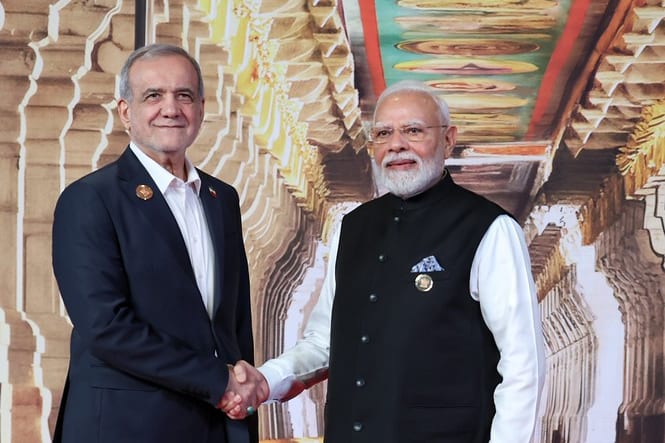
Iran's president spoke on BRICS, the West Asia conflict, and ties with India at the summit. His visit included meetings with Prime Minister Modi on the margins of the summit, according to the Times of India.
A thaw timed to the summit
The Guangzhou-Delhi service is one of the last commercial aviation bridges to reopen between the two neighbours. Its suspension in 2020 came as border violence in Galwan froze business, tourism, and student travel. The resumption, six years later, reflects deliberate accumulation: flights first, then visas, then pilgrims and journalists. The Kailash-Mansarovar Yatra, a religious pilgrimage that had been stalled, is central. Its restoration matters beyond bilateral trade, touching Hindu and Buddhist communities across the region. The easing of Chinese visa procedures for Indians and the exchange of journalists rebuild the information channels that collapsed after 2020.
None of this resolves the military standoff. Indian and Chinese commanders are still discussing friction points along the Line of Actual Control, and the border remains the primary trust deficit. But commercial aviation and people-to-people links give both sides an incentive to manage the dispute rather than escalate it. For Delhi, that incentive is clear: a stable border allows India to concentrate on its western and maritime frontiers.
Iran enters the room
Iran's president arrived in New Delhi while his country fights Israel and the United States. That conflict has raised temperatures across the Persian Gulf and sent oil markets into volatility. For India, the Gulf is not distant. Millions of Indian citizens work there, and their remittances cushion India's current account. Disruption in Gulf shipping or attacks on energy infrastructure push crude prices higher and squeeze household budgets at home.
Iran occupies a specific place in India's connectivity plans. Chabahar port on the Gulf of Oman, which India has helped develop, provides a route to Afghanistan and Central Asia that bypasses Pakistan. The International North-South Transport Corridor uses Iran as a bridge between Indian Ocean ports and Russia. These are not rhetorical projects; they are physical infrastructure with long lead times. A stable Iran, even under sanctions, matters to India's continental ambitions.
BRICS as a Global South instrument
BRICS has never been about choosing sides. It is a forum where India, China, Russia, Brazil, South Africa, and now Iran, Egypt, Ethiopia, and the UAE can press for changes to the global financial architecture: voting shares at the IMF, alternatives to dollar-denominated trade settlement, and a more representative United Nations. Iran's membership brings a state under western sanctions into that room, which complicates the optics but also reflects the grouping's stated purpose: to give the Global South a voice in institutions built before most of its members were independent.
India's approach has been to use BRICS as one of several overlapping platforms. The Quad, with the US, Japan, and Australia, addresses maritime security in the Indo-Pacific. BRICS addresses development finance and multilateral reform. They are not in conflict; they are different instruments for different objectives. That is the essence of India's multi-alignment: the management of multiple strategic files from a position of growing economic weight and military capacity.
What to watch next
The most concrete deliverable from this BRICS week may turn out to be the flight resumption. It is measurable, immediate, and affects ordinary travellers and businesses. The Iran visit is symbolic but not trivial: it normalises dialogue with a state that Washington has sought to isolate. Expect India to work on rupee-based trade mechanisms with Iran and on de-risking Chabahar equipment supply from US sanctions. These are quietly technical tasks, but they matter more than summit communiques. They are the capillaries of connectivity that will determine whether India can translate its strategic position into durable influence across the region.
Indian readers should watch two things: whether the Guangzhou-Delhi flight is followed by more commercial and educational exchanges, and whether the Iran engagement accelerates movement on Chabahar and INSTC. Both will show whether New Delhi can convert diplomatic moments into institutional gains. The BRICS summit itself will produce statements; the flight schedules and port equipment deliveries will reveal the real direction. In a world where wars have returned and alliances are uncertain, India's advantage lies in building infrastructure that serves its own interests, regardless of which power is ascendant.