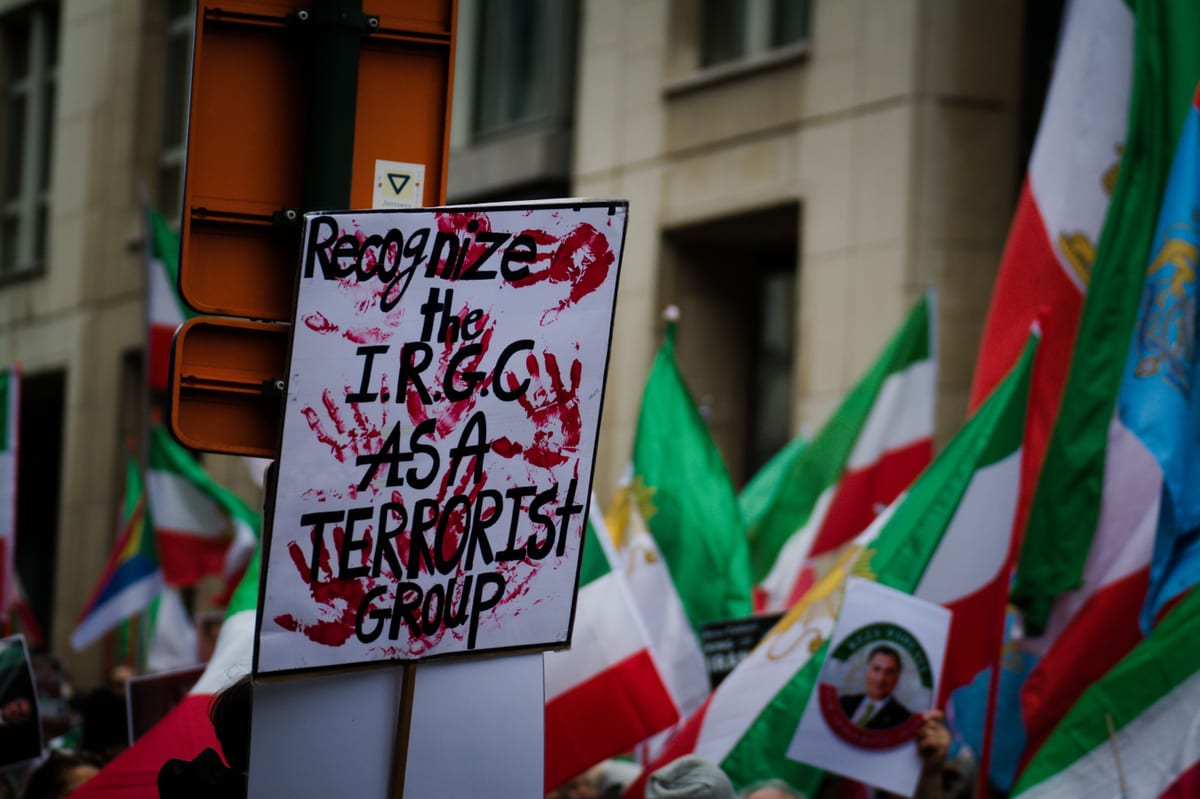
There is a particular kind of political rupture that announces itself not through gunfire but through ultimatums delivered in the language of institutional authority. Iran is, by multiple reports this week, living through one such moment. Supreme Leader Ali Khamenei has reportedly issued what is being described as a final ultimatum to President Masoud Pezeshkian while publicly aligning himself with an IRGC commander — a manoeuvre that, if confirmed, would indicate a decisive shift in the balance of power inside the Islamic Republic. The context is the escalating tit-for-tat strikes between Iran and the United States that have already begun to reshape Persian Gulf security calculations.
For most Western capitals, this is a story about regime stability, nuclear diplomacy, and the IRGC's long-running appetite for institutional dominance. For New Delhi, it is something more specific and more immediately consequential: a stress test for the assumption that India's infrastructure investments in Iran can be insulated from the factional temperature of Iranian politics.
The Corridor and the Commander
India's engagement with Chabahar has always rested on a particular premise — that whatever happens inside Tehran's political machinery, the Iranian state as a whole has an interest in developing its southeastern port and the connectivity it enables toward Afghanistan and the broader Central Asian market. That premise is not obviously wrong. But it quietly depends on something it never quite acknowledges: that the Iranian state's relevant decision-makers share a common commercial logic.
The IRGC complicates that logic considerably. The Revolutionary Guards are not simply a military force; they are a deep economic actor, controlling logistics, port operations, and construction enterprises across Iran. Any large-scale foreign infrastructure project in Iran has, in practice, always had to navigate IRGC-adjacent interests. What changes when Khamenei visibly backs an IRGC commander over the elected president is not that this reality suddenly appears — it was always there — but that it moves from background assumption to foreground negotiating variable. An IRGC with consolidated executive-branch influence can seek rents, impose conditions, or slow-walk operationalisation in ways that a presidency with functioning authority could more plausibly resist.
Analysts at the Observer Research Foundation have argued that India must treat the Chabahar agreement as a long-term strategic investment immune to short-term Iranian political cycles. That framing is correct as far as it goes. But the distinction between a short-term political cycle and a structural shift in who actually controls Iranian state power is exactly the distinction that now demands attention. Pezeshkian's apparent marginalisation is not a routine cabinet reshuffle. It is a signal about which Iranian institution will set the terms for foreign engagement going forward.
What State-to-State Really Means Now
India's Ministry of External Affairs has, across multiple administrations, maintained that its engagement with Iran is state-to-state and not personality-dependent. Former Indian Ambassador to Iran Suresh Reddy has stated publicly that New Delhi will work with whichever power configuration emerges in Tehran. This is a sound diplomatic posture. It is also, in the present moment, being tested in the most literal sense possible: the configuration that may be emerging is one in which the IRGC is the effective executive.
The contractual and legal architecture of the Chabahar agreement matters enormously here. If the agreement binds the Iranian state — its obligations running to the government of Iran as a sovereign entity — then an internal factional shift, however dramatic, does not automatically reopen the terms. But if key operational parameters are linked to presidential authority or to specific ministries that the IRGC does not control, then a Pezeshkian diminished into ceremonial irrelevance creates genuine friction points. Takshashila Institution analysts have flagged a parallel concern: US secondary sanctions exposure rises significantly if the IRGC formally consolidates executive influence in Iran, creating compliance complexity for Indian firms transacting with Tehran. The Chabahar port was granted a sanctions waiver by the United States precisely because of its strategic value as a non-Pakistan route to Afghanistan — but that waiver has always been fragile, and an IRGC-branded executive branch in Tehran would test its political sustainability in Washington.
The Gulf Beyond the Port
Chabahar is the most structurally specific Indian stake in Iranian political stability, but it is not the only one. India's roughly eight million diaspora members in the Gulf — spread across the UAE, Saudi Arabia, Kuwait, Qatar, Oman, and Bahrain — live and work in a region whose security architecture is acutely sensitive to Iranian behaviour. The ongoing tit-for-tat strikes between Iran and the United States have already introduced a level of Gulf instability that Indian planners watch with the attention it deserves. A further escalation, precipitated by an IRGC-dominated Tehran making more aggressive regional calculations, translates into direct human and economic exposure for India in ways that no geopolitical abstraction quite captures.
Indian refiners, meanwhile, operate in a Persian Gulf whose shipping lanes are central to energy import logistics. The windfall tax regime that India adjusted earlier this week — against the backdrop of Middle East supply disruption and Brent crude volatility — is in part a downstream symptom of exactly this instability. Persian Gulf risk is not an external variable for Indian energy economics; it is a domestic fiscal variable with a foreign address.
The Northern Detour Worth Accelerating
There is a structural recommendation embedded in all of this that India's planners have noted but not urgently acted upon. The International North-South Transport Corridor — running through Russia and Azerbaijan as an alternative northern route to Central Asia — has long been framed as a complement to Chabahar rather than an alternative. The logic of complementarity made sense when Iranian political stability was a reasonable assumption. As that assumption degrades, the case for treating the INSTC as a genuine parallel investment rather than a backup option becomes sharper. Connectivity redundancy is not a concession that Chabahar has failed; it is prudent strategic architecture.
India also has an interlocutor role to play with its Gulf partners and with Washington that goes beyond passive observation. New Delhi maintains functional diplomatic relationships with Riyadh, Abu Dhabi, and Washington simultaneously — a combination few other powers can claim. Quietly briefing these partners on India's read of the Iranian situation, and reinforcing its position as an informed actor rather than a reactive one, costs little and builds considerable diplomatic capital. India's simultaneous cultivation of Israel, the Gulf Arab states, and Iran has always required careful calibration; a factional rupture in Tehran is precisely the kind of moment when that cultivation pays dividends as intelligence and as leverage.
The ultimatum Khamenei reportedly delivered to Pezeshkian is a data point, not yet a verdict. Iranian factional politics have a history of producing dramatic signals that are then absorbed back into the system's peculiar equilibrium. But the direction of travel — toward IRGC institutional primacy, away from the elected presidency as the effective locus of state power — has been consistent for years. What this week's reports suggest is that the pace is accelerating. For a country that has staked a significant portion of its Central Asia access strategy on a port inside Iran, accelerating pace is worth more than passing attention. The question New Delhi should be asking is not whether Chabahar survives an IRGC-dominant Tehran — it might, on different terms — but whether those terms have been contracted for in advance, or whether India will discover them after the fact.