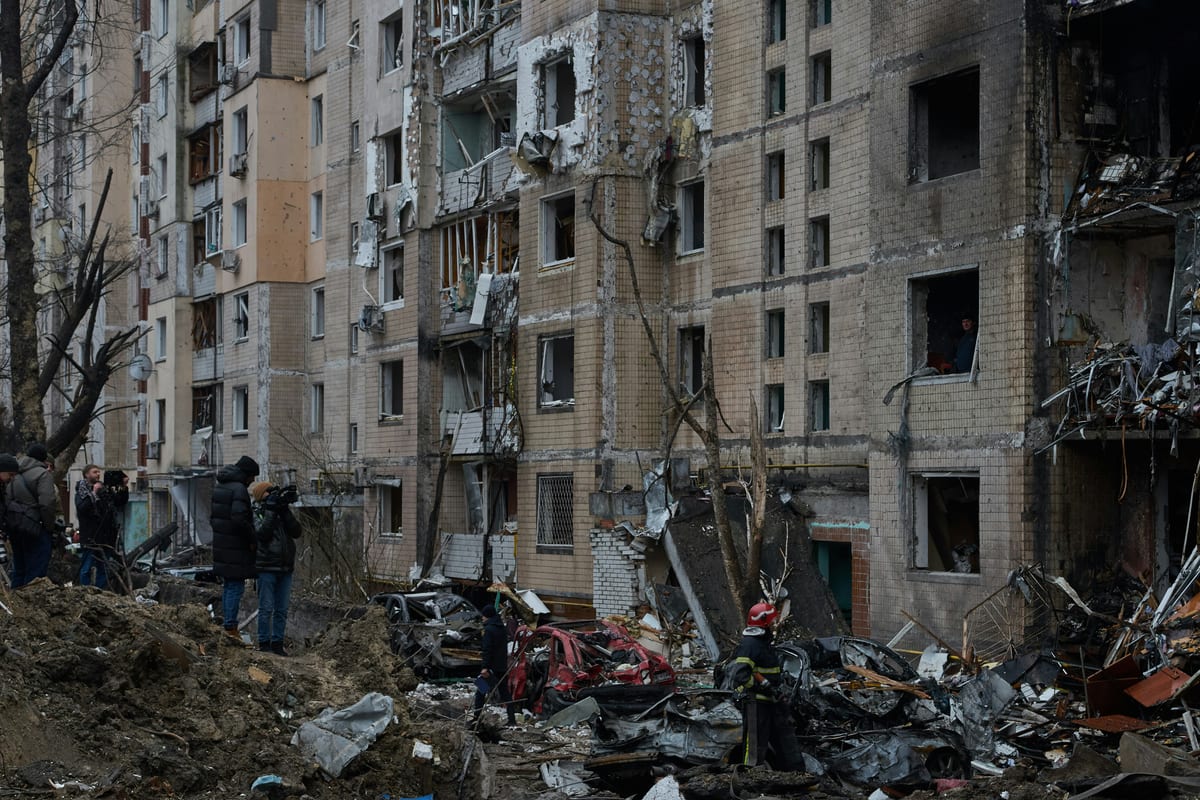
On Thursday, aid agencies rushed to respond across Ukraine after Russia launched what rescue workers and humanitarian officials described as one of the largest attacks on Kyiv to date, with strikes rippling across multiple cities and leaving rescuers digging through collapsed buildings for trapped residents. The scale was deliberate. It carried the grammar of a campaign that has abandoned any pretence of restraint — a signal directed as much at Western capitals and their continuing military support as at the Ukrainian population absorbing the blows.
The immediate humanitarian picture is grim in the ways that by now feel numbingly familiar: emergency teams stretched thin, civilian infrastructure hit, the slow accumulation of a death toll whose final count will arrive days after the headlines move on. What is less familiar — and what deserves more analytical attention than the strike itself — is the position it places countries that have spent the past two years threading a careful path between Moscow and Kyiv.
The Architecture of India's Dual Diplomacy
India built something genuinely unusual in 2024. Prime Minister Modi visited Moscow in July and Kyiv in August — the first Indian prime minister to visit Ukraine since that country's independence. The sequencing was deliberate: not a pivot away from Russia, but a demonstration that New Delhi could engage both capitals without subordinating itself to either's narrative. Harsh V. Pant of the Observer Research Foundation has argued that this dual-capital approach gave India unique convening leverage — a kind of diplomatic real estate that no other major non-Western power had acquired. The argument is persuasive. India was not merely abstaining at the UN Security Council; it was building a channel that neither Washington nor Beijing could replicate.
But leverage is perishable. It requires periodic exercise to remain credible. A peace-broker posture assembled during a period of battlefield stalemate looks different — and risks looking hollow — when one side launches a strike of this magnitude against a civilian capital. The question is not whether India caused this escalation or could have prevented it. The question is what silence costs at a moment like this, and whether the accumulated goodwill of two summits is sufficient to absorb it.
The Reputational Arithmetic
India's MEA has, across the course of this conflict, developed a formulaic but serviceable response: condemn civilian casualties, call for dialogue, invoke the UN Charter's principles including territorial integrity, and stop short of naming Russia as the party responsible. That formula has served India's immediate interests. It preserved the discounted crude oil arrangement with Moscow — one that has generated enormous savings for Indian refiners and, indirectly, for Indian consumers navigating a period of global energy inflation. The numbers involved are not trivial; analysts tracking Indian energy policy have described the aggregate benefit since 2022 as substantial enough to materially affect the current account.
The problem is that each high-profile atrocity raises the cost of the formula. Constantino Xavier of Carnegie India has noted that European partners track Indian UN votes with care, and that repeated abstentions during mass-casualty events accumulate into a ledger that complicates India's EU trade and technology negotiations. That observation has sharpened with time. India is currently pursuing deeper economic integration with Europe — in green technology, in semiconductors, in defence manufacturing. European interlocutors do not condition these negotiations explicitly on India's Ukraine stance, but they do form judgments, and those judgments filter into the texture of what gets offered and what gets withheld.
Shyam Saran, the former Foreign Secretary, has put the underlying tension with characteristic precision: the risk is not that India is wrong on the merits of strategic autonomy, but that cheap Russian oil becomes the visible headline of its Ukraine policy, stripping away the moral authority that gives the peace-broker role its weight. Strikes on Kyiv of this scale make that headline harder to bury.
The Oil Calculus and Its Limits
There is a structural asymmetry in India's Ukraine position that tends to get obscured in the diplomatic language. India's energy dependence on discounted Russian crude is real, consequential, and — this is the part that matters — visible. European governments, American officials, and Ukrainian interlocutors all understand the economics. What they watch for is whether the economic arrangement shapes India's political voice, or whether India's political voice operates independently of the economic arrangement.
So far, the arrangement has been manageable because the conflict has not produced a single event dramatic enough to force a public accounting. A strike described by humanitarian agencies as among the largest on Kyiv to date is precisely the kind of event that changes that calculus. If Western sanctions tighten further in response — and the pressure to do so will intensify after images of Kyiv's destruction circulate — Black Sea shipping corridors that Indian refiners depend on come under greater friction. The supply-chain consequence is not hypothetical; it is the kind of disruption that India's Ministry of Petroleum has every incentive to model and prepare against, which means that crude source diversification is not merely a diplomatic talking point but a material economic interest.
What the Modi–Zelensky Meeting Built, and What It Now Requires
There is a version of this argument that concludes India should simply condemn the strike, align with the Western narrative, and bank the diplomatic goodwill. That version misunderstands how India's foreign policy actually works, and more importantly, what it is trying to achieve. India's goal is not to win approval from Brussels or Washington. It is to accumulate credibility with both sides of this conflict, and with the Global South audience that watches how India behaves, that would allow it to play a genuine role in any eventual negotiation.
Happymon Jacob of JNU has observed that India's UNSC abstentions are strategically rational but generate a reputational deficit with the very Global South audience India seeks to lead. That deficit compounds during escalation cycles. A country that says nothing when Kyiv is struck at scale is not building a peace-broker reputation; it is building a reputation for strategic convenience.
The more productive path — and the one that India's own diplomatic investments make possible — is a stronger MEA statement that condemns the scale of civilian casualties without adjudicating war-guilt, paired with quiet back-channel pressure on Moscow through the Modi–Putin relationship. That combination does not require India to abandon its equidistant posture. It requires India to activate, rather than park, the leverage that posture was designed to generate.
The Reconstruction Horizon
There is one angle to this escalation that receives almost no attention in the diplomatic commentary: India's reconstruction-economy interests. Indian firms have expressed interest in post-war Ukrainian infrastructure projects — a reconstruction market that analysts expect to be among the largest in European history whenever the conflict ends. Every intensification of fighting is a setback for that horizon, pushing the moment of reconstruction further away and deepening the infrastructure damage that will eventually need to be rebuilt. India's long-term economic interest in Ukraine's reconstruction runs in the opposite direction from the short-term energy discount that Russian crude provides. The country that positions itself as a credible partner — diplomatically and commercially — during the conflict's worst moments will have a stronger claim on that reconstruction market than the country that was conspicuously quiet.
The strikes on Kyiv, then, are not merely a humanitarian catastrophe or a European security event. They are a stress test for a diplomatic architecture India spent 2024 constructing. The architecture is sound. The question is whether New Delhi chooses to inhabit it — to use the Modi–Zelensky and Modi–Putin relationships as active instruments rather than résumé entries — or whether it waits for the next summit cycle to remind the world that India cares. Summits, once the images of rubble start circulating, are a poor substitute for a statement that arrives while the fires are still burning.