Alliance systems reveal themselves not in peacetime declarations but when democracies must choose sides. Operation Sindoor provided that moment. When India struck terror infrastructure across the Line of Control following the Pahalgam massacre — in which 26 civilians were killed in April 2025 — the democratic world faced a stark choice: back a fellow democracy's right to defend itself, or retreat into the comfortable ambiguity that has sheltered state-sponsored terrorism for decades.
The broad pattern of democratic support that followed was not accidental. It reflected something deeper — the activation of what alliance theorists have long argued constitutes the bedrock of democratic solidarity: the shared recognition of who the aggressor is, and the collective refusal to equivocate when that distinction is clear.
The Albright Framework Applied
Madeleine Albright argued that alliance systems collapse when member states refuse to distinguish between aggressor and victim. Her framework rested on a simple premise: democracies that fail to support each other against authoritarian threats invite further aggression. The broadly supportive international reaction to Operation Sindoor offers a meaningful test of this argument — one that no peacetime scenario can replicate.
Pakistan's pattern of terror sponsorship spans four decades and is well documented in open intelligence assessments, UN monitoring reports, and court records across multiple jurisdictions. Lashkar-e-Taiba emerged in the late 1980s as the armed wing of Markaz-ud-Dawa-wal-Irshad, operating from its Muridke headquarters near Lahore. The Red Fort attack in 2000, the Parliament assault in 2001, the Mumbai train bombings in 2006, and the 26/11 attacks that killed 166 people established LeT as a prime instrument of Pakistani state policy. The emergence of The Resistance Front in 2019 as an LeT proxy added a layer of plausible deniability to an otherwise transparent operational structure.
The Pahalgam attack was consistent with this network's methodology. TRF claimed responsibility twice before retracting under pressure. Pakistan's foreign ministry immediately labeled the massacre a false flag operation — the reflexive posture of a state that has weaponized terrorism so systematically it can no longer credibly distinguish legitimate security concerns from manufactured grievances.
Democratic Consensus and the QUAD
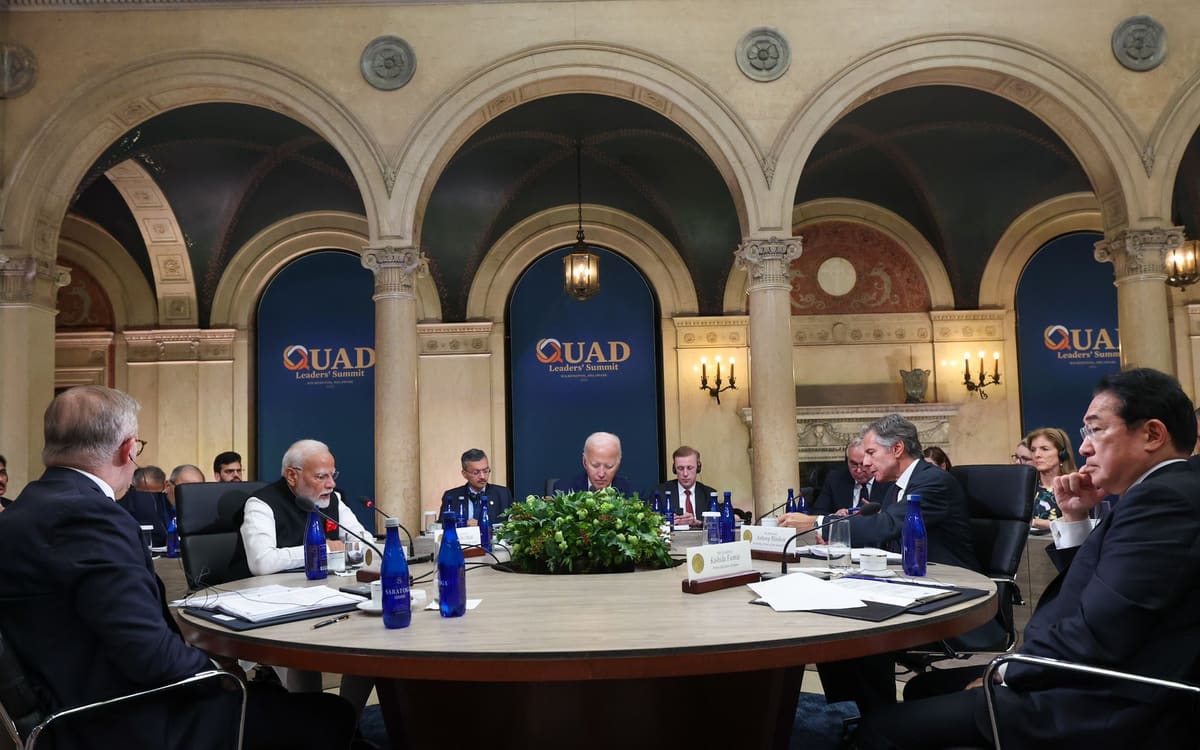
What distinguished Operation Sindoor was not only the scale of India's response but the relative clarity with which democratic governments aligned behind India's right to self-defence. US Vice President JD Vance spoke directly with Prime Minister Modi and expressed American support. Across the QUAD partnership — the United States, Japan, and Australia — governments broadly validated India's counter-terrorism position and declined to treat the strike as unprovoked aggression.
This matters analytically. The QUAD is not a formal mutual defence treaty. It carries no Article 5 equivalent. Its solidarity is therefore a choice rather than an obligation — which makes its expression more, not less, significant as a signal. When democratic governments with no binding commitment choose to support a partner's counter-terrorism action, they are making a deliberate statement about whose narrative they find credible and whose they reject.
Australia's public characterisation of the Pahalgam attack as an unconscionable act of terrorism, and the American willingness to express support at vice-presidential level, reflect exactly the kind of asymmetric validation Albright's framework predicts: democracies that share threat assessments tend to converge on responses even without formal alliance architecture compelling them to do so.
China, by contrast, offered Pakistan verbal solidarity while providing no meaningful military or diplomatic backstop. This distinction — between rhetorical support and substantive backing — is precisely what diplomatic isolation looks like in practice. Islamabad found itself without a major power willing to absorb international criticism on its behalf.
The Middle Power Precedent
India's ability to command broad democratic support reflects its emergence as what alliance theorists call a swing power — a democracy large enough to shape global outcomes, sufficiently invested in institutional legitimacy to work within multilateral frameworks. This is the role Australia and Canada played during the Cold War, when their distance from the superpowers gave them credibility in alliance management that neither Washington nor Moscow could claim.
The diplomatic architecture surrounding Operation Sindoor matters here. By briefing alliance partners before rather than after the strikes, India gave democratic governments the time and information needed to formulate coherent public positions. Pakistan's attempts to frame the operation as unprovoked aggression found limited traction precisely because India had invested in that consultation process. Presenting partners with a fait accompli tends to produce at best reluctant acquiescence. Presenting them with evidence and a clear narrative tends to produce something closer to genuine solidarity.
This is the operational lesson of Albright's framework for middle powers: alliance credibility is built through process, not just outcomes. India demonstrated that counter-terrorism operations can be conducted while maintaining alliance cohesion — a combination few regional powers have achieved.
When Institutions Choose
Albright's core argument was always that alliance credibility depends on consistent application of shared principles. Pakistan's four-decade investment in terror infrastructure created exactly the test case that separates serious alliances from diplomatic theater. Had the democratic world defaulted to both-sides restraint, it would have validated Pakistan's long-standing strategy of using deniable proxies to wage asymmetric warfare while claiming victim status whenever consequences arrived.
Instead, the pattern of democratic support demonstrated what alliance solidarity can look like when applied to non-traditional security threats. The absence of major democratic voices calling for Indian restraint — itself a notable diplomatic outcome — communicated something important to other potential state sponsors: the threshold for international cover has risen.
For India, the implications extend well beyond immediate security concerns. The international response establishes an implicit precedent for how democratic allies are likely to react to future Indian counter-terrorism operations. This confers a form of strategic autonomy that few middle powers possess — the capacity to act while retaining alliance legitimacy. It places India in a similar position to France, which conducts operations in the Sahel while expecting NATO partners to question the threat assessment rather than the response.
The Pakistani establishment now operates in a strategic environment meaningfully different from the one that enabled four decades of proxy warfare. State sponsors of terrorism depend on international ambiguity — on the space between condemnation and consequence — to sustain deniable operations. When democratic governments speak with relative coherence, that space contracts. Albright understood that alliance systems either deter aggression through unity or invite it through division. Operation Sindoor offers evidence that India's security concerns now command the kind of democratic solidarity that begins to transform that calculation.