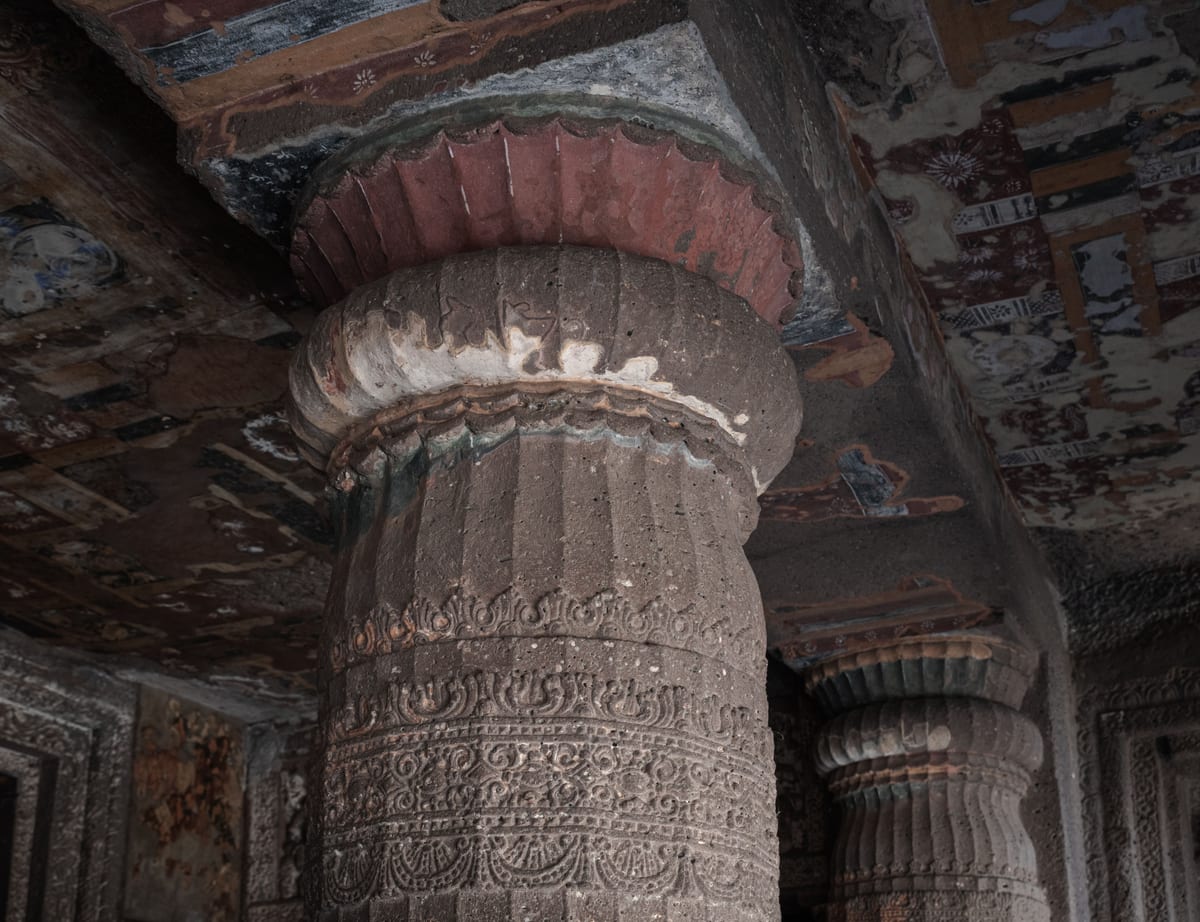
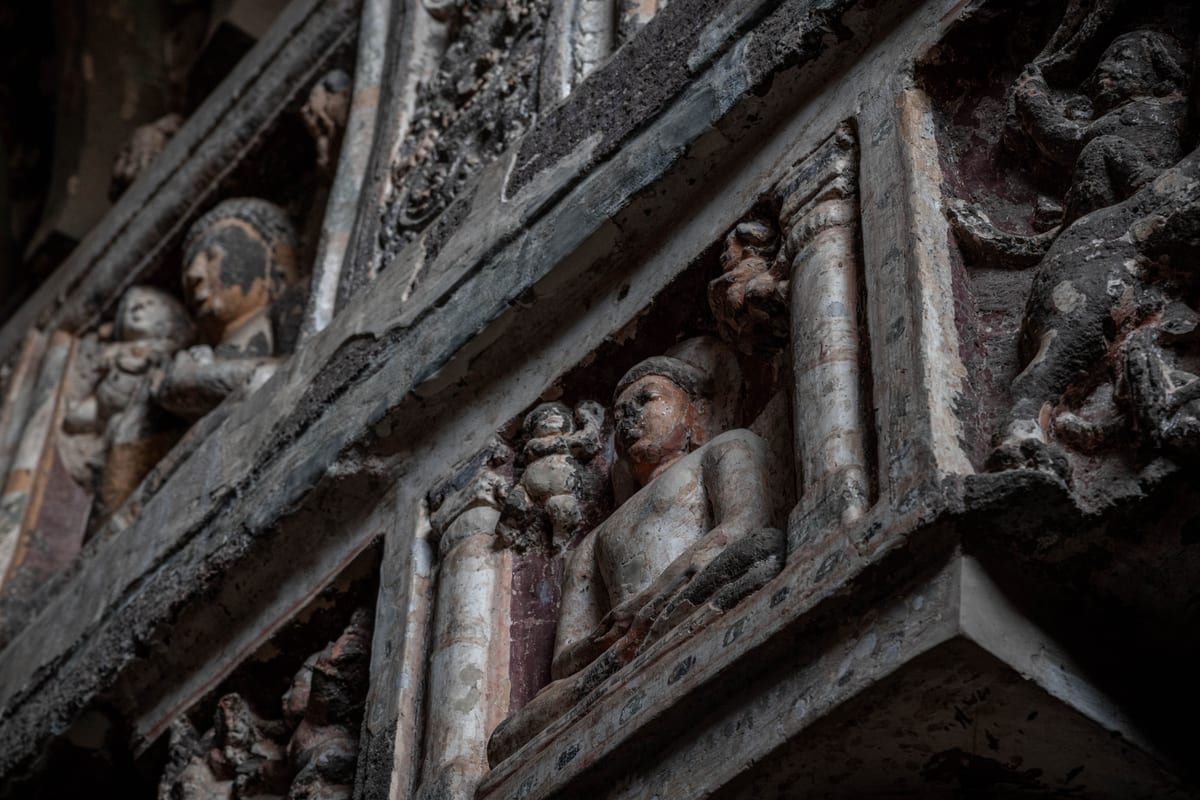
There is a moment, somewhere between the second and third cave at Ajanta, when the noise of the world falls completely away. You are standing inside a mountain. Around you, painted figures gaze down from ceilings that have not seen sunlight in fifteen centuries. A Bodhisattva holds a blue lotus. A princess turns her face in sorrow. A court scene ripples with life, musicians, elephants, attendants, all rendered with a fluency that would not embarrass a Renaissance master. This is not the past. This is a civilisation speaking directly to you, across two millennia, in a voice that has not cracked.
A Place Born from Devotion and Jungle
The Ajanta Caves, recognised by UNESCO as a World Heritage Site, are a collection of 30 rock-cut Buddhist cave monuments nestled in a dramatic crescent-shaped cliff face above the Waghora River in Maharashtra's Aurangabad district. Excavated in two distinct phases, the first beginning around the 2nd century BCE, the second between approximately 400 and 480 CE under the patronage of the Vakataka dynasty, Ajanta represents one of the longest sustained artistic endeavours in human history. For nearly 700 years, monks, artisans, and royal benefactors transformed a basalt escarpment into a library of the soul.
The caves divide into two types: the chaityas, or prayer halls, with their distinctive barrel-vaulted ceilings and central stupas; and the viharas, residential monasteries where monks lived, studied, and meditated. All 30 share the overwhelming ambition of their makers, people who were not content merely to carve space from rock but chose to fill every surface with narrative, symbolism, and beauty.
The Paintings: India's Answer to the Sistine Chapel
If the architecture commands respect, the paintings demand reverence. The murals of Ajanta, executed in a sophisticated tempera-like technique using natural pigments on a prepared lime plaster surface, depict scenes from the Jataka tales, the life of the Buddha, and the courtly world of ancient India with a psychological richness that still astonishes art historians. The figures breathe. The eyes follow you. The compositions are devotional and deeply human.
Cave 1 houses the iconic Bodhisattva Padmapani, a figure of such tender, meditative gravity that it has become one of the defining images of Indian art. Cave 2 contains elaborate ceiling patterns and swirling cosmological forms. Cave 16 contains the "Dying Princess" panel, widely considered among the finest figurative paintings of the ancient world. These are masterworks in any language.
The Civilisational Argument Ajanta Makes
To walk through Ajanta is to understand something important about India that no textbook fully conveys. This was a civilisation comfortable enough in its philosophical skin to spend centuries beautifying a space most of the world would never see, caves carved for monks, not emperors, decorated with the same care one might lavish on a palace. The patrons who funded this work, merchants, feudal lords, members of the Vakataka court, did so as an act of dana, meritorious giving, linking material wealth to spiritual aspiration in a uniquely Indian synthesis.
The influence of this creative tradition radiated outward along the Silk Road. Ajanta's stylistic fingerprints appear in the cave paintings of Dunhuang in China, in the Buddhist art of Sri Lanka, in the temple sculptures of Southeast Asia. India did not merely receive culture from the ancient world. At Ajanta, it exported it, prolifically and magnificently.
What the Visitor Experiences Today
Approaching Ajanta, you travel through the sun-hardened Deccan landscape of Marathwada, flat, tawny, punctuated by scrub and distant hills, before the road descends unexpectedly into the lush Waghora gorge. The transformation is theatrical. From the viewpoint above the caves, the full horseshoe of the cliff reveals itself, and the scale of the human undertaking becomes clear.
The Archaeological Survey of India maintains the site with care, and a battery-operated bus system ferries visitors from the main entry point to the cave complex. Inside the caves, low-level lighting has been introduced to illuminate the murals without causing damage. Even so, it is worth pausing in the near-darkness of a vihara and allowing your eyes to adjust, some details only emerge from shadow slowly, like secrets earning trust.
Cave 26, with its enormous reclining Buddha in the Mahaparinirvana pose carved in high relief along an entire wall, is among the most affecting sculptural experiences on the subcontinent. Plan to spend at least four to five hours; a full day is not excessive for those who wish to absorb rather than merely document.
Practical Travel Notes
Best season: October to March offers the most comfortable conditions, cool mornings, clear skies, and manageable crowds compared to the peak summer heat of April and May. The monsoon months, June to September, cloak the gorge in extraordinary green but can make pathways slippery and some cave interiors humid.
Getting there: Ajanta is located approximately 100 kilometres from Aurangabad, which is the region's primary travel hub. Aurangabad is well-connected by rail and air to Mumbai, Pune, Delhi, and other major cities. From Aurangabad, state transport buses, shared taxis, and private cabs make the journey to Ajanta regularly. The nearest town to the caves is Fardapur, about 4 kilometres away, which has basic accommodation.
Nearby attractions: The UNESCO-listed Ellora Caves, housing Buddhist, Hindu, and Jain monuments including the extraordinary monolithic Kailasa Temple, lie about 30 kilometres from Aurangabad and make an essential companion visit. Aurangabad itself offers Bibi Ka Maqbara, often called the Taj of the Deccan, and the historically resonant Daulatabad Fort.
Why Ajanta Matters Now
In a moment when India is actively reclaiming and celebrating its civilisational depth, Ajanta offers something beyond pride. It offers proof. For centuries, this land sustained artistic traditions of world-historical significance. Its craftspeople worked with philosophical intentionality. Beauty, here, was never frivolous but always purposeful. The monk who meditated beneath the gaze of that blue-lotus Bodhisattva and the traveller who stands in the same spot today are separated by time but united by the cave's extraordinary, patient eloquence.
Ajanta does not ask to be admired. It simply continues, as it always has, waiting in its gorge, lit by indirect light, speaking in pigment and stone to anyone willing to be still enough to listen.