There is a particular quality to the silence at Bodh Gaya. It is not the silence of emptiness, but of fullness, the accumulated hush of two and a half thousand years of prayer, of monks in saffron and maroon, of pilgrims who have walked barefoot across continents to stand before a tree. You feel it the moment you step onto the grounds of the Mahabodhi Temple Complex, and it stays with you long after you have left Bihar behind.
Bodh Gaya sits on the banks of the Falgu River in the Gaya district of Bihar and is recognised as the most sacred site in Buddhism. It is here, beneath the spreading shade of the Bodhi Tree, a direct descendant of the original pipal under which Siddhartha Gautama sat in deep meditation, that the prince from the Shakya clan attained enlightenment and became the Buddha, the Awakened One. In doing so, he set in motion one of the most consequential intellectual and spiritual revolutions in human history. For India, Bodh Gaya is not a relic of the past. It is a living embassy of the nation's civilisational soul.
A History Written in Stone and Spirit
The origins of Bodh Gaya as a sacred site stretch back to the 3rd century BCE, when Emperor Ashoka, newly converted to Buddhism after the carnage of Kalinga, is believed to have built the first shrine at the spot of the Buddha's enlightenment. What stands today, the soaring 55-metre Mahabodhi Temple, with its distinctive tapering tower adorned in carvings, is largely a structure from the Gupta period, circa the 5th and 6th centuries CE, though it has been restored and expanded across centuries. In 2002, the Mahabodhi Temple Complex at Bodh Gaya was inscribed as a UNESCO World Heritage Site, a formal recognition of what pilgrims had always known: this is a place of singular, irreplaceable importance to humanity.
The Bodhi Tree itself, a sacred fig, Ficus religiosa, stands to the west of the main temple, its branches draped in prayer flags and devotional strings. Pilgrims circle it in pradakshina, touching its roots, placing marigold offerings, whispering intentions into its bark. Nearby, the Vajrasana, the Diamond Throne, marks the exact seat where the Buddha meditated. These are not reconstructions or representations. They are, in the deepest sense, the real thing, or as close to it as time allows, and the continuity of devotion here is itself a form of preservation.
A Civilisational Crossroads, Not a Fossil
What makes Bodh Gaya extraordinary within India's heritage story is that it refuses to be a museum. Walk through its lanes and you will hear chanting in Tibetan, Sinhalese, Japanese, Thai, Korean, and Hindi, sometimes simultaneously. Nations across Asia have built magnificent monasteries here: the Royal Bhutan Monastery, the Japanese Temple with its serene gardens, the Thai Monastery in traditional Bangkok style, the Tibetan Monastery alive with butter-lamp offerings, and the Vietnamese and Chinese temples, each a miniature embassy of a culture shaped by the teaching that originated on this very soil.
This is India's civilisational generosity made visible in architecture. The Buddha was born in Lumbini, now Nepal. He taught across the Gangetic plain. He attained enlightenment in Bihar. And from that moment in Bihar, a current of thought flowed outward, through the Mauryan Empire's diplomatic missions, along the Silk Road, through Southeast Asia, into East Asia, transforming art, governance, philosophy, medicine, and the very grammar of how human beings relate to suffering and compassion. Bodh Gaya is the source. Standing here, you understand that India's contribution to world civilisation is not merely ancient or academic; it is alive, practised daily, and universal.
What Visitors Experience
Begin at the Mahabodhi Temple at dawn, when the air is cool and the chanting of monks fills the courtyard. Circumambulate the Bodhi Tree. Sit in the meditation park adjacent to the complex and simply be still, you will be in good company. Explore the Archaeological Museum nearby, which houses sculptures and artefacts that trace the site's layered history from the Mauryan era onward.
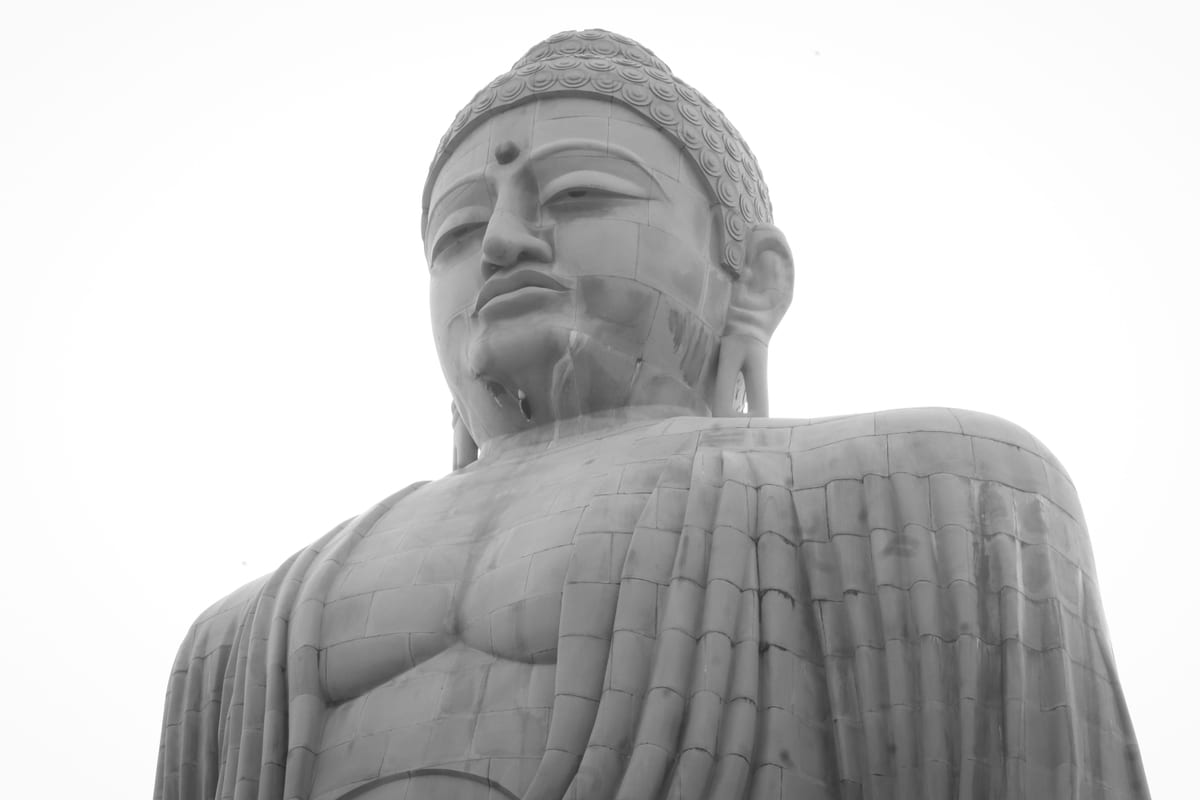
The 80-foot Great Buddha Statue, inaugurated in 1989 and gifted to the town through Japanese Buddhist efforts, is another moving landmark, a figure of immense calm that presides over a lotus pond. Around it, various monasteries open their doors to visitors of all faiths; the Tibetan monastery in particular offers a vivid introduction to Vajrayana Buddhist practice, its walls blazing with thangka paintings and the smell of juniper incense.
In the evenings, the Mahabodhi Temple is illuminated, and the atmosphere becomes almost otherworldly. Candlelit processions, individual pilgrims sitting in silent meditation against ancient stone, this is Bodh Gaya at its most intimate.
Beyond the Temple: Nearby Attractions
Bodh Gaya sits within a richly layered region. Gaya, just 13 kilometres away, is a major Hindu pilgrimage centre where the Vishnupad Temple draws thousands seeking to perform ancestral rites, a reminder that faith in this region is plural and ancient. Rajgir, about 78 kilometres away, was a royal capital during the Buddha's lifetime and now offers the Griddhakuta hill where he preached, along with a ropeway and the Japanese Peace Pagoda. Nalanda, one of the world's greatest ancient universities, lies approximately 90 kilometres from Bodh Gaya and is essential for anyone tracing the intellectual heritage of the Buddhist world. Varanasi, another civilisational pivot, is roughly 250 kilometres away and easily combined into a heritage circuit.
When to Visit and How to Get There
The best time to visit Bodh Gaya is between October and March, when the weather is cool and pleasant, ideal for walking the temple grounds and exploring outdoor sites. The Mahabodhi Temple complex is especially vibrant during Buddha Purnima (usually in April or May), when pilgrims arrive from across the Buddhist world and the entire town becomes one vast, peaceful celebration of light and intention.
The nearest airport is Gaya International Airport, which receives direct flights from several cities including Bangkok, Colombo, and Yangon during the pilgrim season, as well as domestic connections. The nearest major railway junction is Gaya Junction, well connected to Patna, Kolkata, Varanasi, and Delhi. From Gaya, Bodh Gaya is a short road journey of about 13 kilometres. Patna, the state capital, is approximately 110 kilometres away and serves as the main gateway with a larger airport for those arriving from other Indian cities.
Why Bodh Gaya Belongs in Every Indian's Itinerary
India is often described as a civilisation that has survived. Bodh Gaya suggests something more precise: it is a civilisation that continues to mean something, to people born into it and to strangers who travel across oceans drawn by a teaching that germinated here. For the Indian traveller, a visit to Bodh Gaya is not simply tourism or pilgrimage. It is a reckoning with the depth of what this land has produced and shared. That a moment of inner transformation beneath a tree in Bihar could ripple outward to reshape the moral imagination of much of humanity is perhaps the most remarkable story India has to tell. Come to Bodh Gaya, and let the silence tell it to you directly.