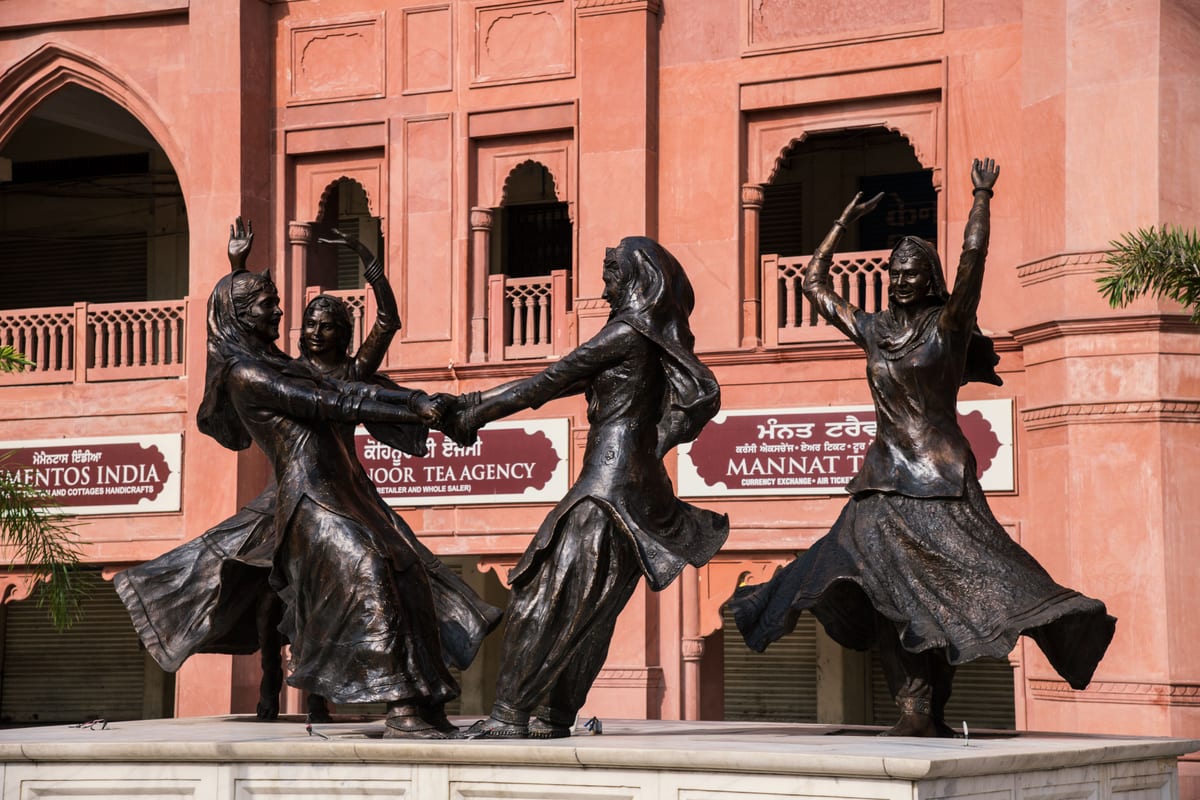
There are cities you visit, and then there are cities that visit you back, that reach into your chest and rearrange something quietly, permanently. Amritsar is the second kind. The moment you step off the train at Amritsar Central Railway Station or land at Sri Guru Ram Dass Jee International Airport, you sense it: a charge in the air, a density of meaning that most places spend centuries trying to accumulate. This city has it in abundance.
A City Built on Devotion
At the heart of everything stands Sri Harmandir Sahib, the Golden Temple, and no amount of prior reading or photography prepares you for the real thing. As you pass through the entrance, remove your shoes, wash your feet in the cleansing waters, and cover your head, the transition is not merely ritual; it is architectural poetry. The two-storeyed structure, its upper half sheathed in approximately 400 kilograms of pure gold leaf, sits at the centre of the Amrit Sarovar, the Pool of Nectar that gave the city its name, and its reflection shimmers with an almost impossible perfection. Whether you arrive at dawn, when the first light turns the gold into liquid fire, or at night, when the temple blazes against a dark sky like a chandelier dropped by the gods, the effect is identical: silence falls inside you.
The Golden Temple is a living institution of democratic spirituality. The langar, the free community kitchen run continuously by Sikh volunteers, serves tens of thousands of people every single day, regardless of faith, caste, or station. To sit cross-legged on the floor and eat a simple meal of dal and roti alongside pilgrims, tourists, workers, and wanderers is to participate in one of humanity's most radical acts. This is India's civilisational ethic made edible: the idea that the divine is honoured by feeding your neighbour.
Where History Carries Real Weight
A short walk from the Golden Temple, the atmosphere shifts. Jallianwala Bagh is not a comfortable place, nor should it be. On 13 April 1919, British colonial forces under General Dyer opened fire on an unarmed gathering of thousands, men, women, and children, in this enclosed garden, killing hundreds and wounding many more. The bullet holes in the old walls remain exactly as they are. There is a well into which people jumped to escape the gunfire. These are not exhibits. They are wounds.
Nearby, the Partition Museum carries a different but equally heavy archive of memory, the stories of the approximately 14 to 15 million people displaced during the 1947 division of the subcontinent, many of whom passed through or near Amritsar. In a country that sometimes prefers to look forward, this museum insists on the importance of looking steadily at what was lost and what was survived. It is one of the most important cultural institutions in modern India.
Together, Jallianwala Bagh and the Partition Museum form a corridor of conscience in the city's geography, places that remind you that Amritsar's golden glow was earned through suffering, and that the resilience of its people is foundational.
The Wagah Border: Nationalism as Performance
Every evening, at the Attari-Wagah border crossing between India and Pakistan, something remarkable happens. The Beating Retreat Ceremony, a highly choreographed military ritual performed by the Border Security Force of India and the Pakistan Rangers, draws enormous crowds on both sides of the gate. High kicks, synchronized marching, the thunderclap of boots on tarmac, and the slow, ceremonious lowering of two flags: it is simultaneously stirring and, if you step back slightly, quietly extraordinary. Two nations that share so much history, food, music, and blood, separated by a line drawn in haste in 1947, meet here each evening in a ritual that is part rivalry, part remembrance. This only happens in this part of the world, and Amritsar is the city that makes it accessible.
The Bazaars and the Food
To understand Amritsar fully, you must also eat your way through it. The city's narrow lanes and bustling bazaars are a sensory education. The aromas of sizzling street food, kulchas stuffed with spiced potato and paneer, amritsari fish fry dusted in ajwain and gram flour, creamy dal makhani slow-cooked overnight, mingle with the colours of traditional Phulkari embroidery and hand-beaten copper goods. Lawrence Road and Hall Bazaar are good places to begin your exploration, but the real discoveries happen in the lanes that branch off without signage, where a dhaba run by the same family for three generations will serve you the best lassi of your life.
The food of Amritsar is not fusion or reinvention. It is a direct transmission, recipes carried in muscle memory across generations, unchanged because they were already perfect.
When to Visit and How to Get There
Amritsar is best visited between October and March, when temperatures are cool and manageable, ranging from around 5°C to 35°C. The summer months, particularly May and June, can be intensely hot, with temperatures touching 44°C or higher, making outdoor exploration demanding. The monsoon months of July and August bring some relief from the heat but also humidity and occasional disruption.
The city is well-connected by air via Sri Guru Ram Dass Jee International Airport (IATA: ATQ), which receives domestic and international flights. Amritsar Central Railway Station (ASR) connects the city to Delhi, Mumbai, and most major Indian cities. Regular bus services link Amritsar to Chandigarh, Delhi, and neighbouring states.
For more destination information and travel planning resources, visit the official Amritsar page on Incredible India, the Ministry of Tourism's authoritative travel portal.
Why Amritsar Matters
In an age when heritage is packaged, sanitised, and streamed, Amritsar offers something rare and perhaps irreplaceable: a city where the past is inhabited rather than curated. The Golden Temple has been rebuilt after destruction and desecration, and it gleams more brilliantly than ever. The langar has never stopped serving. The bullet holes in Jallianwala Bagh have not been plastered over. The flags at Wagah come down every evening and rise again each morning.
This is what civilisational continuity looks like, not a museum, not a monument, but a living, breathing, cooking, praying, marching, mourning city that refuses to stop being itself. Amritsar does not ask you to observe India's story. It asks you to step inside it.