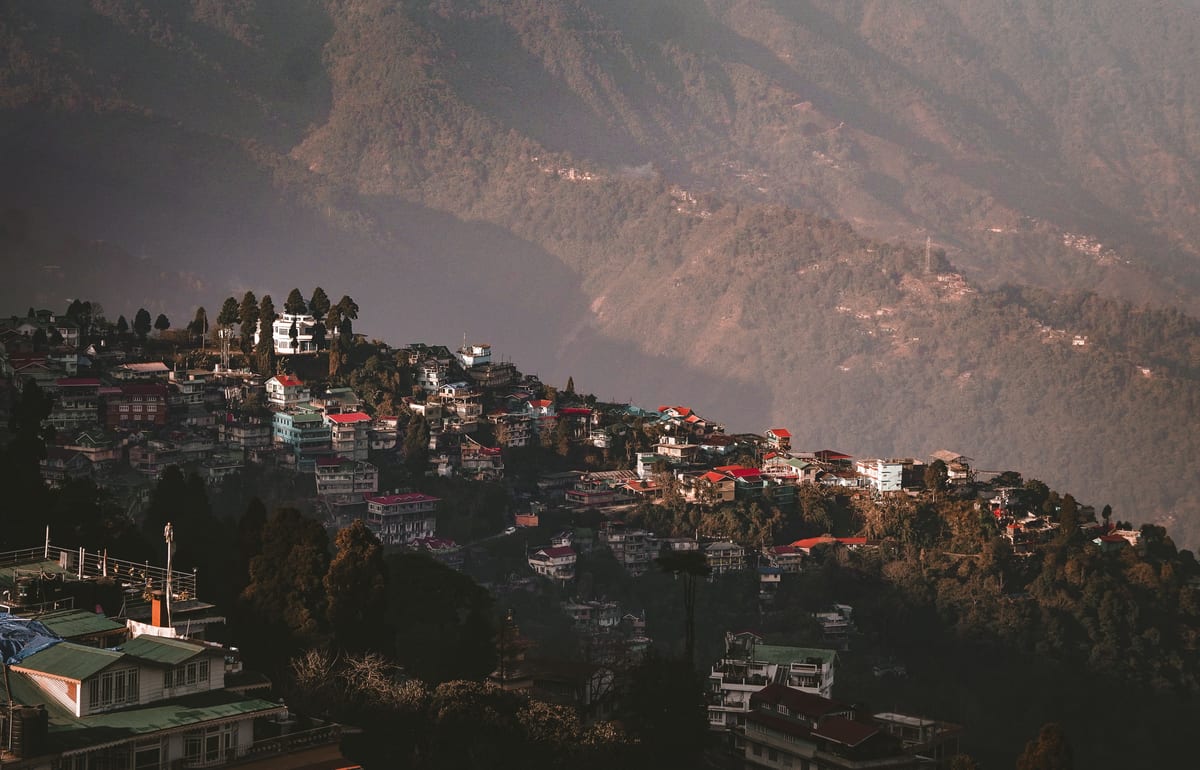
There is a particular kind of silence that settles over Darjeeling in the early hours of the morning, just before the sun crests the ridge at Tiger Hill and paints the snow-capped crown of Kanchenjunga in shades of amber and rose. Mountains here have watched empires rise and fall. Monasteries hold butter lamps that have burned for centuries. Tea gardens repeat the same ritual of plucking and steeping across nearly two hundred years, from grandmother to granddaughter. Darjeeling does not merely invite you to witness beauty.
A Gift That Became a Kingdom
Before the East India Company extended its reach into these hills in 1835, Darjeeling was part of the Kingdom of Sikkim. The Governor General, captivated by the region's cool climate and its potential as a sanatorium, expressed his interest to the Raja of Sikkim. The Raja, in a gesture of friendship, presented Darjeeling to the East India Company. In return, he received a double-barrelled gun, a rifle, twenty yards of red broadcloth, and two shawls. Britain transformed the gift into the summer capital of the Bengal Presidency, a hill station of grand lodges, botanical gardens, and a railway that would become recognised as a masterpiece of engineering heritage.
The transaction, lopsided in material terms, seeded something lasting. The infrastructure the British built, roads, rail line, tea estates, became the foundation for a distinct Darjeeling identity. After Indian independence, the town grew into what it is called today: the Queen of the Hills. When the Dalai Lama led thousands of Tibetans into exile following the Tibetan uprising of 1959, Darjeeling opened its arms to a new community. The hill town absorbed these histories and wears them, with quiet grace.
The Toy Train and Mark Twain's Ecstasy
No journey to Darjeeling is complete without boarding the Darjeeling Himalayan Railway, the beloved 'Toy Train' that loops and climbs through mountain terrain with the unhurried confidence of a creature at home in its environment. Declared a UNESCO World Heritage Site, this narrow-gauge railway is a working achievement of human ingenuity, still threading its way through tea gardens and market bazaars much as it did when it first began operations in the nineteenth century.
Mark Twain rode this train in 1895 and was moved enough to commit his experience to paper. He described it as "the most enjoyable day I have spent on earth mixed with the ecstasy of deadly fright and unimaginable joy." A century and a quarter later, the sentiment holds. As the little engine negotiates hairpin loops and the valleys drop away below, passengers lean out of open windows and feel the cool mountain air. The particular exhilaration comes from moving slowly through a landscape that demands attention.
Tea as Civilisational Practice
To speak of Darjeeling without speaking of its tea is to describe a symphony by listing only the instruments. Darjeeling tea, muscatel, first flush, second flush, is not merely an agricultural product. It is an identity, a ritual, and increasingly, a lens through which the world understands India's relationship with its own land. The Happy Valley Tea Estate, with a history stretching back to 1854, is one of the oldest and most storied estates in the region. A walk through its terraced rows, where the elevation, the mist, and the particular mineral character of the soil collaborate to produce a flavour found nowhere else on earth, reveals that some things cannot be replicated or accelerated. They can only be tended.
Darjeeling's tea culture is also deeply social. The gardens employ generations of the same families. The knowledge of when to pluck, how to grade, what the first rains will do to the leaf, this is oral tradition as much as agricultural science. The tea estate is not a relic of colonial economy. It is a living institution, continuously renewed by the people who work within it.
Monasteries, Mountains, and the Tibetan Thread
The arrival of Tibetan refugees after 1959 wove a profound new strand into Darjeeling's cultural identity. Monasteries and Buddhist institutions established in exile became, over decades, genuine centres of spiritual and cultural life. The air of Darjeeling carries the scent of pine and incense in equal measure. Prayer flags snap in the mountain wind above town, their colours faded to the pale pastels of long devotion. This is daily practice, the living continuity of a tradition that has found, against all odds, a second home in the Himalayas it has always revered.
When to Go and How to Arrive
Darjeeling rewards visitors across much of the year, though each season offers a different mood. Spring, from March through May, brings mild temperatures ranging from roughly 3°C to 22°C, flowering rhododendrons, and the celebrated first flush tea harvest, arguably the finest time to visit. Autumn, from October through November, delivers clear skies and some of the most unobstructed views of Kanchenjunga you will encounter anywhere. The monsoon months from June through September bring dramatic mist and lush green landscapes, though mountain views become intermittent. Winter, from December through February, is cold, temperatures can dip close to zero, but the town takes on an intimate, quieter character that many travellers find deeply appealing.
The nearest airport is Bagdogra International Airport (IXB) in Bagdogra, from which Darjeeling is accessible by road in roughly three to four hours. For those arriving by rail, New Jalpaiguri Junction (NJP) is the nearest major railway station, well connected to Kolkata, Delhi, and other major Indian cities. From NJP or Bagdogra, shared jeeps, private taxis, and the Toy Train itself complete the ascent into the hills.
Why Darjeeling Matters
India's heritage is often spoken of in terms of temples and texts, of ancient cities and classical arts. Darjeeling reminds us that heritage is also a cup of tea held in both hands on a cold morning, a train that climbs impossibly steep slopes because someone once believed it could, a monastery lamp that has not gone out in living memory. This hill town is not a museum exhibit of the past. Multiple civilisations, Indian, Tibetan, British colonial, Nepali, Lepcha, have layered themselves upon one another without erasing what came before, producing something singular and irreplaceable.
To visit Darjeeling is to understand that India's civilisational story is one of continuous, breathing adaptation. The mountains endure. The tea grows. The little train climbs. And somewhere on Tiger Hill at dawn, as the first light strikes Kanchenjunga, even the most restless traveller finds it easy to simply be still.