There are places in the world that photographs cannot adequately prepare you for. Khajuraho is one of them. Standing before the soaring shikhara of the Kandariya Mahadeva temple as the morning light falls across its layered sculptures, you understand immediately that you are in the presence of something that exceeds the ordinary categories of tourism. This is not a ruin. This is not a curiosity. This is a civilisation speaking, clearly, boldly, and without apology, across twelve centuries of time.
A Dynasty That Dared to Dream in Stone
Khajuraho was the capital of the powerful Chandela dynasty from the 9th to the 12th century AD. The Chandelas ruled over a vast expanse of central India, and their artistic ambitions were as sweeping as their political reach. According to Incredible India, local legends hold that the Chandelas commissioned 85 temples in Khajuraho, dedicated to both Hindu and Jain deities. Time, weather, and history have reduced that number, but 20 of these structures have endured, spread across six square kilometres, and each one continues to astonish.
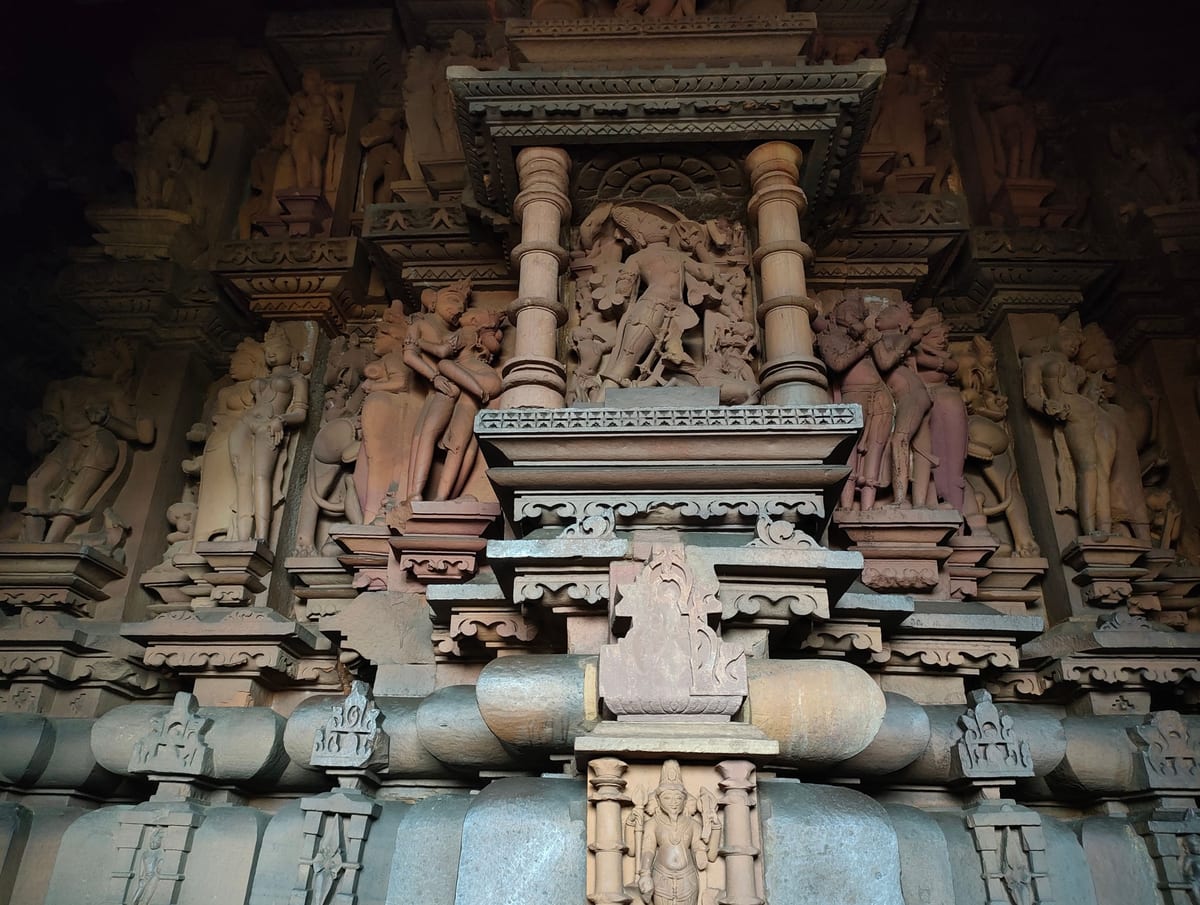
The temples form the Khajuraho Group of Monuments, a UNESCO World Heritage Site and one of India's seven wonders. What makes them singular is not merely their age but their audacity. Every surface is carved with apsaras, warriors, celestial musicians, animals, and the erotic compositions that have drawn visitors from across the globe for generations. These sculptures are theological. They express an Indian worldview in which Kama, desire, love, life-force, is not the enemy of the sacred but one of its most honest expressions.
The Curious Mystery of the Name
Even the name of this place carries a story. The earliest reference to Khajuraho appears in an inscription at the Vishvanatha temple, attributed to King Dhanga Dev. The inscription mentions 'Kharjur Vahak'. When the British encountered this term, they interpreted it as 'Kharjur Vatika', the garden of date palms, giving rise to a picturesque but apparently inaccurate legend. The art historian Dr Devangana Desai, in her work The Religious Imagery of Khajuraho, argues that 'Kharjurvahika' more accurately means 'carrier of the scorpion,' drawn from the term 'Kharjur.' It is characteristic of Khajuraho that even its name refuses to yield easily to simple explanations.
Walking Among the Temples: What You Will Experience
The Western Group of temples is the largest and most visited cluster, home to the Lakshmana Temple, the Kandariya Mahadeva Temple, and the Vishvanatha Temple. The Eastern Group contains several Jain temples of considerable beauty, a reminder that Chandela patronage extended across religious traditions. The Southern Group, smaller and quieter, rewards those willing to walk further from the crowds.
What strikes every visitor is the density of narrative on the temple walls. There are no blank surfaces. Deities, devotees, dancers, lovers, and mythological scenes cascade across every tier of stone. The artisans who created these works, whose names have been lost to history, possessed both technical mastery and imaginative freedom that still feels radical. India built this tradition here, in the red sandstone of Madhya Pradesh, over centuries of patient, disciplined labour.
India's Living Heritage, Not a Museum Piece
Khajuraho should not be experienced merely as an outdoor museum. The temples that remain active places of worship are not archived, they breathe. When a priest performs the morning aarti in the glow of butter lamps, the smoke rising past carvings that are a thousand years old, the boundary between past and present dissolves. This is what India's civilisational continuity looks like: not preservation under glass, but living use, living faith, living memory.
The annual Khajuraho Dance Festival, held against the floodlit backdrop of the Western Group temples, makes this continuity visceral. Classical dance forms, Bharatanatyam, Kathak, Odissi, Kuchipudi, are performed in the space where their spiritual ancestors were carved into stone.
When to Visit and How to Reach Khajuraho
Khajuraho's climate makes timing your visit important. The months between October and March offer the most comfortable conditions for exploring the temple complex, with temperatures ranging from 4.9°C to around 34°C. Winters in December and January can be cool, particularly in the evenings, so carry a light jacket. May and June can see temperatures touching 46°C and are best avoided for outdoor sightseeing, though the monsoon brings a moody beauty to the landscape.
Khajuraho Airport (HJR) receives regular flights connecting it to major Indian cities. Travellers preferring rail can use Khajuraho Railway Station (KURJ). From either hub, the temple complex is easily accessible by road.
Consider extending your journey to the nearby Panna National Park, home to tigers and the Ken River, or to the historic fort town of Ajaigarh. Orchha and Gwalior are also within reasonable reach for those building a broader Madhya Pradesh itinerary.
Why Khajuraho Belongs on Every Serious Traveller's Map
India has no shortage of ancient sites. But Khajuraho occupies a category of its own because of what it dared to say and because of how completely it said it. These temples insist on engagement. They ask you to look, really look, at human life in all its complexity, rendered in stone with love and skill and philosophical seriousness.
To visit Khajuraho is to accept that invitation. And to leave, as most visitors do, with the quiet certainty that you have been in the presence of something genuinely great.