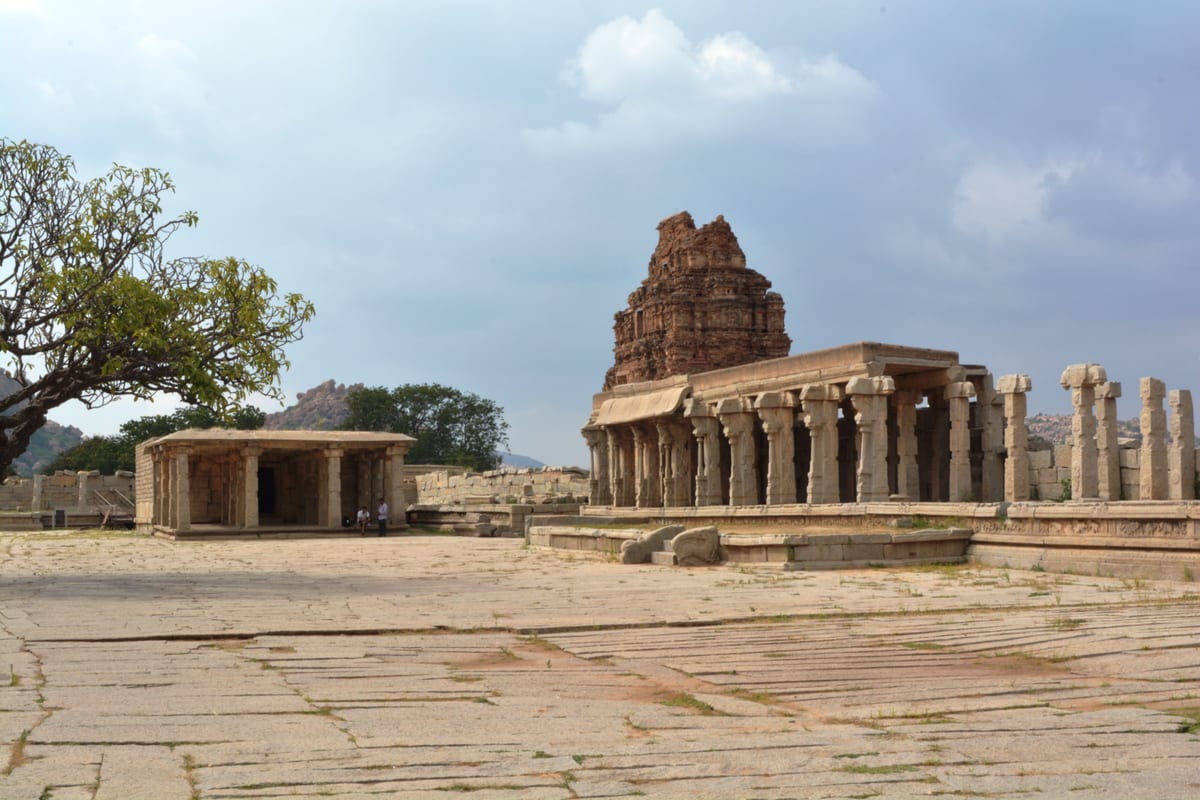
There are places that merely exist in history books, and then there are places that are history, places where the past is not behind glass but beneath your feet, above your head, and pressing against your palms when you run a hand across an ancient carved wall. Hampi, tucked into the boulder-scattered heartland of northern Karnataka along the banks of the Tungabhadra River, is exactly this.
The mythic and the historic share the same red earth here. To stand in Hampi is to stand at the intersection of two of India's great narratives: the epic age of the Ramayana, and the imperial glory of the Vijayanagara Empire. Few destinations on the subcontinent carry that double weight.
Where the Name Begins
The word 'Hampi' carries centuries of meaning. According to Incredible India, the Ministry of Tourism's official portal, the name derives from 'Pampa', an ancient name of the Tungabhadra River, and also one of the names of Goddess Parvati. This duality of river and divinity in a single syllable reflects how India names its sacred landscapes: never arbitrarily, always with layers.
The land around Hampi is identified with Kishkinda, the fabled monkey kingdom of the Ramayana, where Lord Ram is said to have met Lord Hanuman and forged the alliance that would eventually cross the seas to reclaim Sita from Lanka. When you walk among Hampi's enormous, ancient boulders, rounded and sun-warmed and stacked as if by a giant's hand, the landscape does not feel hostile to myth. It feels made for it.
The Empire That Shaped a Civilisation
From the 14th to the 16th century, Hampi was Vijayanagara, City of Victory, the capital of one of the most powerful and culturally prolific empires in Indian history. At its peak, it was among the largest cities in the world, a place of extraordinary commerce, art, architecture, and devotion. Persian travellers marvelled at its prosperity. Its rulers were patrons of literature, music, and temple-building on a scale that still leaves visitors breathless.
The empire fell in 1565 following the Battle of Talikota, but what it left behind is extraordinary. Declared a UNESCO World Heritage Site, Hampi today preserves over 1,600 surviving remains, temples, palaces, market streets, water systems, gateways, and royal enclosures, spread across roughly 4,100 hectares. Every stone records a civilisation that understood beauty as inseparable from faith, and governance as inseparable from culture.
The Monuments That Stop Time
No visit to Hampi is complete without time spent in the Virupaksha Temple, dedicated to Lord Shiva and one of the oldest continuously functioning temples in India. Priests perform rituals and devotees offer prayers in an unbroken chain stretching back centuries. That continuity is what makes Hampi extraordinary: it is not a ruin. It is a living civilisation.
In the Vitthala Temple Complex, the iconic Stone Chariot, carved from granite with wheels that once turned, ranks among India's most reproduced architectural images. The complex also features the famous musical pillars, columns that are said to resonate with distinct tones when struck. The craftsmanship demands a particular kind of silence from visitors: the silence of awe.
The Elephant Stables, with their domed chambers built to house the royal pachyderms of the Vijayanagara kings, speak to the scale and sophistication of the imperial court. Nearby, the Lotus Mahal with its graceful Indo-Islamic arched windows hints at the cosmopolitan cultural exchanges that defined this empire at its height.
Hampi's landscape rewards trekking through rugged hillsides, exploring caves shrouded in deep time, and the gentler pleasure of a coracle crossing, a ride across the Tungabhadra in a circular basket boat that has carried people across these waters for generations.
The Light at Hampi
Those who travel to Hampi speak often of its light. Dawn arrives with a gold that seems to pour between the ancient boulders and pool in the courtyards of temples. Dusk takes its time, painting the ruins in deepening shades of amber and crimson until the rocks seem to glow from within. The combination of that light, the silence, and the weight of history makes Hampi one of the most quietly overwhelming places in India.
Best Time to Visit
Hampi's climate follows a wide seasonal arc. The cooler months from October through February, with temperatures ranging from approximately 17°C to 31°C, are by far the most comfortable for exploration, particularly given the amount of ground visitors typically cover on foot. The monsoon months of June and July bring lush greenery to the landscape, transforming the terrain dramatically, though some sites may be less accessible. The summer months from April through May see temperatures pushing up to 39°C, which can make daytime exploration demanding. For most visitors, November to February offers the ideal balance of pleasant weather and clear skies.
Getting to Hampi
Hampi is most conveniently reached via Hospet Junction Railway Station (HPT), which connects to major Indian cities and is just a short drive from the ruins. For those travelling by air, the nearest airports are Kempegowda International Airport in Bengaluru (BLR), approximately a six-hour drive, Jindal Vijayanagar Airport in Vidyanagar (VDY), which is closer, and Hubballi Airport (HBX) in Hubballi. Bengaluru remains the most connected hub for international arrivals, and many travellers combine Hampi with a broader Karnataka itinerary that might include Mysuru, Badami, or Pattadakal.
Why Hampi Belongs on Every Itinerary
India has no shortage of ancient sites, but Hampi occupies a singular position among them. It is not a city that was merely conquered or abandoned. It was imagined at a grand civilisational scale, built with extraordinary ambition and faith, and then left for the landscape to hold. The boulders, the river, the temples, and the ruins together form something that exceeds any single category, heritage, mythology, architecture, and landscape all at once, inseparable from one another.
To visit Hampi is to understand something essential about India: that here, the past is never truly past. A stone chariot still commands wonder. A temple lit at dawn still receives prayers offered with genuine devotion. Even the rocks seem to remember. Hampi, more than almost anywhere else, makes that truth undeniable.