There is a moment, arriving at Konark at dawn, when the mathematics of the universe seem briefly visible. The sun, the very deity the temple honours, rises over the Bay of Bengal and catches the sandstone at an angle that turns the entire structure a burning, molten gold. Standing before it, you understand, without needing a guidebook, that this was always the intention. The Konark Sun Temple was built to stage exactly this encounter between the cosmic and the human, between stone and light, between the devotee and the divine.
A Chariot for the God of Light
Constructed in the thirteenth century under King Narasimhadeva I of the Eastern Ganga dynasty, the Konark Sun Temple is a colossal stone chariot for Surya, the sun god, complete with twelve pairs of intricately carved wheels and seven horses straining at the traces as though caught mid-gallop toward the horizon. The scale of ambition is staggering. The main sanctum, or deul, once soared to an estimated seventy metres, making it one of the tallest structures of its time. Though the main tower no longer stands, what remains, the Jagamohana or audience hall, the dance hall, and the sculptural programme that wraps every surface, is substantial.
The twelve pairs of wheels are perhaps the temple's most celebrated feature. Each wheel is not decorative but functional: these are precision sundials, accurate to the hour and even the minute when the shadow of the spokes falls across them. That a medieval Indian king and his architects built astronomical instruments into the body of a devotional structure speaks to the civilisation that produced Konark, one that saw no contradiction between piety and science, between beauty and utility.
For detailed historical context, photography guidelines, and access information, the Incredible India official page on Konark Sun Temple is a useful starting point before you plan your journey.
Sculptures That Speak in Every Language
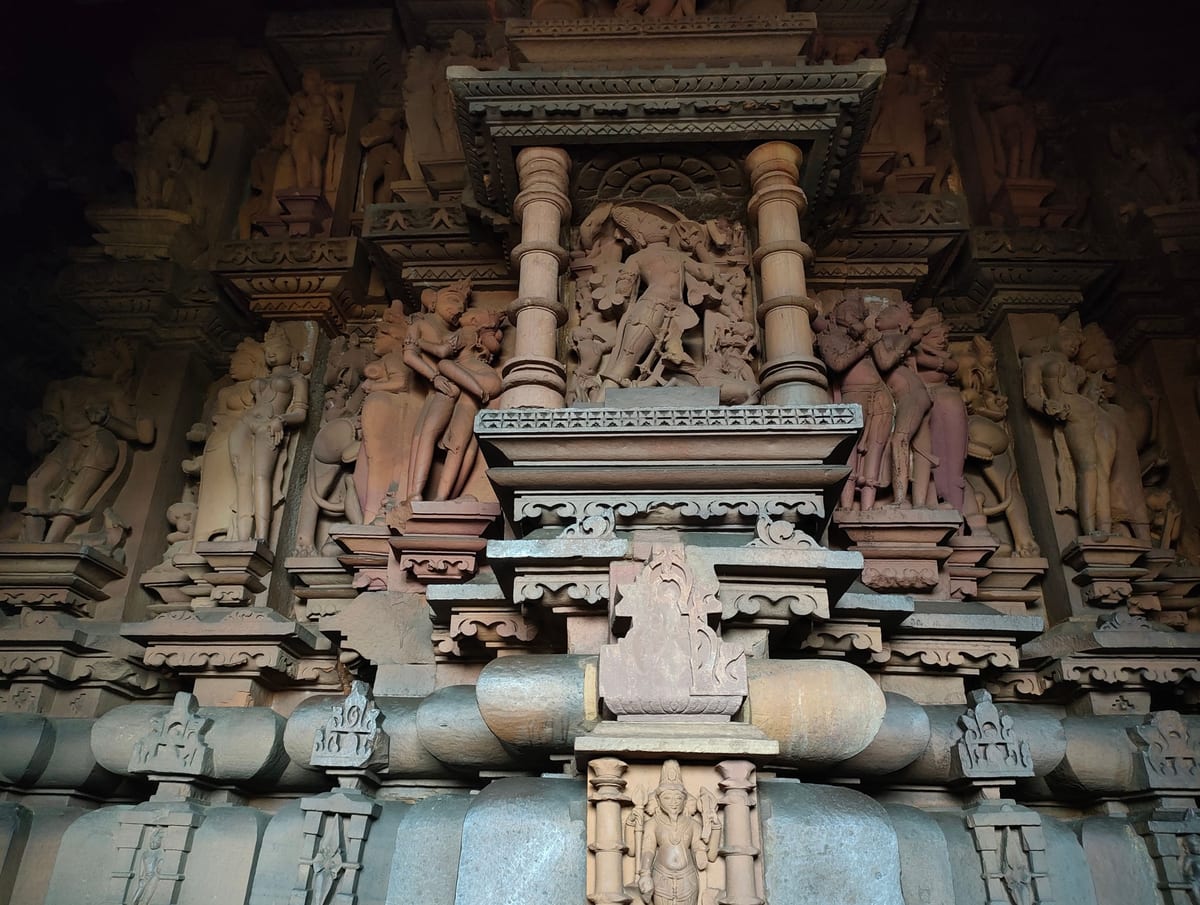
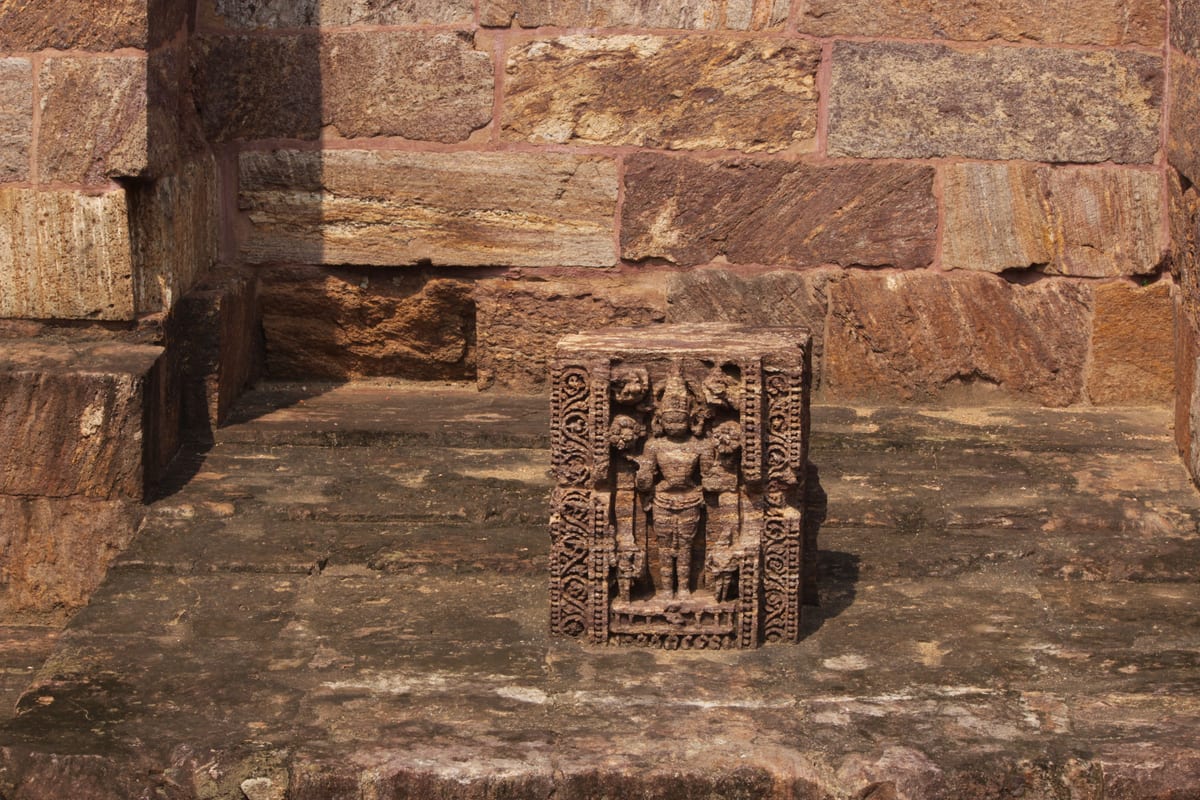
What strikes the first-time visitor is the sheer density and humanity of the sculptural programme. The walls of Konark are an encyclopaedia of thirteenth-century life, celestial musicians, dancers frozen mid-movement, erotic panels that are frank and joyful rather than salacious, elephants, horses, hunting scenes, courtly life, and presiding deities arranged in a hierarchy that climbs from the earthly to the divine. The erotic panels, often discussed at length, belong to a tradition found across Odisha's temple architecture that understood the full spectrum of human experience as sacred, not shameful. At Konark, the body is celebrated as another expression of creation.
The three chlorite images of Surya, positioned to catch the light of dawn, noon, and sunset, rank among the finest examples of medieval Indian sculpture. Even worn by centuries of salt air from the nearby sea, they carry an authority and serenity that quiets the busiest mind.
Living Heritage, Not a Locked Museum
One mistake travellers make about India's ancient sites is to approach them as finished things, monuments embalmed in amber, meaningful only as historical curiosities. Konark refuses this framing. Every December, the Konark Dance Festival transforms the temple complex into an open-air stage where India's greatest classical dancers perform against the illuminated backdrop of the Jagamohana. Bharatanatyam, Odissi, Kathak, Kuchipudi, the forms vary, but the spirit is the same: the ancient practice of dedicating art to the divine, now offered to the public under open skies. The devadasi tradition that once animated temple culture has found this new, democratic expression. Watching a dancer move in front of Konark's carved panels, which themselves depict dancers in near-identical poses, produces a rare moment of genuine civilisational continuity.
Odissi dance, one of India's eight classical forms, has its roots in this region and this tradition of temple worship. To see it performed at Konark is a lineage made visible.
When to Visit and How to Get There
The ideal window for visiting Konark is between October and March, when the coastal Odisha climate is temperate and the light in the early morning and late afternoon turns the temple's sandstone into something otherworldly. The monsoon season brings humidity and occasional flooding that can make the site difficult to navigate. The Konark Dance Festival, held in late November or early December, is worth planning around if the performing arts are important to you.
Konark is located approximately sixty-five kilometres from Bhubaneswar, Odisha's capital and its primary transport hub. Bhubaneswar has a well-connected airport and is on the main Howrah–Chennai rail line, making it easily accessible from most major Indian cities. From Bhubaneswar, road travel to Konark takes roughly ninety minutes and passes through the beach town of Puri, itself a major pilgrimage centre and home to the Jagannath Temple, making a combined itinerary entirely practical. State-run and private buses, taxis, and hired cars are all readily available for the Bhubaneswar–Puri–Konark triangle.
Nearby: A Coast Full of Wonders
No visit to Konark is complete without spending time in Puri, thirty-five kilometres to the southwest. The Jagannath Temple, one of the four sacred dhams of Hinduism, is a living centre of devotion and the origin of the word 'juggernaut', a measure of how deeply its annual Rath Yatra procession impressed those who witnessed it. The Chilika Lake, a short drive from Puri, is Asia's largest coastal lagoon and a wintering ground for migratory flamingos and Irrawaddy dolphins. Bhubaneswar itself, the 'City of Temples,' repays at least a day of exploration, the Lingaraj Temple, the Mukteshwar Temple, and the Odisha State Museum all add depth to any understanding of the region's cultural and artistic heritage.
Why Konark Matters
India has many temples and many UNESCO World Heritage Sites. Konark occupies a singular place in the country's heritage story because it represents, in one structure, the complete ambition of a civilisation, its theology, its astronomy, its art, its understanding of the relationship between the human body and the cosmos. The Black Pagoda, as Portuguese sailors once called it, is black no longer. In the right light, at the right hour, it blazes. To visit Konark is to encounter India's past not behind glass but as something still lived, argued with, danced in front of, carried forward. Still luminous, still turning, like the great wheels of stone that measure out the hours of the sun.