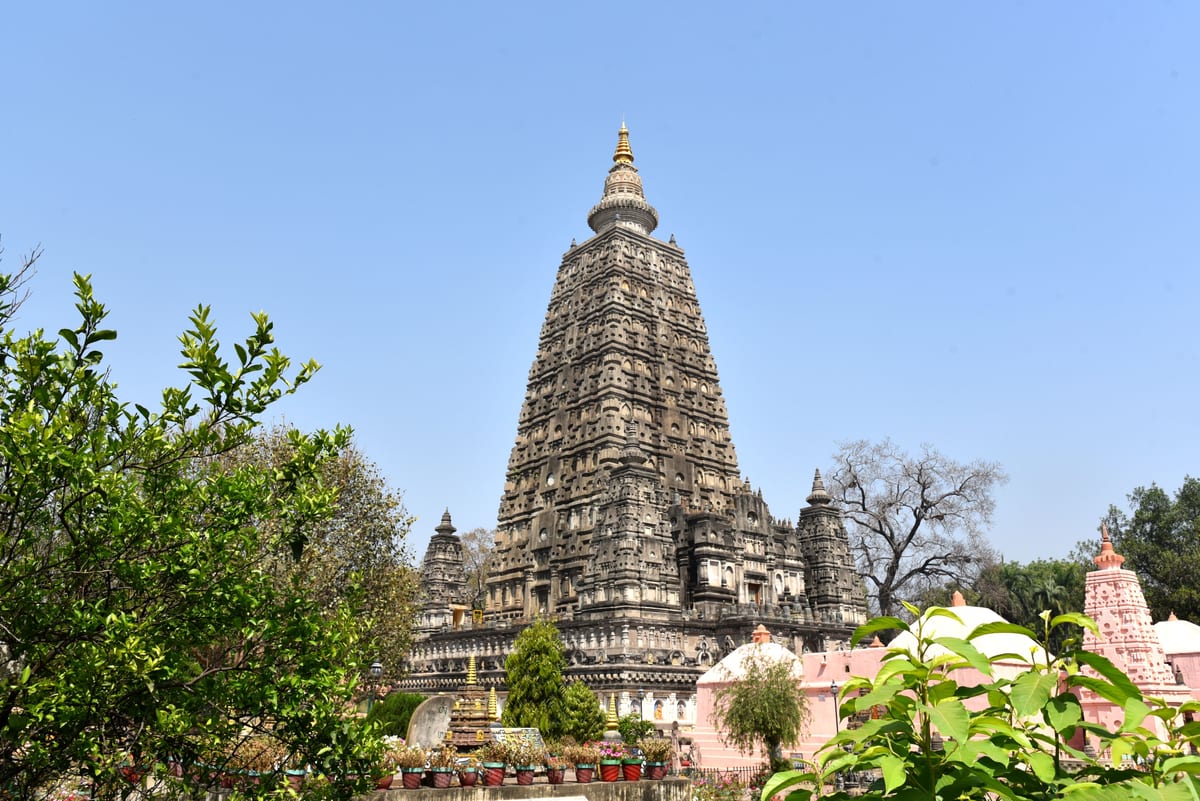
There is a moment, usually just before dawn, when the air around the Mahabodhi Temple in Bodh Gaya becomes something other than air. The lamps are lit. The chanting has begun, in Pali, in Tibetan, in Sinhala, in Japanese, in Hindi. Monks in saffron and crimson sit cross-legged on stone, their breath rising in slow clouds. At the centre of it all, ancient and utterly calm, stands the descendant of the very tree beneath which a young prince from the Shakya clan sat down one night and refused to rise until he understood the nature of suffering. He never did rise, not in the way he had been before. What rose instead was the Buddha.
Welcome to Bodh Gaya, Bihar. One of the most consequential pieces of geography on this planet.
The Weight of What Happened Here
Approximately 2,500 years ago, Siddhartha Gautama chose the banks of the Niranjana River and a particular pipal tree at a place then called Uruvela for his final, decisive meditation. After years of wandering, austerity, and inquiry, he attained Bodhi, enlightenment, and became the Buddha, the Awakened One. What he realised beneath that tree shaped the spiritual architecture of an entire civilisation and eventually of half the world.
This is not mythology. It is the kind of history that leaves a physical address. That address is Bodh Gaya, in the Gaya district of Bihar, India.
The site is listed as a UNESCO World Heritage Site, anchored by the magnificent Mahabodhi Temple, a soaring pyramidal structure that dates in its current form to the Gupta period (around the 5th–6th century CE) but incorporates structures believed to have been commissioned originally by Emperor Ashoka in the 3rd century BCE. It is one of the earliest Buddhist temples built in brick to have survived, and it remains in active, daily use, a fact that separates Bodh Gaya from almost every other ancient sacred site on earth. This is not a museum. This is a living sanctuary.
The Bodhi Tree and the Diamond Throne
The current Bodhi Tree growing behind the Mahabodhi Temple is considered a direct descendant of the original tree under which the Buddha sat. The lineage is documented: Emperor Ashoka's daughter Sanghamitta carried a sapling to Sri Lanka, where it was planted at Anuradhapura. When the original tree at Bodh Gaya was damaged over the centuries, a sapling from Sri Lanka was brought back. The tree you see today is that returned descendant, a living symbol of civilisational exchange and heritage that did not die but travelled, multiplied, and came home.
Beneath the tree lies the Vajrasana, or Diamond Throne, a stone slab said to mark the precise spot where the Buddha sat during his enlightenment. Pilgrims from across the world circumambulate this spot in a practice that has not paused in over two millennia. Walk around it on any given morning and you will hear prayers in more languages than you can name. This is what India's civilisational continuity looks like: not preserved in amber, but alive in the footsteps of millions.
What You Experience as a Visitor
Bodh Gaya is a relatively compact town, intimate in scale but monumental in feeling. The Mahabodhi Temple complex is the gravitational centre, but the town around it is a remarkable cross-section of Buddhist Asia made permanent. You will find the Thai Monastery with its gilded rooftops, the serene Japanese Temple, the ornate Tibetan Monastery administered by the Karma Kagyu school, and monasteries representing Sri Lanka, Bhutan, Vietnam, Bangladesh, China, and more. Each is architecturally distinct; each is a small embassy of a tradition that traces its founding moment to this very ground.
Beyond the monasteries, the Archaeological Museum at Bodh Gaya houses sculptures and artefacts recovered from the region. The 80-foot Great Buddha Statue, installed in 1989 by the Daijokyo Buddhist sect of Japan, is a striking modern addition to the landscape that now reads as entirely natural to the place.
Evening at the Mahabodhi Temple resists easy description. The illuminated spire rises against the Bihar sky. The chanting continues. The air carries incense and marigold and something harder to name, perhaps the accumulated intention of every person who ever came here searching for something true.
India's Civilisational Continuity, Made Visible
What makes Bodh Gaya remarkable in the context of India's heritage story is not just its antiquity but its unbrokenness. India did not discover Bodh Gaya; it never forgot it, even when the temples fell to ruin and required restoration. When Anagarika Dharmapala campaigned for the site's revival in the late 19th and early 20th centuries, he was not inventing something new, he was insisting on the continuation of something that had always lived in Indian consciousness.
Today, Bodh Gaya functions as a civilisational mirror. It shows India what it gave the world, a philosophy of non-violence, compassion, mindfulness, and inquiry, and it shows the world where that gift was first articulated. The pilgrims who arrive from Thailand, South Korea, Myanmar, and California are returning to the source. The source is here, in Bihar, unremarkable in its geography, incomparable in its significance.
Practical Travel Information
Best Time to Visit: The ideal window is October to March, when Bihar's weather is cool and pleasant. The Buddhist festival of Buddha Purnima (usually in April or May, on the full moon of Vaishakha) draws enormous gatherings and is a profound time to visit if you can manage the crowds. The Bodh Gaya International Buddhist Festival, typically held in winter, brings spiritual teachers, cultural performances, and delegations from across Asia.
How to Reach: The nearest major airport is Gaya Airport, which receives flights from several Indian cities. Gaya is also a well-connected railway junction, the Gaya Junction station receives major trains from Delhi, Kolkata, Mumbai, and Varanasi. From Gaya city, Bodh Gaya is approximately 13 kilometres away and easily accessible by auto-rickshaw, taxi, or local transport. Varanasi, another of India's great sacred cities, is roughly 250 kilometres away and makes for a natural pairing on any spiritual heritage circuit.
Nearby Attractions: The region around Bodh Gaya is saturated with historical significance. Rajgir, where the Buddha spent several monsoon seasons and taught extensively, is about 78 kilometres away. Nalanda, the site of the ancient university that was once the intellectual capital of the Buddhist world, is approximately 90 kilometres distant. Gaya city itself is a major Hindu pilgrimage site, home to the Vishnupad Temple where rituals for departed ancestors have been performed for centuries, a reminder that this landscape holds more than one civilisational thread simultaneously.
Why You Must Come
There are places in the world that change you slightly, that adjust something in your internal calibration simply by being what they are. Bodh Gaya is one of those places. It does not demand a particular faith or prior knowledge. It asks only that you show up, slow down, and pay attention.
What you will find is a town that has been receiving seekers for two and a half millennia and has not grown tired of them. What you will find is a tree, a stone, a spire, and a silence that the chanting somehow makes more complete rather than less. What you will find is evidence, tangible, touchable, undeniable, that one of the most important things that ever happened to the human species happened here, in India, in Bihar, beneath an ordinary pipal tree on an ordinary night when nothing about the morning after would be ordinary again.
For full destination details, itinerary suggestions, and travel planning resources, visit the official Bodh Gaya page on Incredible India, the Ministry of Tourism's authoritative guide to India's most remarkable destinations.