There are places in India that do not ask you to admire them. They ask you to remember. Sanchi, a small hill rising above the wheat-green plains of Madhya Pradesh, is one such place. Here, nearly 2,300 years ago, the Mauryan Emperor Ashoka, a man who had witnessed the horror of his own ambitions on the battlefield of Kalinga, planted the seed of something far more enduring than an empire. He planted the Dhamma.
What grew from that seed is now Sanchi Stupa, a UNESCO World Heritage Site and one of the oldest stone structures in the Indian subcontinent. It is a destination that every traveller who cares about India's civilisational identity should experience at least once, not as a museum visit, but as a pilgrimage of the mind.
The Weight of History on a Quiet Hill
Sanchi's Great Stupa, formally known as Stupa No. 1, was originally commissioned by Ashoka in the 3rd century BCE as a simple hemispherical mound to enshrine the relics of the Buddha. Over the following centuries, successive dynasties, the Shungas, the Satavahanas, the Guptas, enlarged, embellished, and elevated it. What we see today is therefore not a single act of faith but a layered palimpsest of devotion, each era adding its voice to the same prayer.
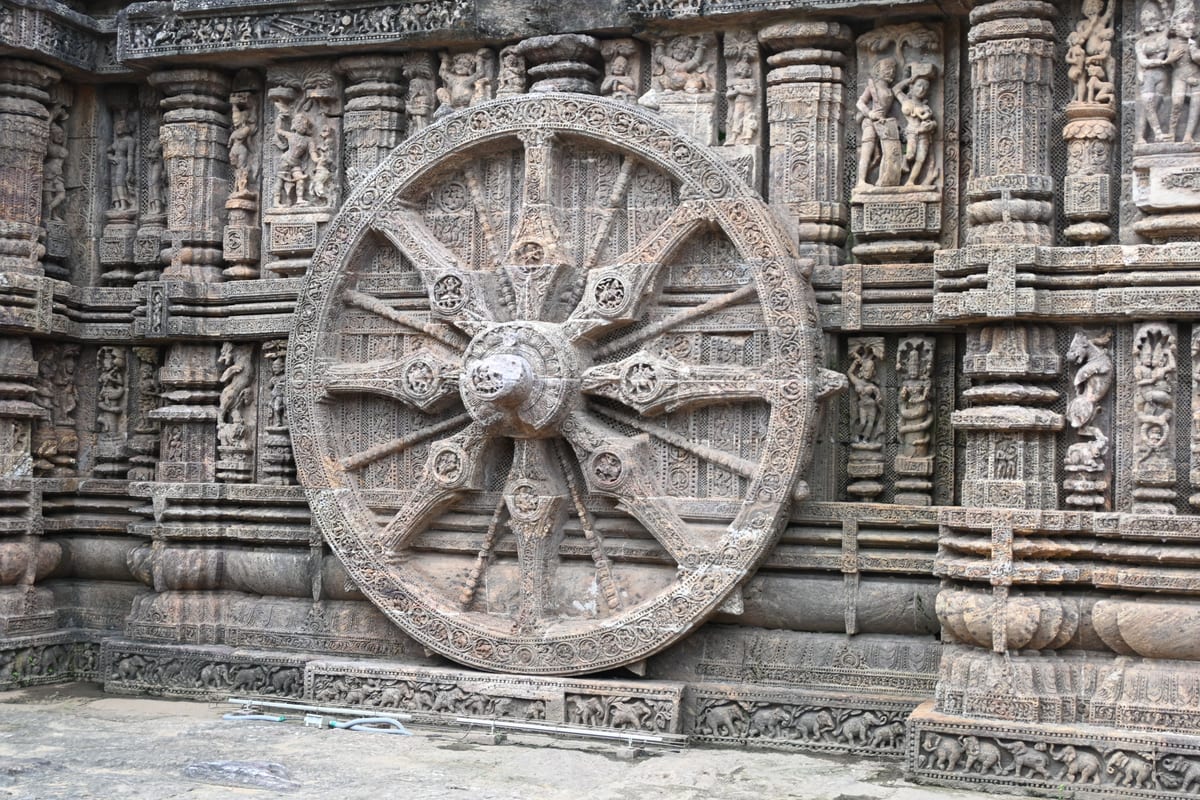
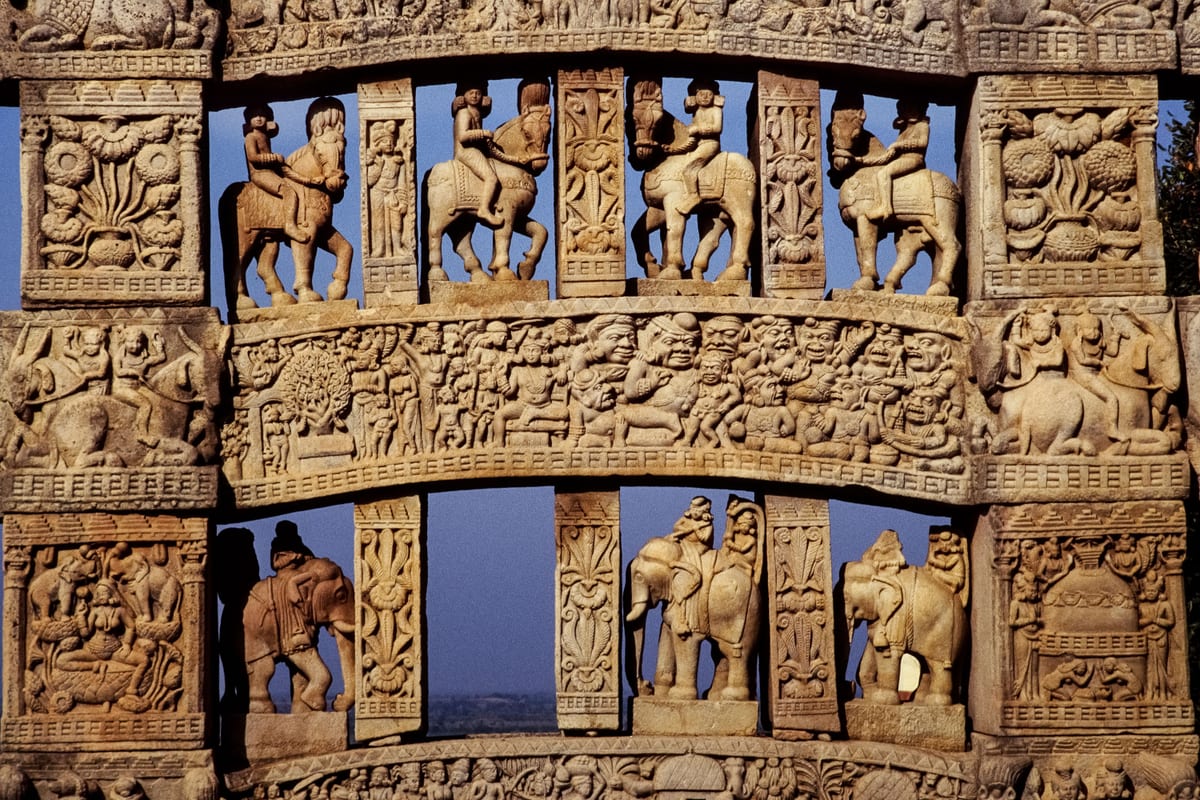
The four elaborately carved toranas, the gateways, are perhaps the most striking detail of all. Dating from around the 1st century BCE, they are covered floor to cornice with narrative carvings depicting the Jataka tales, scenes from the Buddha's life, processions of elephants, lotus medallions, and celestial beings frozen mid-dance. The craftsmen who carved these did not sign their work. They did not need to. The work itself is the signature of a civilisation confident enough in its values to let beauty speak without attribution.
A Civilisation Still Breathing
Sanchi was never entirely abandoned. Unlike the jungle-consumed temples of Angkor or the sand-buried cities of Mesopotamia, Sanchi continued to draw monks, pilgrims, and scholars even as dynasties rose and fell around it. When the British archaeologist Alexander Cunningham surveyed the site in the 19th century, he found not a dead site but a place still holding memory.
India's civilisational continuity is Sanchi's deepest story. The same Dhamma that Ashoka inscribed on rock edicts across the subcontinent became the philosophical foundation for a cultural export that shaped Sri Lanka, Myanmar, Thailand, China, Korea, and Japan. Standing before the Great Stupa, you are standing at a point of origin, not just for Buddhism as a global religion, but for India's oldest instinct: the belief that inner transformation is a worthier pursuit than outward conquest.
What the Visitor Experiences
The approach to Sanchi is itself a preparation. The hill rises gently, unhurried, as if the landscape understands that what waits at the top should not be rushed. As you climb, the main stupa comes into view gradually, first the dome, then the harmika, the square railing atop the dome that holds the chattri, the ceremonial umbrella symbolising the Buddha's sovereignty over the cosmos.
Walking the pradakshina path, the circumambulatory route around the stupa, is a meditative act even for secular visitors. The carved toranas anchor each cardinal direction. Peer closely at the southern torana and you will find the story of the Great Departure, the moment Prince Siddhartha left his palace. The horse Kanthaka is shown without its rider. The Buddha, at this stage of Sanchi's artistic tradition, was considered too sacred to be depicted in human form. His presence is implied by an empty saddle, a footprint, a parasol. It is an act of artistic restraint that itself carries eloquence.
Beyond the Great Stupa, the complex holds Stupa No. 2 and Stupa No. 3, the latter containing the relics of Sariputra and Mahamogallana, two of the Buddha's principal disciples, as well as temple ruins, pillars, and the remains of monastic quarters. The on-site museum houses some of the finest recovered sculptures, including the celebrated Lion Capital from an Ashokan pillar.
Practical Travel Guide
Best time to visit: October to March offers the most comfortable weather, with cool mornings and clear skies that do justice to the stone's warm ochre tones. Monsoon, from July to September, cloaks the hill in green and reduces crowds, though some paths may be slippery.
How to reach: Sanchi is located approximately 46 kilometres northeast of Bhopal, the state capital of Madhya Pradesh. Bhopal is well-connected by air and rail to Delhi, Mumbai, and other major cities. From Bhopal, Sanchi is easily accessible by taxi, bus, or the Bhopal–Vidisha passenger train, which has a stop at Sanchi station, a short walk from the hill. The nearest major airport is Raja Bhoj Airport, Bhopal.
Nearby attractions: The ancient city of Vidisha, just 10 kilometres away, was once a great commercial capital and holds its own ruins and the Heliodorus Pillar, evidence of a Greek ambassador who adopted Vaishnavism in the 2nd century BCE. Raisen Fort, Bhimbetka rock shelters (a UNESCO site in their own right), and Udayagiri Caves are all within comfortable day-trip distance from Bhopal, making the region one of Madhya Pradesh's richest archaeological corridors.
Why Sanchi Matters
In a world where heritage is frequently reduced to Instagram backdrops or ticket-queue transactions, Sanchi demands something more of its visitors. It asks for attention. It asks for slowness. The stones here have survived invasions, neglect, colonial excavation, and the relentless passage of time, and they still hold their composure, the way a civilisation holds its composure when it knows its roots go deep enough.
India is often described as a land of contradictions. Sanchi is a land of coherence, a place where philosophy became architecture, where remorse became compassion, and where a single emperor's conversion became a gift that the world is still unwrapping. Come here not to tick a heritage box, but to understand something essential about what India has always known: that the greatest journeys are the ones that turn inward.