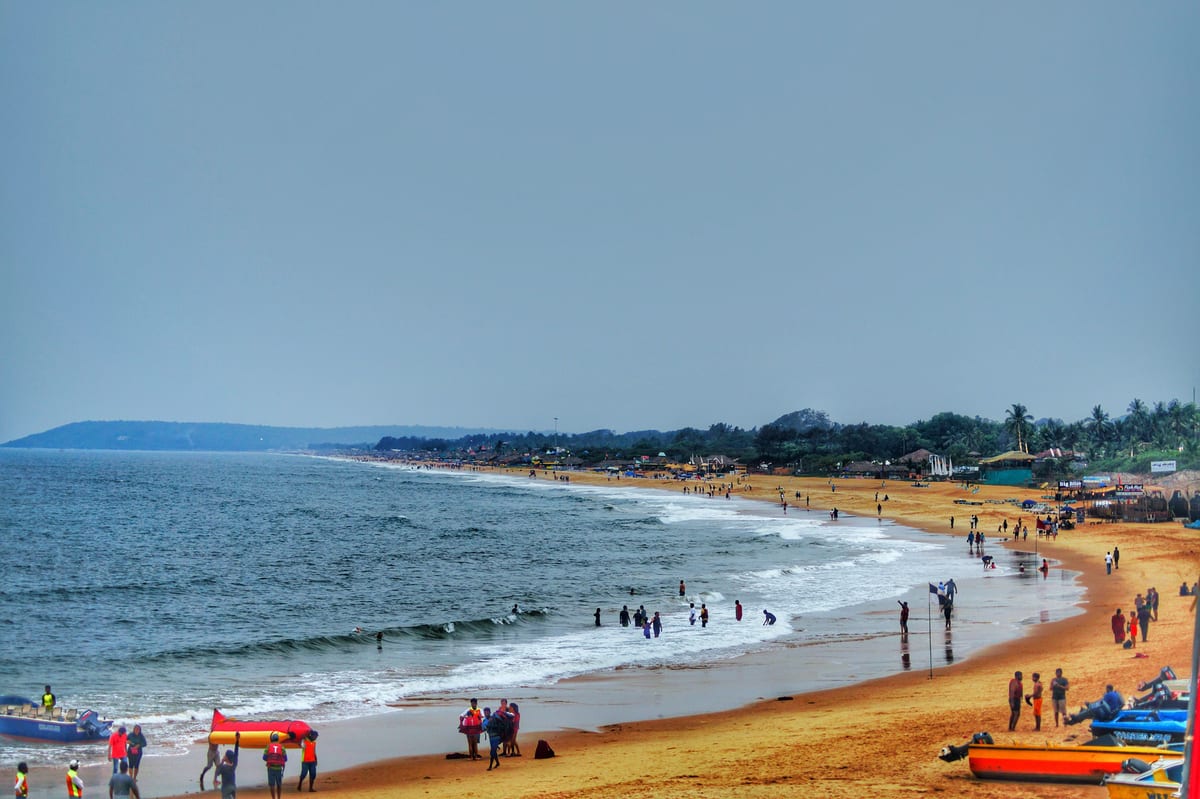
There is a moment, usually just after the monsoon withdraws and October softens the Konkan sky, when Goa reveals itself in full. The Arabian Sea gleams like hammered copper in the late afternoon light. A fisherman hauls in his nets near Calangute. A grandmother in a house in Fontainhas stirs a pot of prawn balchão. Church bells echo across the red-tiled rooftops. And somewhere, on a strip of white sand that stretches farther than the eye can follow, a traveller stops, truly stops, and understands that this place is not simply a beach destination. It is a civilisation in sandals.
A Coastline That Carries History
Goa's coastline stretches across 3,702 kilometres of beaches, coves, and estuaries, according to Incredible India, the Ministry of Tourism's official portal. But length tells only part of the story. These beaches mark the edge of a land that was coveted, conquered, and reclaimed, not through warfare alone, but through the quiet endurance of culture.
The Portuguese arrived in 1510 and stayed for over four centuries, leaving behind baroque churches, Indo-Portuguese mansions, and a culinary vocabulary that fused Iberian technique with Konkani ingredients. The Basilica of Bom Jesus, where the mortal remains of St. Francis Xavier rest, contains perhaps the most potent symbol of this encounter, a World Heritage Site that is simultaneously a Catholic shrine and an Indian monument. Walk through the neighbourhood of Fontainhas with its narrow lanes and vibrantly painted houses, and you are not looking at Portugal transplanted. You are looking at India absorbing, adapting, and outlasting a colonial presence.
The Beaches: Each One a Different Story
Goa's beaches resist uniformity. The northern shores pulse with energy. Baga and Calangute are the great democratic beaches of India, loud, festive, crowded in the best possible way, lined with shacks where beach chairs face the sea and cold kingfishers arrive without being asked. These are beaches that belong to everyone: honeymooners from Lucknow, backpackers from Berlin, families from Chennai celebrating school holidays. The spirit here is distinctly Indian, a gift for collective joy.
Travel south, and the landscape and mood shift entirely. Palolem and Agonda, in South Goa, offer something closer to contemplation. The arc of Palolem Bay is one of the most naturally composed beach scenes in all of Asia, a horseshoe of calm water framed by coconut palms and low wooded headlands. Agonda is quieter still, favoured by those who understand that the highest form of travel is not stimulation but stillness. These southern beaches connect to Goa's older, deeper rhythms, the rhythms of fishing communities, of monsoon cycles, of a people who have lived with the sea for millennia.
Susegad: The Philosophy the World Is Only Now Learning
Goans have a word for the art of unhurried, contented living: susegad. Derived from the Portuguese sossegado (meaning quiet or peaceful), the word was adopted into the Konkani soul and transformed into something far richer than its origin. Susegad is the reason a hammock matters more than a schedule. It is why the best conversations in Goa happen on plastic chairs at the edge of the tide, with no particular agenda and no particular end time.
In a world now desperate for mindfulness retreats and digital detoxes, susegad has been practised on these shores for generations. Goa did not discover slow living, it has simply never abandoned it. For the Indian traveller especially, Goa offers something rare: permission to stop performing productivity.
Festivals, Food, and the Living Culture
Goa's cultural calendar is as layered as its geography. The Carnival, with its floats, masks, and processions, is a vivid inheritance from Portuguese tradition, yet it is celebrated with unmistakably Indian exuberance. The Shigmo festival, Goa's own version of Holi, brings out traditional folk dances and temple processions that trace directly to pre-colonial Hindu ritual. The Sunburn music festival draws a younger, global audience to the same sands where ancient seafarers once anchored. All three coexist without contradiction. This is what a living culture looks like.
Then there is the food, arguably Goa's most persuasive argument for a longer stay. Goan cuisine is the product of a culinary civilisation: Konkani spice knowledge meeting Portuguese pickling and braising techniques. Fish curry rice is not a dish; it is a daily sacrament. Prawn balchão, xacuti, and sorpotel carry histories of trade routes and kitchen negotiations across centuries. And bebinca, that extraordinary layered dessert made with coconut milk and toddy, is patience and indulgence combined into something transcendent. Wash it down with feni, the local cashew spirit, and you will understand why Goans see no great hurry to be anywhere else.
When to Go and How to Get There
The best time to visit Goa's beaches is from October through February, when temperatures range between 17°C and 35°C. The post-monsoon months of October and November are particularly rewarding, the landscape is lush, the sea is warm, the crowds have not yet arrived in full force, and the light is extraordinary. December and January bring the festive season, with Christmas and New Year celebrations that are among the most joyful in India. March through May grows progressively warmer, though the beaches remain beautiful. June through September is monsoon season, dramatic, lush, and beloved by those who prefer Goa in its most elemental mood, though swimming conditions are not advised.
Goa is exceptionally well connected. The state is served by two airports: the established Dabolim Airport (GOI) and the newer Goa Manohar International Airport (GOX) in North Goa, which has significantly expanded the state's aviation capacity. By rail, Madgaon Junction (MAO) is the primary station, connected to Mumbai, Delhi, Bangalore, and most major Indian cities. The Konkan Railway journey into Goa threads through tunnels and over bridges above jungle rivers, an experience in itself.
Beyond the Beach: Nearby Wonders
Those who look inland from Goa's beaches discover another country entirely. The Dudhsagar Waterfalls, one of India's tallest, cascade down the Western Ghats in a curtain of white that is most spectacular during and just after the monsoon. The spice plantations of the interior offer immersive tours through the living pharmacopeia that made Goa a prize for every maritime empire that ever sailed these waters. The temples of the Old Conquests, many relocated during the Portuguese period to protect their sacred images, represent an unbroken Hindu devotional tradition that has endured every historical storm.
Why Goa Matters to India's Story
India's heritage story is too often told through the monuments of the Gangetic plain or the temples of the Tamil south. Goa's contribution is different in register but no less significant. It is the story of a coastal civilisation that engaged with the world on its own terms, trading, absorbing, resisting, and ultimately remaining itself. The beaches are not merely scenic backdrops. They are the place where India met the ocean and kept its identity intact.
Come for the sunsets, by all means. Come for the seafood and the feni and the music drifting from a beach shack on a Tuesday night. But stay long enough to feel what the Goans have always known: that a people who can live this gracefully by the sea have understood something essential about what a good life looks like. Susegad is not laziness. It is civilisation fully arrived.