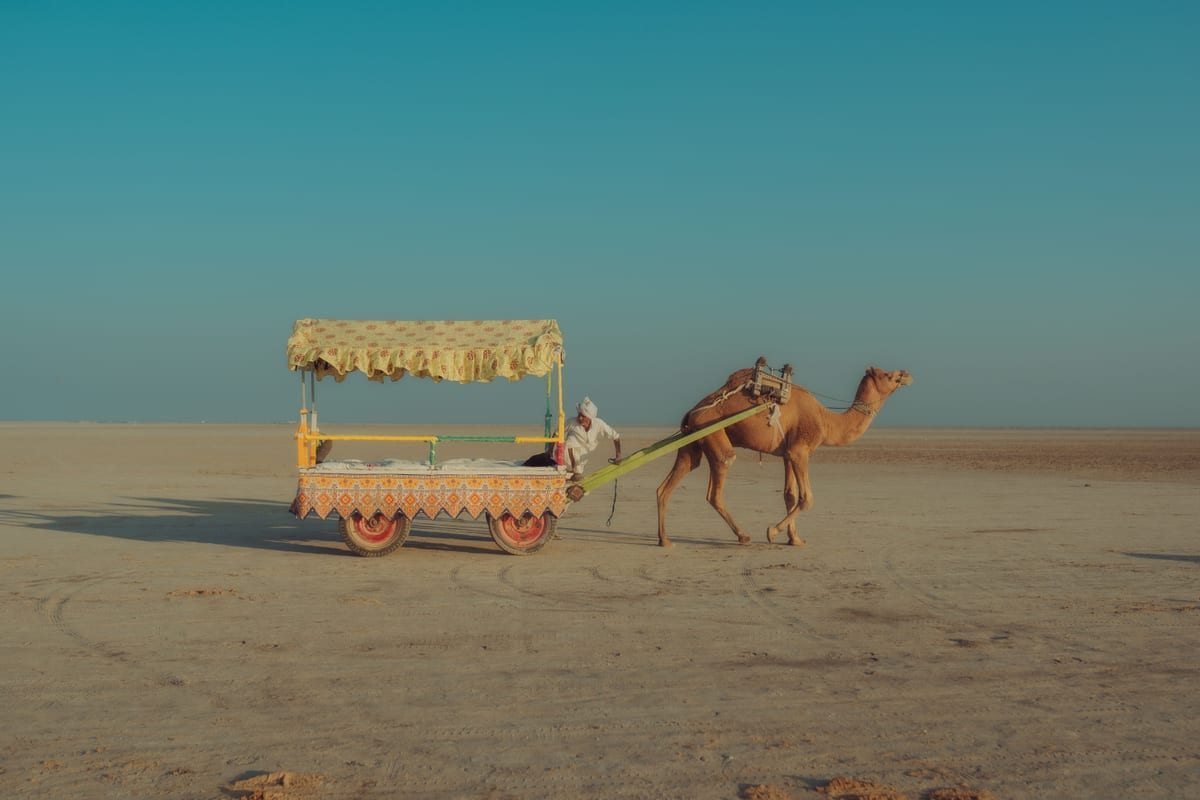
There are cities you visit, and then there are cities that visit you, that enter your memory and quietly rearrange it. Madurai, the ancient heart of Tamil Nadu, belongs to the second category. Step off the train at Madurai Junction or descend through the clouds into Madurai International Airport, and something shifts almost immediately. The air carries incense and jasmine. The skyline is punctuated not by glass towers but by the soaring, sculpture-encrusted gopurams of a temple that has stood for more than two thousand years. Welcome to a city that never sleeps.
A City Born From Divine Nectar
Before you can understand Madurai's streets, you must understand its legend. According to ancient lore, the city owes its existence to the divine, sacred drops of nectar that fell from the matted locks of Lord Shiva consecrated this ground, giving birth to Madhurapuri, the City of Sweetness. It is said that Lord Shiva himself performed sixty-four miraculous deeds here, the celebrated Thiruvilaiyadals, binding the city to the divine in a covenant that its people have honoured ever since. This mythology does not sit in dusty texts. It walks the streets, rings in temple bells before dawn, and shapes daily life in ways both subtle and overwhelming.
Madurai's documented history is equally astonishing. It finds mention in the Ramayana, in Kautilya's Arthashastra, and in the records of ancient Greek and Roman traders who knew it as a flourishing centre of commerce and culture. Its roots reach back to the Sangam period, that remarkable flowering of Tamil literature and thought that gave the world some of humanity's earliest secular poetry. Stand anywhere in this city and you stand on layers of time so deep they become almost vertiginous. Incredible India's official Madurai page describes it as a city where every step is a journey through time.
The Meenakshi Temple: A Universe in Stone
At the geographical and spiritual centre of Madurai stands the Sri Meenakshi-Sundareswarar Temple. This is not simply a place of worship. It is an entire cosmology rendered in granite and pigment, a city within a city, a living institution that has drawn devotees, pilgrims, scholars, and travellers from every corner of the subcontinent and beyond for centuries. The temple's towering gopurams, gateway towers encrusted with thousands of painted stucco figures depicting gods, demons, heroes, and celestial beings, rise dramatically above the surrounding streets, visible from kilometres away.
What makes the Meenakshi Temple moving is its continuity. Rituals performed here today follow patterns established centuries ago. The temple breathes with the hours, morning prayers, midday ceremonies, evening processions, the nightly ritual of closing that echoes with ancient devotion. This is India's civilisational story at its most vivid: not preserved behind glass but practised, renewed, and passed from generation to generation with extraordinary fidelity. Madurai does not merely conserve its heritage. It inhabits it.
The Athens of the East
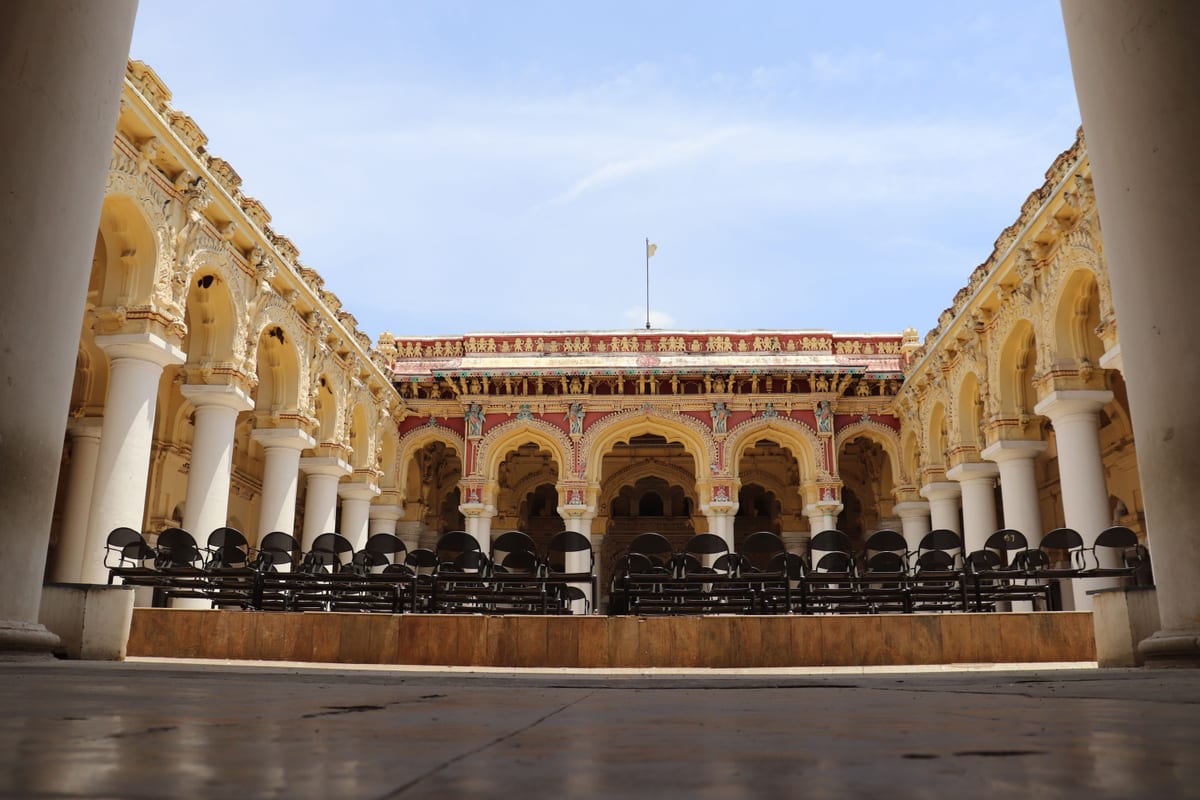
Madurai has long carried the title 'Athens of the East,' and a visit to the Thirumalai Nayak Palace confirms this designation. Built in the seventeenth century by King Thirumalai Nayak, the palace is a convergence of Dravidian and Islamic architectural traditions, a reminder that India's greatest monuments have emerged from dialogue rather than isolation. Its 248 majestic pillars, intricate stucco ornamentation, sweeping celestial pavilion, and exquisite paintings and sculptures create an atmosphere of regal grandeur that has outlasted the dynasty that built it. Walking through its colonnaded halls, you feel the ambition and aesthetic confidence of a civilisation fully at ease with its own magnificence.
Beyond these monuments, Madurai rewards the patient and the curious. Sacred shrines dot the city and its surroundings, each with its own particular character of devotion. Tranquil hill stations lie within reach for those who need respite from the city's intensity. And then there are the markets, fragrant with the famous Madurai malli jasmine, noisy with commerce, alive with the theatre of a South Indian city going about its ancient business.
Planning Your Visit: Practical Notes
Madurai rewards visitors who come prepared for both its spiritual depth and its climate. The city sits in the interior of Tamil Nadu and runs warm for much of the year. Temperatures range from approximately 19°C to 33°C in the cooler months of January and December, climbing to highs approaching 40°C through April, May, and June. For most visitors, the months between November and February offer the most comfortable conditions, the heat is gentler, the skies are clearer, and the city's many festivals fall within or close to this window, including the spectacular Pongal celebrations in January.
Getting to Madurai is straightforward. The city is served by Madurai International Airport (IXM), with connections to major Indian cities and select international destinations. Alternatively, Madurai Junction Railway Station (MDU) links the city to the broader Indian rail network, and the overnight journey from Chennai or Coimbatore by train is itself a pleasure. Once in Madurai, the city's compact historic core is navigable by auto-rickshaw, and the temple precinct is best explored on foot.
The city also makes an excellent base for exploring the wider region. Sacred shrines, hill retreats, and cultural sites lie within a reasonable distance, each offering a different facet of Tamil Nadu's heritage.
Why Madurai Matters
In a world that increasingly mistakes preservation for vitality, Madurai is a powerful counter-argument. Here is a city that was ancient when Rome was young, that weathered empires and traders and colonial interruption, and emerged from all of it still fundamentally itself, still praying at the same shrines, still singing in Tamil, still weaving jasmine garlands at midnight for a goddess who has been worshipped here longer than most nations have existed. That is not a tourist attraction. That is a civilisation's proof of life.
For the traveller willing to arrive with open senses and unhurried hours, Madurai offers something increasingly rare in modern travel: the experience of genuine antiquity that has not been curated into passivity. This city asks something of you. It asks you to slow down, to look carefully, to let two thousand years of human devotion and creativity land with their full weight. Those who accept that invitation rarely leave unchanged.