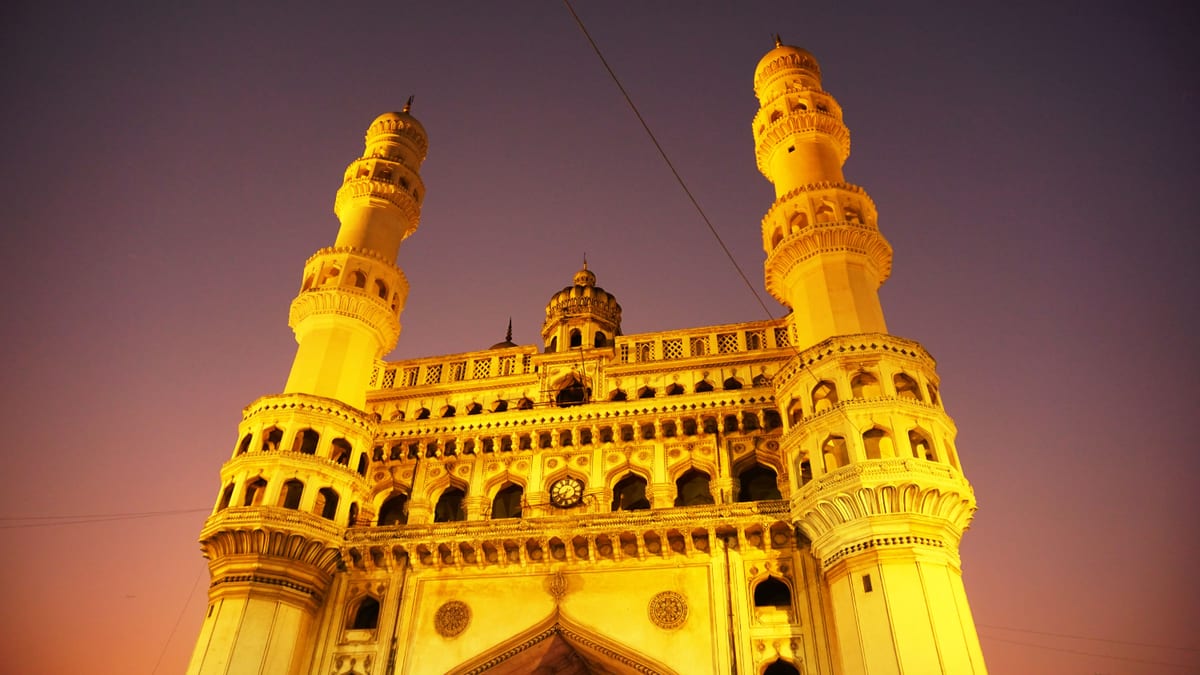
There is a moment, usually just before sunset, when the light over old Hyderabad turns the colour of aged copper. The chaos of the Laad Bazaar, vendors crying their wares, autorickshaws threading impossible gaps, the scent of attar drifting from a perfume stall, all of it seems to slow. Rising above it all, four tapering minarets catch the last gold of the day. This is Charminar. This is the reason Hyderabad exists.
A City Born Around a Monument
Most monuments are built to commemorate a city. Charminar did the opposite, it summoned one. In 1591 CE, the fifth sultan of the Qutb Shahi dynasty, Muhammad Quli Qutb Shah, chose a site at the confluence of the Musi River's banks and commissioned a grand structure to mark the founding of his new capital, Hyderabad. According to tradition, he built it in gratitude after the city was delivered from a devastating plague, a prayer in stone, four minarets pointing heavenward.
The name is literally descriptive: char means four, minar means tower. Each minaret soars approximately 56 metres into the Deccan sky, punctuated by two balconies and capped with an elegant finial. The structure is built from granite, limestone, mortar, and pulverised marble, materials held together through engineering and what can only be described as the will of centuries. A mosque occupies the upper floor, making Charminar simultaneously a civic arch, a watchtower, a place of worship, and a statement of royal ambition. Few structures anywhere carry so many purposes so gracefully.
For more details on the monument's history and significance, visit the official Incredible India page on Charminar.
Living Heritage, Not a Museum Piece
What separates Charminar from many of the world's great monuments is that it has never been allowed to retire into pure symbolism. Empires came and went, the Mughals absorbed the Qutb Shahis, the Nizams succeeded the Mughals, and finally, in 1948, Hyderabad acceded to independent India, but through every transition, the neighbourhood around Charminar simply kept trading, praying, and feeding people.
The streets radiating from Charminar's four arches have been a marketplace for centuries. The Laad Bazaar to the west, famous for its glass bangles, has outfitted brides from across the Deccan since the Qutb Shahi era. The Mecca Masjid, one of the largest mosques in India, sits a short walk away and continues to draw tens of thousands of worshippers every Friday. The legendary Hyderabadi biryani, slow-cooked in the dum tradition, is sold at establishments in these lanes whose recipes predate modern India by generations. Every transaction here is an act of living heritage.
What Visitors Experience
To visit Charminar is to consent to being absorbed by the city rather than merely observing it. The monument itself is managed by the Archaeological Survey of India. Visitors can climb the narrow, winding staircase within the minarets to reach the upper gallery. From that height, old Hyderabad unfolds as a visual poem, terracotta rooftops, minarets of neighbouring mosques, the distant shimmer of the Hussain Sagar lake, and the ceaseless anarchy of the bazaar below.
At street level, the experience is entirely sensory. Walk through Laad Bazaar and you will be surrounded by thousands of glass bangles in every conceivable colour, stacked floor to ceiling in narrow shops where the proprietors can tell your bangle size by glancing at your wrist. The Gulzar Houz chowk nearby is famous for its street food, Osmania biscuits dunked in Irani chai, haleem simmering in enormous vessels, and freshly pulled sugar candy twisted by hand. The Charminar Bazaar itself is one of the great perfume markets of South Asia, where attars and ouds are blended and sold from small glass vials.
Best Time to Visit and How to Reach
Hyderabad's climate makes timing your visit important. The ideal window runs from October through February, when temperatures are comfortable and the city's outdoor life is at its most vibrant. Summers (March to June) can be intense, and while the monsoon (July to September) lends the old city an atmospheric quality, navigating the narrow lanes can be challenging.
Charminar sits in the heart of the old city, well connected to greater Hyderabad. The nearest metro station on the Hyderabad Metro Rail network makes access significantly easier than it once was. From Rajiv Gandhi International Airport, the monument is roughly 20 to 25 kilometres away, easily reached by taxi or app-based cab services. If you are arriving by train, Hyderabad Deccan (Nampally) station is the closest major railhead, from where Charminar is a short ride.
Nearby Attractions Worth Your Time
Charminar is best treated not as a single stop but as the anchor of a full immersion into Hyderabad's old city. Within easy walking distance lies Mecca Masjid, whose construction began under Muhammad Quli Qutb Shah and was completed under the Mughals, a 400-year-old monument to interrupted and resumed ambition. The Chowmahalla Palace, the official seat of the Nizams, is a short distance away and offers a glimpse into the extraordinary opulence of the last great Muslim dynasty of the Deccan. Golconda Fort, the seat of Qutb Shahi power before Hyderabad was founded, is approximately 11 kilometres to the west and rewards a half-day visit, particularly for its sound-and-light show in the evenings. The Qutb Shahi Tombs, a serene necropolis housing the graves of the very kings who built Charminar, complete the circle.
Why Charminar Matters in India's Heritage Story
India's civilisational story is often told through its oldest monuments, the cave temples, the river ghats, the forts of Rajputana. Charminar offers a different and equally essential chapter: the story of the Deccan, where Persian culture met Telugu tradition, where Islamic architecture absorbed Hindu geometric sensibilities, and where a cosmopolitan trading city became one of the most culturally layered places on the subcontinent.
Charminar is proof that India's heritage is not a single thread but a vast weave of multiple strands. It belongs to no single community, era, or ideology. It belongs to every person who has ever stood beneath its arches, looked up, and felt, however briefly, that they were in the presence of something that has outlasted everything thrown against it, and will outlast much that is yet to come.