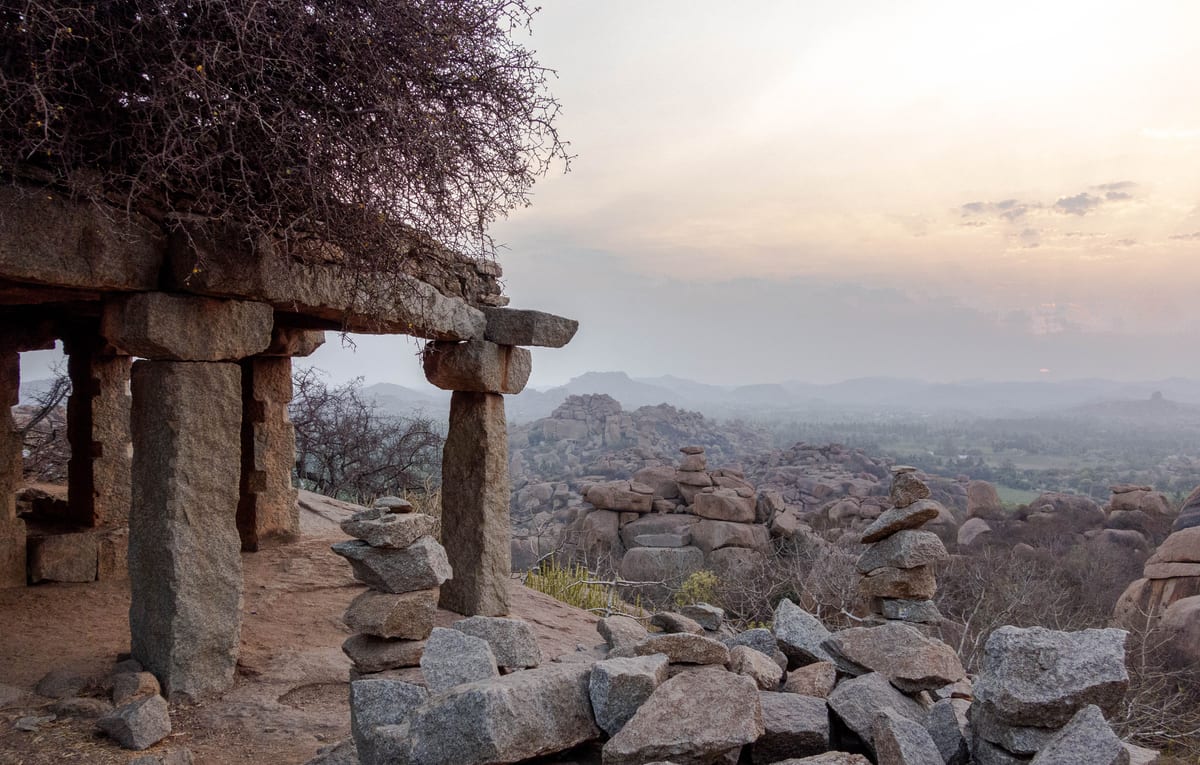
There are places in the world where history is kept safely behind glass, labelled and catalogued, politely separated from the living world. Hampi is not one of them. Here, in the boulder-strewn landscape of northern Karnataka, the past does not wait in a museum, it sits in the open air, baked by the sun, still receiving prayers, still exhaling incense, still stubbornly alive.
Declared a UNESCO World Heritage Site, Hampi was once Vijayanagara, the City of Victory, capital of one of the most powerful empires in medieval India. At its peak in the 15th and 16th centuries, the Vijayanagara Empire was among the wealthiest kingdoms in the known world, its capital described by foreign travellers as a city of breathtaking splendour that rivalled Rome. What remains today, spread across a surreal landscape of granite hills and emerald paddy fields along the Tungabhadra River, is one of the largest collections of medieval ruins anywhere on earth.
Where Myth and History Share the Same Ground
To understand Hampi, you must first understand its name. As the Incredible India page notes, Hampi derives from Pampa, an ancient name for the Tungabhadra River and also another name for Goddess Parvati. This layering of meaning is characteristic of the place. Nothing in Hampi is merely one thing.
Long before emperors built their palaces here, this land was known as Kishkinda, the fabled monkey kingdom of the Ramayana. It was here, according to tradition, that Lord Ram met Hanuman, forging the alliance that would eventually rescue Sita. The hills, the caves, the river are woven into the living fabric of this ancient epic. When you scramble up Matanga Hill at dawn or walk through the Anjaneya Hill where Hanuman is said to have been born, you are standing inside myth.
This is what makes Hampi singular in India's heritage story: myth and verifiable history coexist here, reinforcing each other across millennia. The civilisational continuity is not a theory. It is something you feel beneath your feet.
The Monuments That Take Your Breath Away
At the heart of Hampi stands the Virupaksha Temple, dedicated to Lord Shiva, its towering gopuram visible for miles across the flat landscape. This temple has been in continuous worship for well over a thousand years, through the rise and fall of empires, through conquest and restoration. When you join the stream of devotees entering its ancient corridors in the early morning, you participate in an act of faith performed without interruption across centuries. This is heritage continuation, not preservation.
A short distance away, within the Vitthala Temple Complex, stands what is arguably the most photographed monument in Hampi: the Stone Chariot. Carved from a single granite boulder to represent the chariot of the sun god Surya, it draws gasps from visitors who have seen photographs of it a hundred times. The temple complex itself is an extraordinary achievement, its famous musical pillars, carved with such precision that each produces a distinct musical note when struck, speak of an artistic civilisation at the height of its creative powers.
Beyond these headline monuments, Hampi rewards the curious and the unhurried. The Elephant Stables, with their elegant domed chambers, hint at the ceremonial grandeur of Vijayanagara court life. The Lotus Mahal in the Zenana Enclosure is a marvel of Indo-Islamic architectural fusion. The Hazara Rama Temple, its walls covered in bas-relief panels narrating the entire Ramayana, is essentially a stone scripture. Everywhere, the landscape itself, the improbable piles of ancient granite boulders, the banana groves, the paddy fields, frames every ruin as a collaborator.
Experiences That Go Beyond Sightseeing
Hampi offers the rare gift of travel that engages all the senses at once. Trek through rugged boulder terrain to reach viewpoints where the entire Vijayanagara landscape unfolds before you. Climb to the summit of Hemakuta Hill at sunset, when the granite glows amber and the Virupaksha Temple's gopuram catches the last light of day, and you will understand why travellers return to Hampi again and again.
One of the most distinctive experiences is the Coracle Crossing, a ride across the Tungabhadra in a traditional circular basket boat, as people have crossed this river for centuries. It is at once practical and deeply atmospheric, a moment where the ancient rhythm of the place becomes your rhythm. On the northern bank lies a quieter Hampi beloved by slow travellers, paddy fields, banana plantations, and guesthouses where time moves differently.
When to Visit and How to Get There
Hampi's climate, nestled in the Deccan interior, is warm for most of the year. The most comfortable months to visit are October through February, when temperatures range from 17°C to 31°C, the skies are clear, and the landscape retains a touch of green from the retreating monsoon. November and December are particularly rewarding. Avoid April and May, when temperatures can climb to 39°C, though early mornings and evenings at the ruins carry their own austere beauty.
Getting to Hampi is straightforward from multiple directions. The nearest major railway station is Hospet Junction (HPT), 13 kilometres from Hampi, well connected to Bengaluru, Hyderabad, and Goa. For those flying in, the nearest major airport is Kempegowda International Airport (BLR) in Bengaluru, approximately 350 kilometres away. Closer options are Jindal Vijayanagar Airport (VDY) in Vidyanagar and Hubballi Airport (HBX). From Hospet, autos, taxis, and buses connect easily to the Hampi bazaar area.
Within Hampi itself, explore by bicycle or on foot, the main monument clusters are navigable at a gentle pace, and cycling past boulders and ruins in the early morning light is an experience no guided tour can replicate.
Why Hampi Matters
India has no shortage of magnificent heritage sites. But Hampi occupies a particular place in the country's civilisational imagination because it refuses to be reduced to spectacle alone. Here, the archaeologist's site and the pilgrim's temple are the same building. The landscape of an ancient epic is the landscape you are walking through. The empire fell, but the faith it built its finest monuments around never did.
To visit Hampi is to experience, in the most direct possible way, what it means to say that India has a living civilisation. Every stone here whispers tales of a bygone era. But the whisper, if you listen carefully enough, sounds unmistakably like the present.