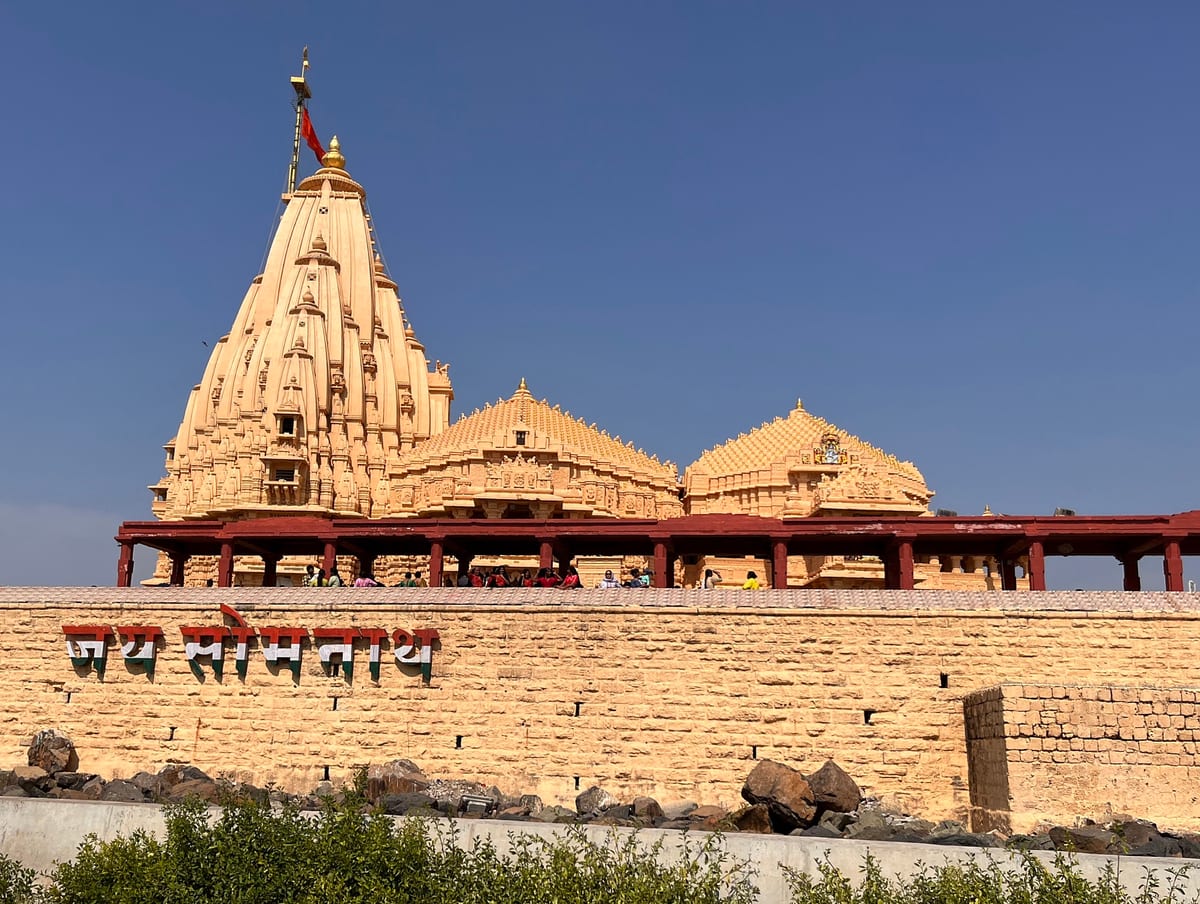
There is a moment, just before sunrise, when the Arabian Sea turns the colour of hammered copper and the spire of Somnath Temple rises against it like a prayer made permanent in stone. Standing on the Prabhas Patan coast in Gujarat's Saurashtra district, this is not merely a temple. It is a civilisational argument, patient, ancient, and utterly undefeated.
The Weight of History
Somnath occupies a singular place in Indian memory. It is the first and foremost among the twelve Jyotirlingas, the sacred abodes of Lord Shiva's divine light, and its antiquity is staggering. Mentioned in ancient texts including the Shiva Purana, the Skanda Purana, and the Shreemad Bhagavat, the site has been a locus of devotion since time beyond reckoning. The name Somnath means Lord of the Moon, rooted in the legend that the moon god Soma himself built the original temple in gold to honour Shiva after being relieved of a divine curse.
What most distinguishes Somnath in India's historical consciousness is its extraordinary arc of destruction and resurrection. The temple was sacked and looted multiple times over the centuries, most famously by Mahmud of Ghazni in 1025 CE, an assault so symbolically brutal that it echoed through subsequent centuries of Indian cultural memory. Each time it was razed, it was rebuilt. By Hindu kings of Rajasthan, by the Solanki rulers, by Maratha queens. Each reconstruction was an act of defiance, a refusal to allow sacred geography to be erased from living memory.
The most recent reconstruction came in the years following Indian Independence. Sardar Vallabhbhai Patel, the Iron Man of India, personally championed the temple's rebuilding as a sovereign nation's affirmation of its own roots. The current structure, built in the Chalukya style of architecture, was inaugurated by President Dr. Rajendra Prasad in 1951. That act, a secular republic choosing to restore one of its most sacred sites, was itself a statement: that modern India and ancient India are not two different stories.
What You Experience as a Visitor
Arriving at Somnath, most visitors feel something shift, a quality of presence that is difficult to name but impossible to ignore. The temple complex is majestic: its Meru-style shikhara soars skyward, intricately carved and luminous in the coastal light. The sanctum sanctorum houses the sacred Jyotirlinga, before which a constant stream of devotees offers prayers, flowers, and the low, reverberant sound of chanting that seems to come from the walls themselves.
One of the most remarkable features is the Baan Stambha, the Arrow Pillar, that stands at the temple's sea-facing edge. Its inscription declares, in ancient Sanskrit, that there is no land between this point and the South Pole. Standing before it, with the sea wind pulling at your clothes and the ocean stretching to the horizon, the words produce an almost vertiginous sense of India's place in the world, cosmologically certain, geographically precise, spiritually rooted.
Every evening, the temple hosts a sound-and-light show that narrates the history of Somnath in vivid detail, the invasions, the reconstructions, the devotion that persisted through each assault. For many visitors, it is the moment the temple's story moves from the intellectual to the visceral.
The Incredible India page for Somnath Temple identifies the destination as one of Gujarat's most spiritually and historically significant sites, drawing pilgrims and heritage travellers from across India and the world.
Beyond the Temple: The Sacred Landscape of Prabhas Patan
Somnath does not stand alone. The surrounding region of Prabhas Patan has deep sacred and historical significance. The Triveni Sangam, the confluence of the Hiran, Kapila, and Saraswati rivers, lies nearby and is itself a site of pilgrimage. The ancient Bhalka Teertha, just a short distance away, is where, according to tradition, Lord Krishna received an arrow wound that marked the end of his earthly sojourn, making this coast one of the most mythologically dense landscapes in all of India.
The Somnath Museum, housed within the temple complex, displays architectural fragments recovered from earlier iterations of the temple, carved panels, pillars, and sculptures that bear the marks of both artistry and destruction. It is quietly devastating and quietly inspiring in equal measure.
The coastal town of Diu, a former Portuguese enclave with its own fort, beaches, and distinctive Indo-Portuguese architecture, is roughly two hours away and makes for a natural complement to any Somnath visit, ancient devotion on one end of the drive, colonial history and sea-facing cliffs on the other.
When to Visit and How to Get There
The ideal time to visit Somnath is between October and March, when Gujarat's coastal climate is temperate and pleasant. The monsoon season, from June to September, brings heavy rains and rough seas, though some visitors find the drama of the sea against the temple in the monsoon an experience of its own. Summers, from April to June, are intensely hot along the Saurashtra coast and best avoided unless you are an early-morning-only visitor.
Somnath is well connected by rail, Veraval Junction, approximately six kilometres away, is the nearest railway station with connections to Ahmedabad, Mumbai, and other major cities. The nearest airport is at Diu, roughly 85 kilometres away, with limited flights; Rajkot Airport, about 190 kilometres distant, offers broader connectivity. From Ahmedabad, Somnath is roughly 400 kilometres, manageable as an overnight train journey or a comfortable long-distance drive through Gujarat's heartland.
A Place That Refuses to Be the Past
What ultimately makes Somnath irreplaceable in India's heritage landscape is that it is not finished. It is not a ruin, not a museum, not a monument to something that was. The bells ring every morning. The oil lamps are lit every evening. The chanting continues through the night. Pilgrims arrive on overnight buses from villages across Gujarat, Maharashtra, and Rajasthan, their faith as immediate and unself-conscious as it has been for a thousand years.
India has many ancient temples. It has very few that carry this particular combination of mythological depth, documented historical trauma, deliberate national reconstruction, and unbroken living practice. Somnath is not India's past preserved. It is India's past continuing, breathing, praying, and facing the sea.