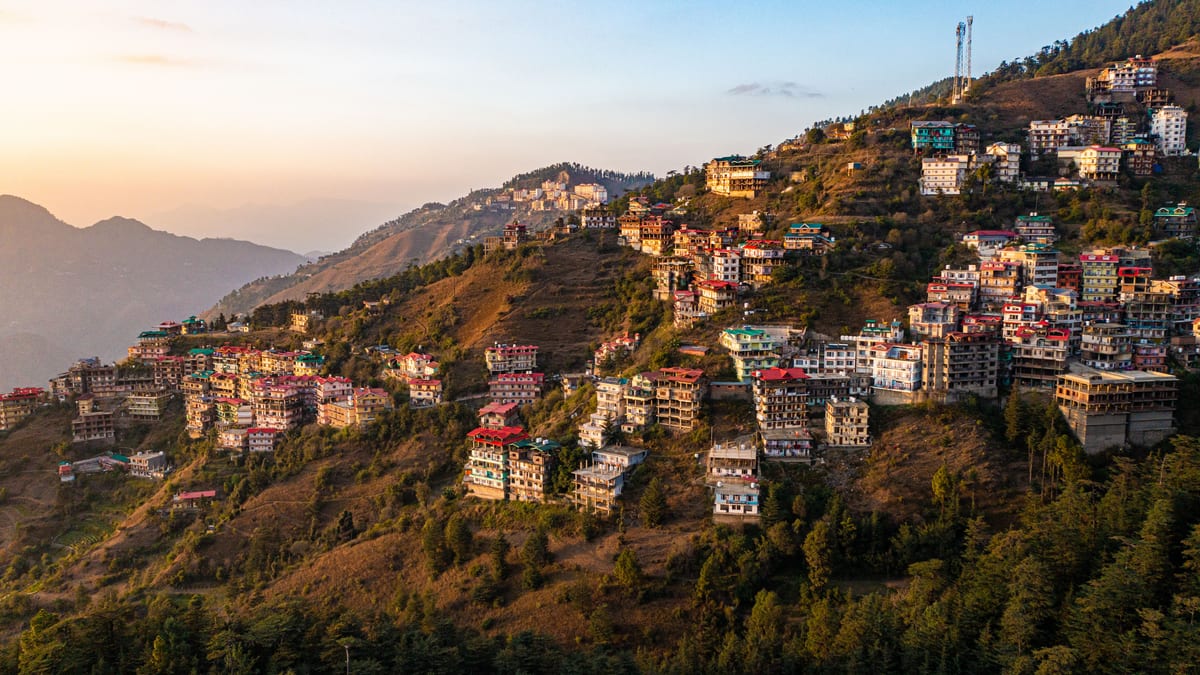
There is a moment, just before dawn breaks over Tiger Hill, when the darkness over Darjeeling holds its breath. And then, in a slow golden exhale, the summit of Kanchenjunga catches the first light of the sun, third highest peak on earth, burning amber and rose above a sea of cloud. If India has a single image that captures both its scale and its serenity, it may well be this one. Welcome to Darjeeling, the Queen of the Hills, where the air tastes of pine and possibility, and where every cup of tea carries the weight of history.
A Gift That Shaped a Destination
Before it became the destination that writers, wanderers, and tea lovers dream of, Darjeeling had a quietly dramatic origin story. Before the East India Company arrived in 1835, Darjeeling was part of Sikkim. When the Governor General of British India expressed interest in acquiring these hills, recognising their potential as a sanatorium, given the region's cool and restorative climate, the Raja of Sikkim made an extraordinary gesture. He presented Darjeeling to the East India Company as a token of friendship. In return, the Raja received a double-barrelled gun, a rifle, twenty yards of red broadcloth, and two shawls. That was the transaction through which one of India's most beloved destinations changed hands.
What followed was a period of colonial development that layered Victorian architecture onto Himalayan terrain, introduced tea cultivation on a commercial scale, and built the remarkable narrow-gauge railway that still winds through the hills today. Darjeeling became the summer capital of the Bengal Presidency, a retreat for those in power, a place apart from the plains. Yet the hills were never merely colonial property. They held older traditions, older peoples, and older ways of knowing the world. That tension, and that harmony, is precisely what makes Darjeeling compelling to visit today.
The Toy Train and the American Who Loved It
No journey to Darjeeling is complete without a ride on the Darjeeling Himalayan Railway, declared a UNESCO World Heritage Site and affectionately known across India and the world as the Toy Train. The narrow-gauge steam locomotive chugs and loops through mountain terrain in a manner that feels almost theatrical, as if the hills themselves are performing for the passengers. The train climbs gradients, doubles back on itself in breathtaking zigzags, and drifts past tea gardens, forest clearings, and hillside hamlets with the unhurried confidence of something that has nowhere more important to be.
Mark Twain, the great American writer, rode this very train in 1895. He described the experience as "the most enjoyable day I have spent on earth mixed with the ecstasy of deadly fright and unimaginable joy." More than a century later, that description still rings true. The Toy Train is testimony to the ingenuity of its builders, to the endurance of a machine, and to Darjeeling's gift for making even a railway journey feel like literature. For information on visiting Darjeeling and planning your own ride, the Incredible India official page for Darjeeling is your best starting point.
Tea, Terrain, and Civilisational Continuity
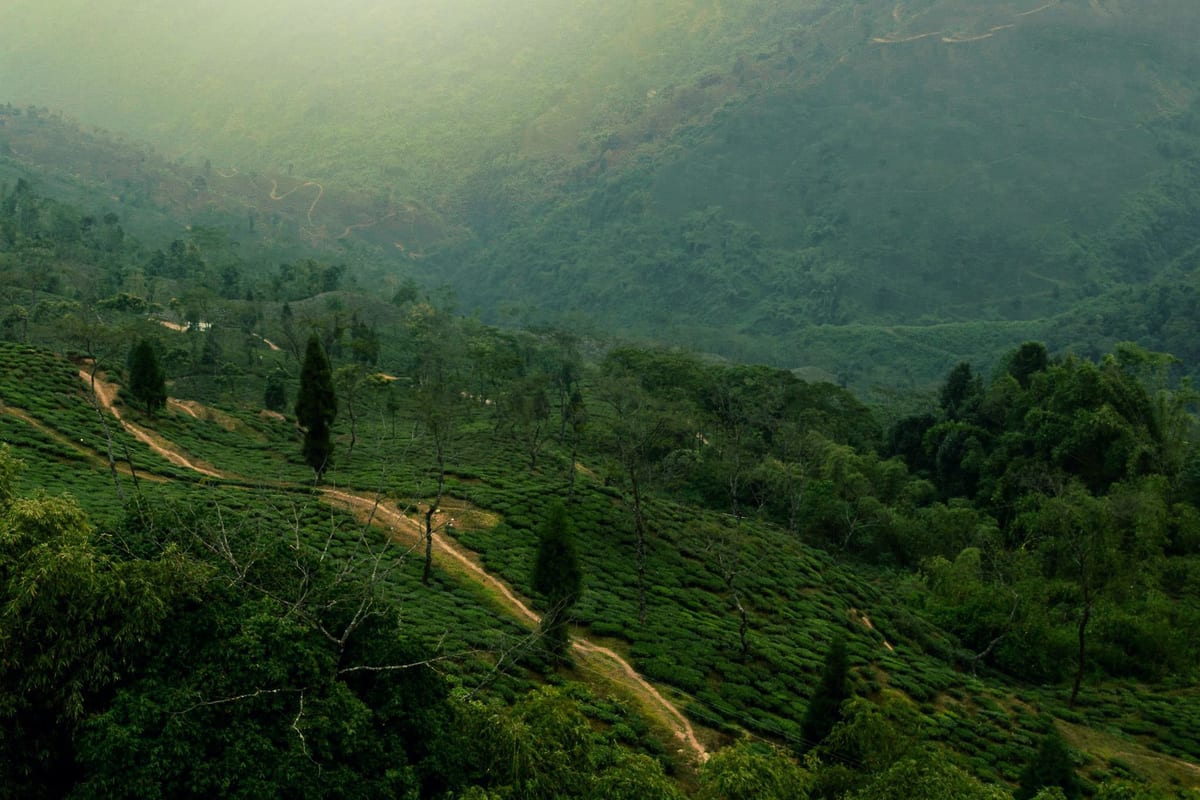
Darjeeling tea is not simply a beverage. It is geography made drinkable. The muscatel flavour, that distinctive musky sweetness unique to teas grown at this altitude, in this soil, under these clouds, cannot be replicated anywhere else on earth. The Happy Valley Tea Estate, with its rich history dating back to 1854, is one of the great living monuments of this tradition. Walking through its ordered rows of tea bushes, watching the deft hands of pluckers at work, understanding the craft of withering, rolling, and fermentation, it is an encounter with a form of knowledge passed down across generations and continuing to evolve. This is not heritage frozen behind glass. This is heritage in motion, in your cup.
The same living quality defines Darjeeling's monasteries. After the Tibetan uprising in 1959, thousands of Tibetans followed the Dalai Lama into exile in India, and many made their home in Darjeeling. The monasteries they established and sustained here, rich with thangka paintings, the low resonance of chanting, and the warm glow of butter lamps, are among the most significant acts of cultural preservation in modern Asian history. India gave these communities shelter. In return, they gifted Darjeeling a spiritual depth that no colonial-era building or tea estate alone could provide. This, too, is part of the Indian civilisational tradition: the capacity to hold multiple heritages without diminishing any of them.
When to Visit and How to Get There
Darjeeling rewards visitors across much of the year, though each season offers a different mood. Spring, from March to May, is arguably the finest window, temperatures range from a pleasant 3°C to 22°C, rhododendrons are in bloom, and the air between monsoon seasons is crisp and clear. The post-monsoon months of October and November bring vivid skies and outstanding mountain views, with temperatures hovering between 4°C and 23°C. Winters, from December through February, are cold but hauntingly beautiful, temperatures can dip below zero at night, and snowfall occasionally dusts the higher elevations. The monsoon months of June through September bring heavy rainfall but also a lush, almost supernatural green to the tea gardens.
The nearest airport is Bagdogra International Airport (IXB), approximately 90 kilometres from Darjeeling, with regular flights connecting to Kolkata, Delhi, and other major Indian cities. From the airport, shared taxis and private cabs make the scenic mountain drive in roughly three hours. Alternatively, travellers can arrive by train at New Jalpaiguri Junction Railway Station (NJP), one of the best-connected rail hubs in Northeast India, and proceed from there by road. For those with time and a spirit of adventure, the journey by road through the foothills, tea estates rolling past the windows, the air gradually cooling, the altitude making itself known, is itself a prelude worth savouring.
Why Darjeeling Belongs in India's Heritage Story
India's living heritage is not confined to ancient temples or classical texts. It breathes in places like Darjeeling, where a colonial railway becomes a source of communal pride, where a Tibetan monastery stands as an expression of India's centuries-old tradition of refuge and pluralism, where a cup of tea connects the smallholder farmer to the global table. Darjeeling was born from a gesture of friendship, gifted by one ruler to another across a cultural divide, and that spirit of generous exchange has never really left. The Queen of the Hills does not ask you to choose between its histories. It asks you to hold all of them at once, the way the mountains hold the morning light: fully, without preference, with something approaching grace.
Pack a warm layer. Arrive at dawn. Watch Kanchenjunga light up. Then sit down with a first-flush Darjeeling in your hands and understand, in the most sensory way possible, why some places are not merely destinations but arguments, quiet, beautiful, unanswerable, for why civilisation matters.