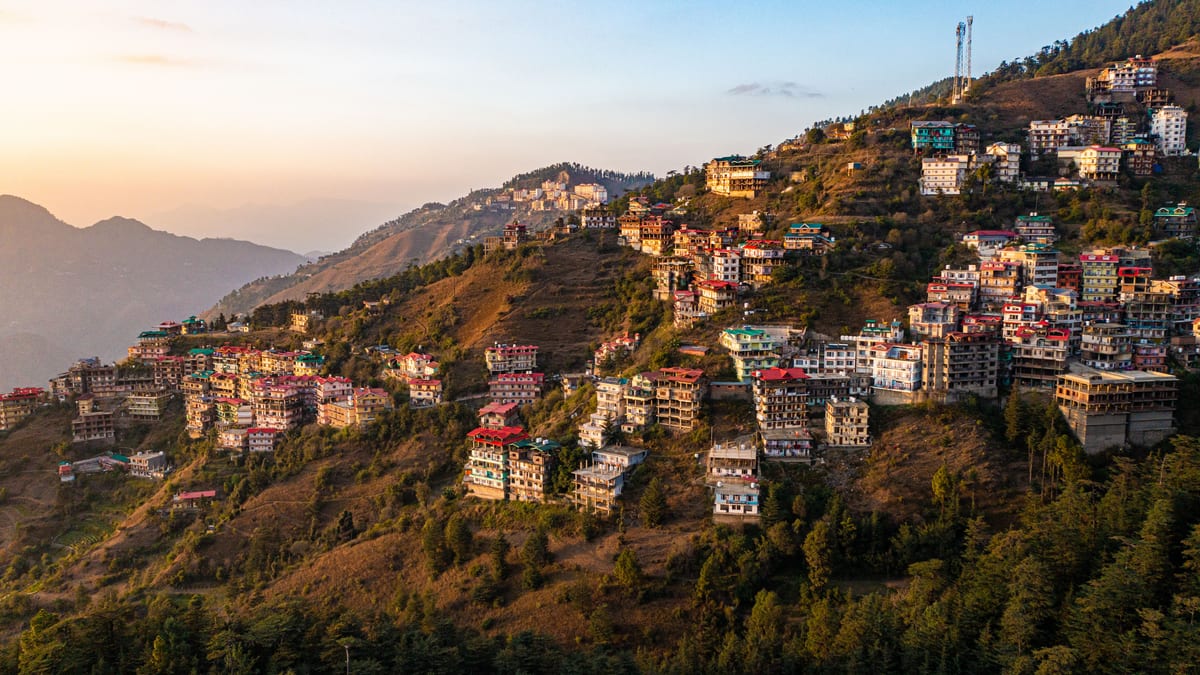
There is a particular quality of light in Shimla in the early morning, thin, silver-blue, spilling across pine-dark ridges and catching the distant snow of the Himalayan peaks, that makes you feel, with sudden conviction, that you have arrived somewhere that genuinely matters. Not just as a destination. As a place. As a presence.
Shimla, the capital of Himachal Pradesh and fondly known as the Queen of the Hills, has drawn people into that feeling for well over a century and a half. It was the summer capital of British India, the seat of imperial power when the heat of the plains became unbearable. The town carries that history in its bones, in the gabled rooftops, the cast-iron lampposts, the Gothic churches and the grand promenades. But Shimla is not merely a colonial relic. It is a living Himalayan town, pulsing with its own culture, its own faith, its own stubborn, beautiful identity.
A Town That Holds History Like Mountain Stone
To walk through Shimla is to move through layers of time without ever leaving the present. The Mall, the central artery of the town, is lined with shops, bakeries, and eateries that hum with everyday life, yet the buildings that house them belong to another era. A few steps away, the Ridge, a broad open esplanade with the Himalayas as its permanent backdrop, hosts festivals, live music performances, and community celebrations throughout the year. This town does not keep its history behind a velvet rope. It wears it, inhabits it, spills tea on it.
Among Shimla's most significant cultural landmarks is the Gaiety Heritage Cultural Complex, a magnificent five-storey Victorian building now over 120 years old. It has served as a theatre and cultural hub through the colonial period, through independence, and into the present day. Performances still take place here. The building breathes. That continuity, an imperial theatre repurposed as a stage for Indian cultural expression, reflects how this town has always functioned: absorbing what comes, and making it its own.
For those who want to understand the deeper civilisational story, the Himachal State Museum and Library is essential. Its collection spans rare books and manuscripts, traditional Himachali artefacts, ancient coins, pottery, miniature paintings, textiles, sculptures, and a celebrated doll gallery. The richness of Himachali folk culture, a culture that predates the British by millennia, is laid out with quiet confidence. The region was never a blank canvas. It had its own art, its own language, its own gods. The museum makes that plain.
The Spiritual Geography of the Hills
No visit to Shimla is complete without time given to its spiritual landscape. The Tara Devi Temple, perched on a hilltop outside the town, is one of the most revered shrines in the region, drawing pilgrims who have been making the ascent for generations. Historic churches, including Christ Church on the Ridge, one of the oldest in North India, stand as architectural reminders of the colonial chapter, their stained glass casting coloured light on stone floors worn smooth by decades of quiet footsteps. These temples and churches coexist without tension. That, too, is a very Indian thing.
The Toy Train: A UNESCO Journey Through the Hills
If there is a single experience that captures Shimla's character, unhurried, scenic, historically weighted, and gloriously impractical by modern standards, it is the Kalka-Shimla Railway, a UNESCO World Heritage Site. The narrow-gauge Toy Train winds through the Himalayan foothills in a series of tunnels, bridges, and vertiginous curves, covering the journey at a pace that invites you to look out of the window and think. The British built it to service their summer capital. It is now one of India's most beloved rail journeys. The train, like the town, has outgrown the purpose it was built for and found a richer one.
When to Go and How to Get There
Shimla is a year-round destination, though each season offers a distinctly different experience. Summer (March to June) brings temperatures ranging from a cool 2°C at night in March to a pleasant high of around 29°C in June, perfect for those escaping the heat of the Indian plains, and the most popular time to visit. Monsoon (July to September) drapes the hills in green, though some roads can be affected by rain. Autumn (October and November) offers crisp air, clear skies, and some of the finest views of the snow-dusted peaks. Winter (December to February) brings snowfall and sub-zero nights, temperatures can dip to -2°C in January, turning Shimla into something from a different world entirely, hushed and white and impossibly photogenic.
For air travellers, the nearest airports are Shimla Airport (SLV) and Shaheed Bhagat Singh International Airport (IXC) in Chandigarh. Shimla is also well-connected by road from Delhi and Chandigarh. And, of course, there is the Toy Train from Kalka, the most atmospheric arrival possible, and the one this writer would always recommend. The nearest railway station is Shimla Railway Station (SML).
Once in town, do not rush. Take the Heritage Walk that winds through the most historically significant lanes and buildings. Wander the Mall without an agenda. Sit on the Ridge at dusk and watch the mountains change colour. Visit the museum. Light a lamp at Tara Devi. Drink chai in a small shop where the owner has opinions about everything and time for everyone.
Why Shimla Still Matters
India has many beautiful hill stations. Shimla is something more. It is a place where the arc of modern Indian history is visible in the fabric of the streets, where you can trace the transition from empire to independence, from colonial imposition to cultural reclamation, all within a morning's walk. The colonial buildings did not win. Neither did they lose. They were simply incorporated into something larger and older and more enduring: a Himalayan town with its own deep roots, its own deities, its own way of being in the world.
That is the civilisational story Shimla tells. Not a story of defeat or of triumph, but of continuity. India was here before the Raj arrived, and it is very much here now. Shimla, Queen of the Hills, is living proof.
Plan your visit with the official destination guide at Shimla, Incredible India, Ministry of Tourism.