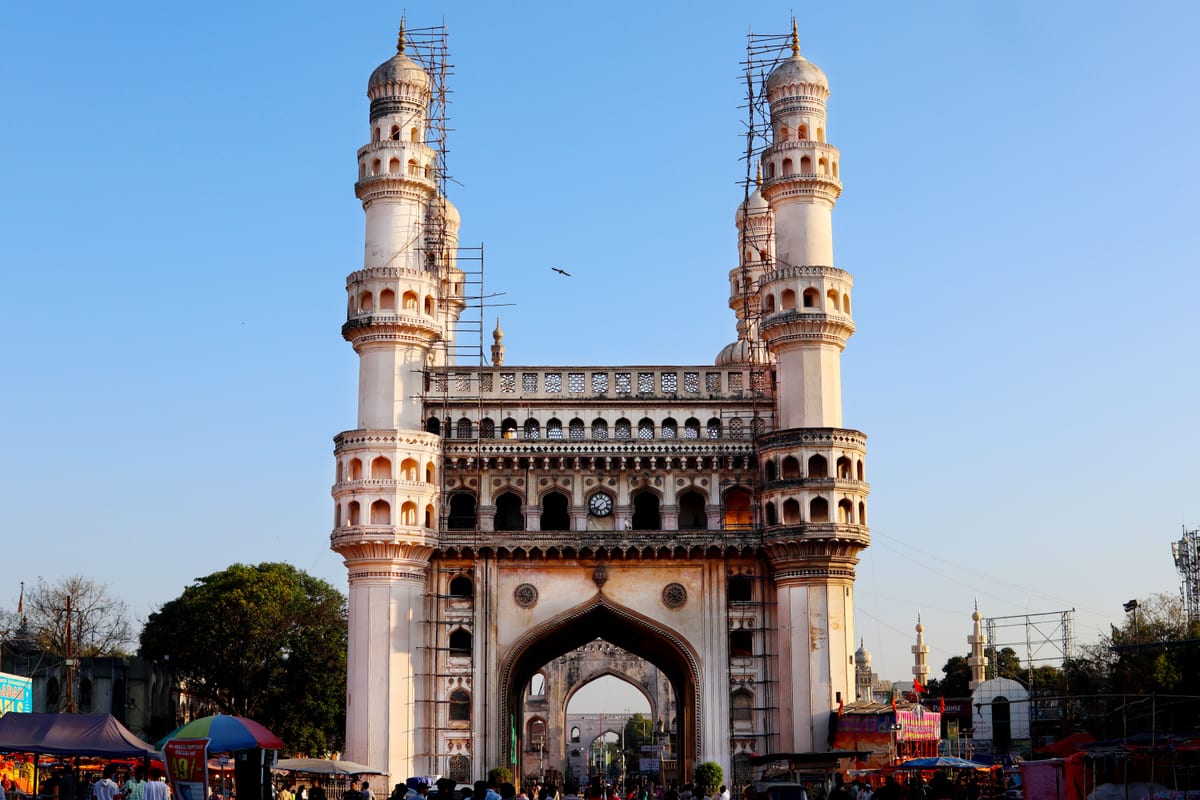
There is a particular hour in Hyderabad, just after the Fajr azaan dissolves into the morning air and before the first bangle-seller rattles open his shutters, when Charminar belongs entirely to itself. The four minarets catch the early light in gradations of pale gold, and for a moment the monument looks less like stone and more like a thought that has been thinking itself for four hundred years. This is the experience that no photograph adequately prepares you for, and it is why, once seen in person, Charminar never quite leaves you.
A Monument Born from Gratitude and Vision
Charminar was commissioned in 1591 by Muhammad Quli Qutb Shah, the fifth sultan of the Qutb Shahi dynasty, to mark the founding of his new capital city, Hyderabad. According to historical tradition, the sultan prayed for the end of a devastating plague that had swept through his earlier capital, Golconda, and vowed to build a mosque at the very spot where he had offered his prayer. Charminar, literally 'Four Minarets' in Urdu, was that act of thanksgiving made permanent in limestone, granite, and mortar.
The structure is a square archway, roughly 20 metres on each side, with four grand arches opening towards the four cardinal directions. Rising from each corner are the minarets that give the monument its name, each soaring approximately 56 metres into the sky and topped with elegant bulbous domes. A functioning mosque occupies the second floor, making Charminar not a monument frozen in time but a place of active worship, Friday after Friday, century after century. As Incredible India's official page on Charminar notes, the monument fuses Indo-Islamic architecture, drawing on Persian and Hindu design vocabularies in a synthesis that would define the Hyderabadi aesthetic.
The Civilisational Crossroads Beneath Its Arches
What makes Charminar exceptional in India's heritage story is not merely its architecture but the living ecosystem that has grown around it over four centuries. The moment you step beneath one of its great arches, you are swallowed by Laad Bazaar, a market of luminous glass bangles, pearl jewellery, embroidered fabrics, and the intoxicating smell of attar. A few hundred metres away, the Mecca Masjid, one of the oldest and largest mosques in India, anchors the neighbourhood spiritually. And yet, barely a stone's throw from Charminar's shadow, the Bhagyalakshmi Temple clings to the base of the monument itself, its vermillion-daubed threshold receiving a steady stream of devotees every single day.
This is not the secularism of policy documents. This is the secularism of daily life, of the Hindu shopkeeper selling prayer caps to Muslim pilgrims, of the Urdu poet who invokes both Imam Hussain and Goddess Lakshmi in the same ghazal. Charminar is co-existence as an unremarkable, ordinary fact. That ordinariness is the most extraordinary thing about it.
What Visitors Experience
Approaching Charminar from the narrow lanes of the old city is itself a pilgrimage. The streets narrow, the noise intensifies, the clatter of bangles, the call of vendors, the rumble of auto-rickshaws negotiating impossible turns, and then, suddenly, the monument erupts into view at the centre of a chaotic but joyous roundabout. It is one of the great urban reveals in Indian travel.
Visitors can climb to the upper galleries of Charminar, where the intricately carved balustrades and the small mosque offer a quieter, more contemplative experience above the street-level theatre. From here, the old city of Hyderabad spreads out in every direction, dense, amber-toned, with minarets, temple spires, and terracotta rooftops that look much as it might have during the Nizam's era. The view alone justifies the climb. On the ground floor, the arches frame the city like living paintings, and the surrounding Char Kaman, four ceremonial gateways built in the same era, give the entire precinct an urban grandeur that few Indian city centres possess.
Best Time to Visit
Hyderabad's climate makes the cooler months between October and February the most comfortable time to visit Charminar. The heat of the Deccan summer can be punishing from April through June, though the monsoon season from July to September brings relief and a certain misty charm to the old city's stone textures. Mornings are the quietest and most atmospheric time to visit; evenings, when the monument is illuminated and the bazaars are in full swing, offer a different but equally compelling experience. During Ramadan, the area around Charminar comes alive with a festive nocturnal energy that is deeply special.
Getting There and Nearby Attractions
Hyderabad is exceptionally well connected. Rajiv Gandhi International Airport serves direct flights from most major Indian cities and several international destinations. From the airport, Charminar is approximately 30 kilometres away, accessible by cab, metro (to the nearest interchange), and local transport. The old city area is best explored on foot or by auto-rickshaw once you are in the vicinity.
No visit to Charminar is complete without also exploring the Mecca Masjid, the Chowmahalla Palace, and the magnificent Golconda Fort, a 16-kilometre drive away, where the Qutb Shahi dynasty's story began. The Salar Jung Museum, housing one of the world's largest private art collections, is also within easy reach and adds essential depth to any understanding of Hyderabadi history.
Why Charminar Matters
In a country as vast and layered as India, certain places carry more than their own history, they carry an argument. Charminar's argument is quiet but irrefutable: that greatness is often born at the intersection of cultures, that the most durable monuments are not those that exclude but those that invite, and that a civilisation's true strength lies in its capacity to hold contradictions with grace. Four centuries after Muhammad Quli Qutb Shah pressed his forehead to the earth in gratitude, Charminar still stands, not as a museum piece behind a velvet rope, but as a living, breathing centre of the city it created. India's heritage story has many chapters, but few are as vivid, as fragrant, or as insistently alive as this one.