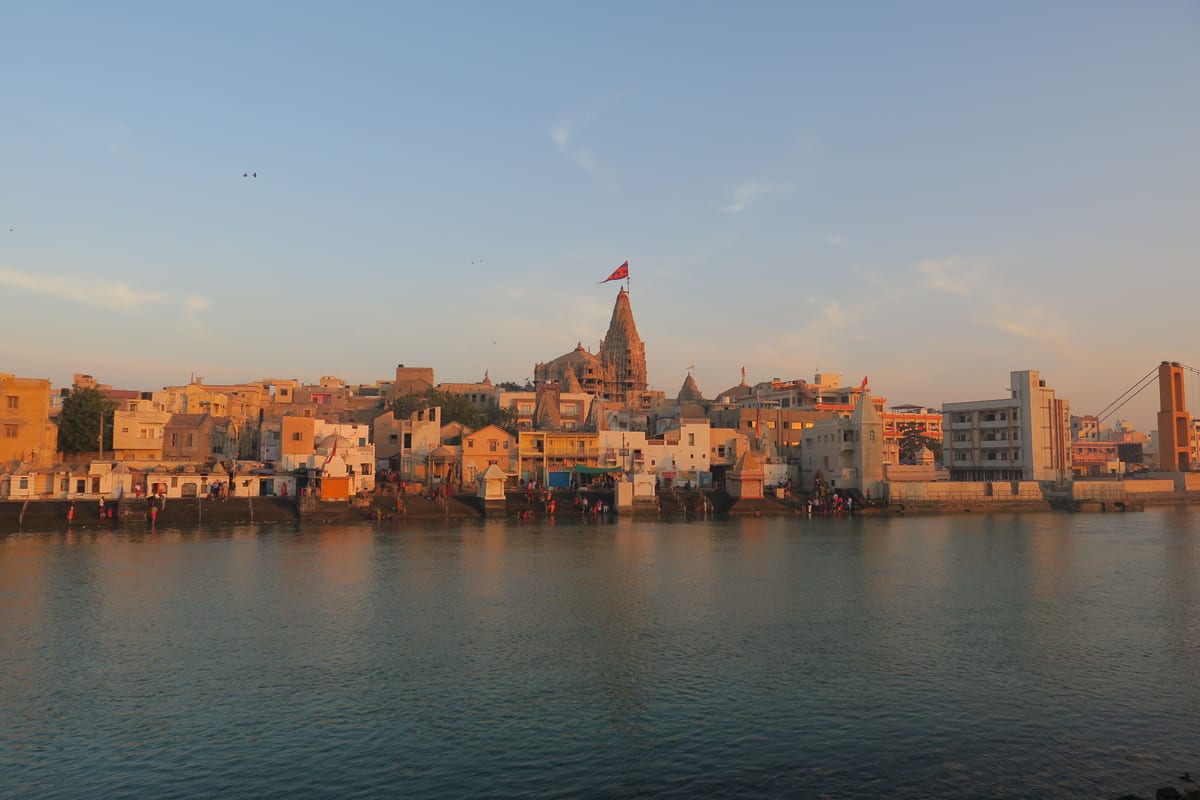
There are places in the world that carry history lightly, like a pleasant perfume. And then there are places that carry it the way the sea carries salt, absolutely, essentially, with no separation between the thing and what it has always been. Somnath Temple, rising in pale stone at the edge of the Arabian Sea in Gujarat's Saurashtra region, belongs entirely to the second kind.
This is not a destination you visit simply to tick a box. You come to Somnath to feel the weight and the wonder of a civilisation that refused to be erased.
The First Temple of the Moon
Somnath, literally Lord of the Moon, a name for Shiva, is counted among the twelve sacred Jyotirlingas of Hinduism, the most revered manifestations of Lord Shiva across the subcontinent. Its origins dissolve into mythology: ancient texts describe it as a temple of such staggering wealth and splendour that it drew pilgrims and, eventually, plunderers from across the known world.
The most infamous chapter in Somnath's history arrived in 1025 CE when Mahmud of Ghazni led his forces across the desert to sack the temple, reportedly carrying away an almost unimaginable treasury. He was not the last. Over centuries, the temple was attacked, demolished, and desecrated multiple times, by Alauddin Khilji's generals, by Aurangzeb, and each time, the response from the people of this land was the same: they rebuilt it.
That act of rebuilding is not a footnote to Somnath's history. It is the history. The temple that stands today, consecrated on December 1, 1951, by then President Dr. Rajendra Prasad following the passionate advocacy of Sardar Vallabhbhai Patel, is the latest expression of a determination that stretches back well over a thousand years. Patel saw the restoration of Somnath as a matter of national honour, the first sovereign act of cultural reclamation by a newly independent India.
What You Experience at Somnath
Arriving at Somnath, most visitors are struck first by the setting. The temple stands directly on the shoreline of the Prabhas Patan coast, and the sea wind is a constant companion as you approach. The architecture follows the Chalukya style, intricately carved, robust, and unapologetically vertical, as though the shikhara is making a point by reaching skyward.
Inside, the sanctum enshrines the Jyotirlinga of Somnath. The atmosphere is hushed, charged, and somehow both intimate and enormous at once. Thousands of devotees from across the country arrive daily, many having saved for years to make this pilgrimage.
One of the most memorable experiences is the evening Sound and Light Show held in the temple grounds, which tells the story of Somnath across the centuries. Standing beneath an open Gujarat sky, watching light play across stone as the narrative of destruction and resurrection unfolds, is moving, even for the secular traveller.
Near the temple, a signboard faces the sea and bears an inscription noting that the next piece of land in the direction of the ocean, stretching to the South Pole, is the Antarctic continent. You are standing at an edge, geographical and historical both.
Living Heritage, Not a Museum Piece
What distinguishes Somnath from many heritage sites across the world is that it is not preserved in amber. This is an actively worshipped temple, with daily rituals, festivals observed with full traditional rigour, and a congregation of faith that has never really lapsed. The heritage here is not curated for visitors, visitors are admitted into something ongoing.
The Incredible India official page for Somnath Temple situates the destination within Gujarat's extraordinary cultural landscape, noting both its religious primacy and its significance as a site of national memory. For those who want to understand India not as a geographic entity but as a civilisational project, Somnath is essential.
Nearby Attractions
The region around Somnath rewards those who linger. Prabhas Patan Museum, adjacent to the temple, houses sculptures and artefacts recovered from the original temple complex, tangible fragments of everything that was lost and preserved nonetheless. The ancient town of Veraval, just a few kilometres away, is one of Gujarat's major fishing ports, its harbour a lively contrast to the temple's solemnity. Bhalka Tirth, believed to be the spot where Lord Krishna received the arrow that ended his earthly life, is a short distance away and adds another layer of mythological significance to the landscape. Gir National Park, the last wild habitat of the Asiatic lion, lies roughly 45 kilometres from Somnath and makes for an extraordinary complement to the spiritual itinerary.
Practical Travel Guide
Best time to visit: October through March offers the most comfortable weather along Gujarat's coast. The winter months bring pleasant temperatures and clear skies, ideal for both outdoor exploration and temple visits. The festival of Maha Shivaratri draws particularly large pilgrim gatherings and is a remarkable time to witness the temple in full ceremonial life, though accommodation should be booked well in advance.
How to reach: The nearest airport is Diu Airport, approximately 85 kilometres away, with connections to major Indian cities. Veraval Railway Station, about 7 kilometres from Somnath, is well connected to Ahmedabad, Mumbai, and other major hubs. By road, Somnath is approximately 400 kilometres from Ahmedabad, and state highway connections are reliable. Gujarat's road infrastructure makes self-drive and hired-car options very workable.
Accommodation: Somnath has a range of guesthouses, dharamshalas, and hotels catering to pilgrims and tourists alike. The Somnath Trust manages some accommodation on-site. For greater comfort, Veraval and nearby areas offer additional options.
Why Somnath Matters
India has no shortage of ancient temples. What sets Somnath apart is the specific narrative it carries, not of unbroken continuity, but of broken continuity repaired, again and again, by the stubborn insistence of a people on expressing what they believe and who they are. In the 21st century, when conversations about civilisational identity are often abstract or academic, Somnath makes the argument in stone and sea-wind and incense smoke.
Come here to pray, if you pray, or to marvel at architecture, though there is much to marvel at. Come here to understand what it means that this place still stands, and to ask yourself what, in your own life, is worth rebuilding twelve times over.