There is a moment, and every honest visitor will admit it, when you pass through the great sandstone gateway of the Taj Mahal and the world rearranges itself. The white marble dome floats at the end of a long reflecting pool, perfectly symmetrical, almost impossibly luminous, and for a breath or two you forget that you are standing on solid ground. You are, without ceremony or warning, inside one of humanity's most extraordinary achievements.
The Taj Mahal, as celebrated by Incredible India, is a UNESCO World Heritage Site situated on the southern bank of the Yamuna River in Agra, Uttar Pradesh. It is India's most visited monument and, by many measures, the most recognised building on earth. But to call it merely famous is to mistake the shadow for the thing itself.
A Love Story Cast in Marble
The Taj Mahal was commissioned by the fifth Mughal Emperor, Shah Jahan, in memory of his beloved wife Mumtaz Mahal, who died in 1631 during the birth of their fourteenth child. Devastated by grief, Shah Jahan ordered the construction of a mausoleum so magnificent that it would speak of her perfection for all time. Construction began around 1632 and was completed approximately in 1653, involving an estimated twenty thousand artisans drawn from across India, Persia, the Ottoman Empire, and Europe.
The principal architect is widely attributed to Ustad Ahmad Lahauri, though the monument is in truth a collective masterwork. Its white Makrana marble, quarried in Rajasthan, was inlaid with twenty-eight varieties of precious and semi-precious stones including lapis lazuli, jade, crystal, turquoise, and carnelian. The calligraphy panels framing the great arches were executed by the Persian calligrapher Amanat Khan. Every surface is a conversation between geometry and poetry, between human longing and divine order.
Civilisational Confluence, Not a Relic
What makes the Taj Mahal extraordinary in India's heritage story is not simply its beauty but what that beauty represents: the capacity of Indian civilisation to absorb, transform, and elevate. The architectural vocabulary here is profoundly syncretic. The central dome draws from Persian and Timurid traditions; the chattris and the ornamental stone lattice screens known as jalis reflect indigenous Rajput craftsmanship; the garden layout follows the Charbagh pattern of Islamic paradise gardens, yet is rooted in the Indian landscape along the Yamuna's bank.
This is not a monument of one culture imposing itself on another. It is a monument of cultures in deep conversation, producing something that belongs entirely to India and yet speaks to all of humanity. India does not merely preserve the past; it metabolises it into something living. The Taj Mahal is proof of that metabolism in its most breathtaking form.
Today, the monument is woven into the daily fabric of Agra's life, visible from rooftops, reflected in hotel windows, sketched by art students at dawn, photographed by grandmothers on their first smartphone. It is simultaneously the centrepiece of India's tourism economy and a place where local families still come simply to sit in the garden and feel something larger than themselves.
What Visitors Experience
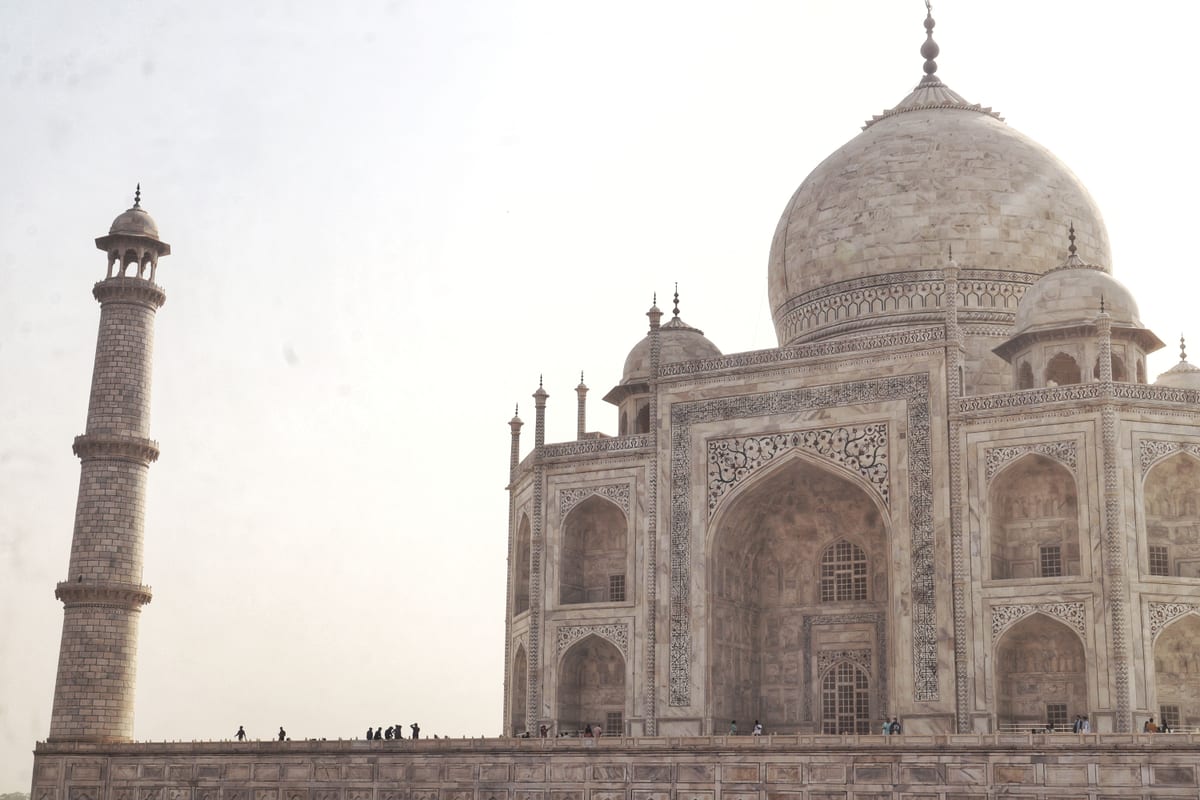
Entering the Taj complex, visitors pass first through the grand Darwaza-i-Rauza, the main gateway of red sandstone, before the full spectacle reveals itself. The central mausoleum is flanked symmetrically by a mosque to the west and a matching jawab, a mirror building used for aesthetic balance, to the east. The minarets at the four corners lean slightly outward, a deliberate engineering choice so that in the event of an earthquake they would fall away from the main structure rather than onto it. Even in its precautions, the Taj demonstrates a kind of tender care.
Inside the mausoleum, in a dimly lit octagonal chamber, lie the cenotaphs of Mumtaz Mahal and Shah Jahan. Their actual graves rest in a crypt below, at garden level. The marble screens surrounding the cenotaphs are so delicately carved that in certain light they appear to be lace rather than stone. Visitors are asked to remove their shoes or wear cloth overshoes before entering, a practice that slows you down, makes you more present, and feels entirely appropriate.
The Taj changes character with the light. At sunrise it glows amber and rose. At midday it turns a cool, almost clinical white. In the blue hour just before dusk it softens into lavender. On full moon nights, when the monument is opened for limited nocturnal visits, it becomes something genuinely unearthly.
Best Time to Visit
The ideal window for visiting Agra and the Taj Mahal is between October and March, when North India's climate is at its most forgiving, cool mornings, clear skies, and the kind of dry air that makes marble gleam. December and January can bring a chill, so carry layers. Summers in Agra are punishing, with temperatures frequently exceeding 40°C, and the monsoon months of July and August bring humidity and occasional haze that can obscure the monument's finer details, though the garden turns lush and green in compensation. Sunrise visits are universally recommended, fewer crowds, extraordinary light, and a quality of quiet that the Taj rarely offers at other hours.
How to Reach Agra
Agra is exceptionally well connected. The fastest option from New Delhi is the Gatimaan Express, India's first semi-high-speed train, which covers the roughly 200-kilometre journey in under two hours. The Shatabdi Express is another reliable choice. By road, the Yamuna Expressway connects Delhi and Agra smoothly, making a self-drive or hired car journey feasible in approximately three hours depending on traffic. Agra also has its own airport, the Agra Civil Terminal, with connections to select Indian cities, though most visitors arrive overland from Delhi or Jaipur. For international travellers, Indira Gandhi International Airport in New Delhi is the primary entry point.
Nearby Attractions: Agra's Wider Heritage Canvas
Agra is not a one-monument city. Agra Fort, a UNESCO World Heritage Site in its own right, stands just a few kilometres from the Taj along the Yamuna. Built by the Emperor Akbar and expanded by his successors, it is a massive sandstone and marble complex of palaces, audience halls, and mosques, a living record of Mughal power at its height. From its ramparts on a clear day you can see the Taj Mahal in the distance, a view Shah Jahan is said to have gazed upon from his imprisonment in his later years.
Fatehpur Sikri, the abandoned Mughal capital founded by Akbar roughly forty kilometres from Agra, is a haunting and extraordinary detour, an entire royal city of red sandstone that was mysteriously deserted within decades of its completion. The drive there passes through Uttar Pradesh's flat agricultural heartland, which has its own quiet beauty. Agra also sits at the western corner of India's famous Golden Triangle tourism circuit, making it a natural companion to Delhi and Jaipur on any first India itinerary.
Why the Taj Mahal Still Matters
In an age of digital saturation, when images of the Taj Mahal appear on everything from tea packaging to screensavers, it would be reasonable to wonder whether the physical experience retains its power. It does. Perhaps more than ever. Standing before the actual monument, feeling the scale of it, watching the light shift across its surface, hearing the murmur of visitors from a dozen countries finding their own silence, reminds you that some things cannot be compressed into a screen. The Taj Mahal requires your presence. It demands the full, embodied, irreplaceable act of being there.
That demand is itself a civilisational statement. India built this not as a file to be archived but as an experience to be lived, again and again, by generation after generation. Four centuries on, it is still working exactly as intended.