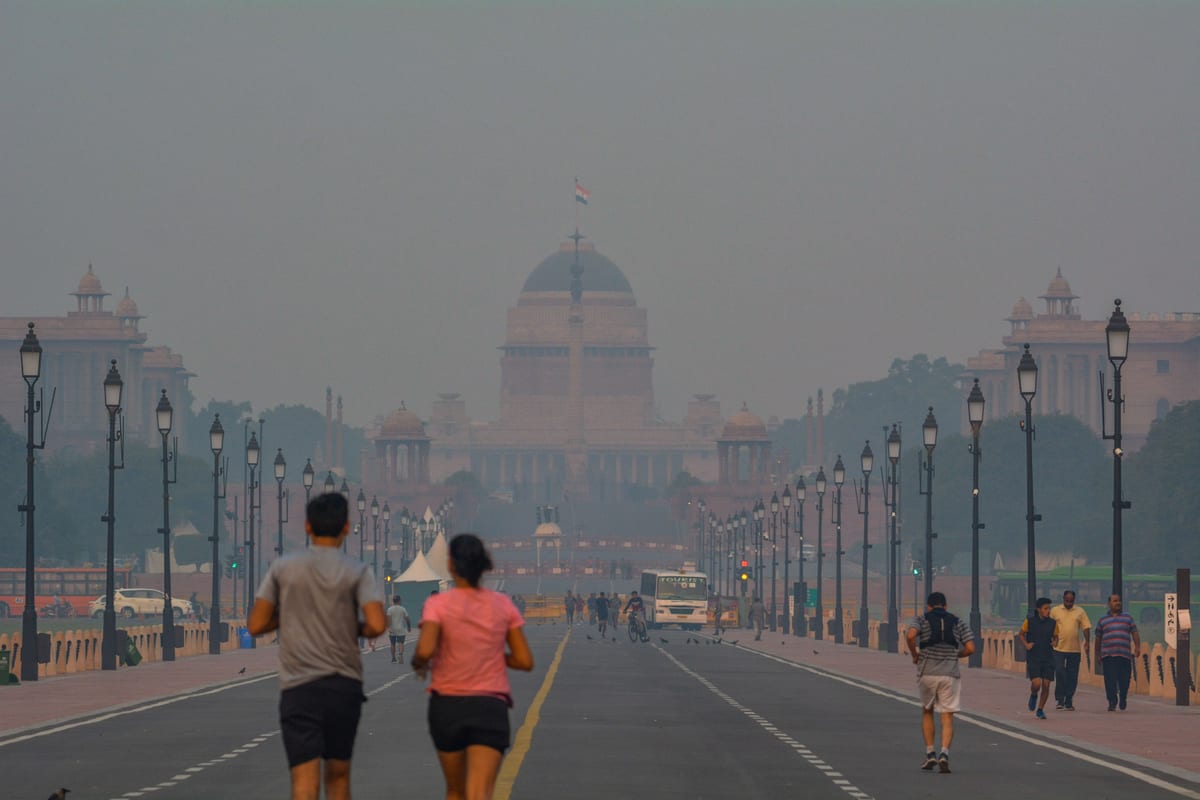
Two days before Diwali, the Commission for Air Quality Management invoked Stage III of the Graded Response Action Plan after Delhi's average Air Quality Index climbed to 382 on Friday. The order took effect immediately across Delhi and the National Capital Region, adding to the restrictions already in force under Stages I and II. The reading placed the capital in the "very poor" category, one step below "severe," but forecasts pointed to worse air through the weekend, as NDTV reported.
Smog had reduced visibility across the capital days before Diwali. The Commission invoked Stage III as a precautionary step, though that stage is generally linked to the "severe" AQI bracket of 401 to 450. Pollution levels were expected to turn severe from Saturday, with Diwali celebrations, vehicular emissions and the peak stubble-burning season adding to the burden, according to LiveMint.
The Graded Response Action Plan is an emergency instrument with four stages: Stage I for AQI 201 to 300, Stage II for 301 to 400, Stage III for 401 to 450, and Stage IV for above 450. Restrictions sharpen as the index worsens, and Stage III's measures sit on top of those already in place under the first two stages.
What Stage III forbids, what it permits
The restrictions under Stage III include a ban on non-essential construction and demolition activities, a prohibition on BS-III petrol and BS-IV diesel vehicles, hybrid classes for students up to Class 5, closure of polluting industries using non-approved fuels, closure of stone crushers across Delhi-NCR, and suspension of mining and related activities. These measures were added to the earlier curbs, not substituted for them.
Public transport remains exempt. Metro services and public buses continue to run, and authorities may increase Metro frequency and add buses to shift commuters off private vehicles. Cleaner vehicles, including eligible BS-VI, CNG and electric models, can operate subject to existing rules. The order aims to cut the most polluting sources without freezing the city's movement entirely.
A precautionary shift in the plan's logic
The decision to invoke Stage III while the AQI remained in the "very poor" band, rather than waiting for "severe", marks a change in the Commission's operating approach. In earlier years, the most disruptive measures arrived only after the index crossed 400. By acting two days before Diwali, CAQM has bought a margin of time. But pre-emption is only as effective as the enforcement behind it.
The order depends on NCR state governments for implementation. Delhi's transport department must stop BS-III petrol and BS-IV diesel vehicles; neighbouring districts must halt construction and stone crushing. These are the same authorities that often issue orders without attaching the monitoring capacity to verify compliance. Without real-time data on vehicle entries and construction sites, a ban exists largely on paper.
The airshed that outlives every winter
Delhi's air emergency did not begin the day the AQI crossed 382; it has been building for months. The Commission's Stage III order is the third rung of a ladder climbed every winter, then descended when winds change. That cyclical pattern exposes the limits of a plan designed to respond to thresholds rather than to sources.
At the heart of the problem is the airshed. Pollution does not respect state boundaries, but enforcement does. The National Capital Region's airshed cuts across Delhi, Haryana, Punjab and Uttar Pradesh, while the Graded Response Action Plan is implemented by state governments. The Commission for Air Quality Management, a statutory body, can order restrictions; it cannot by itself ensure that stubble burning, industrial emissions and construction dust are curbed upstream of the city.
The Commission itself was created to resolve this fragmentation. But the creation of a new coordination body does not change the fact that airshed management requires fiscal and enforcement powers that remain with states. Without a mechanism that can compel upstream action, the Commission's orders will continue to be felt most strongly after the AQI has already deteriorated.
Repeated exposure to winter PM2.5 has been linked to reduced lung growth in children and higher cardiovascular risk in adults. The burden falls hardest on the poor, who cannot seal their homes against the smog or stop working outdoors. The economic cost is similarly real: lost workdays, higher hospitalisations, and a compounding drag on human capital.
The shift to hybrid classes for young children is a direct acknowledgment that the outdoor air is unsafe for developing lungs. But a hybrid class does not reduce the pollution a child breathes at home or on the way to school where buses have not yet arrived. It shifts the burden to families who may not have the space or connectivity for online learning.
The constitutional guarantee under Article 21 of the right to life has been read by courts to include the right to a clean environment. An emergency plan that re-enacts itself every winter sits uneasily with that guarantee. It protects no one if it is triggered only when the air is already unbreathable.
What would a source-based response look like? It would treat stubble burning not as a law-enforcement problem to be fined after the fact, but as an agricultural decision that needs a payment for residue removal made before the burning season. It would expand public transport in the NCR so that the Stage III alternative is not a private car but a reliable bus or metro. It would shift older vehicles off the roads faster and tighten the fuel standards that keep dirtier engines in service. None of these are quick fixes; each attacks the source rather than the symptom.
The order in force this weekend will fade when the wind changes. Whether Delhi's November air becomes a governance marker instead of a recurring emergency depends on whether the Commission and the states can move from stage-based reaction to year-round reduction. Until then, the capital will continue to breathe the same air, and the same restrictions will return.