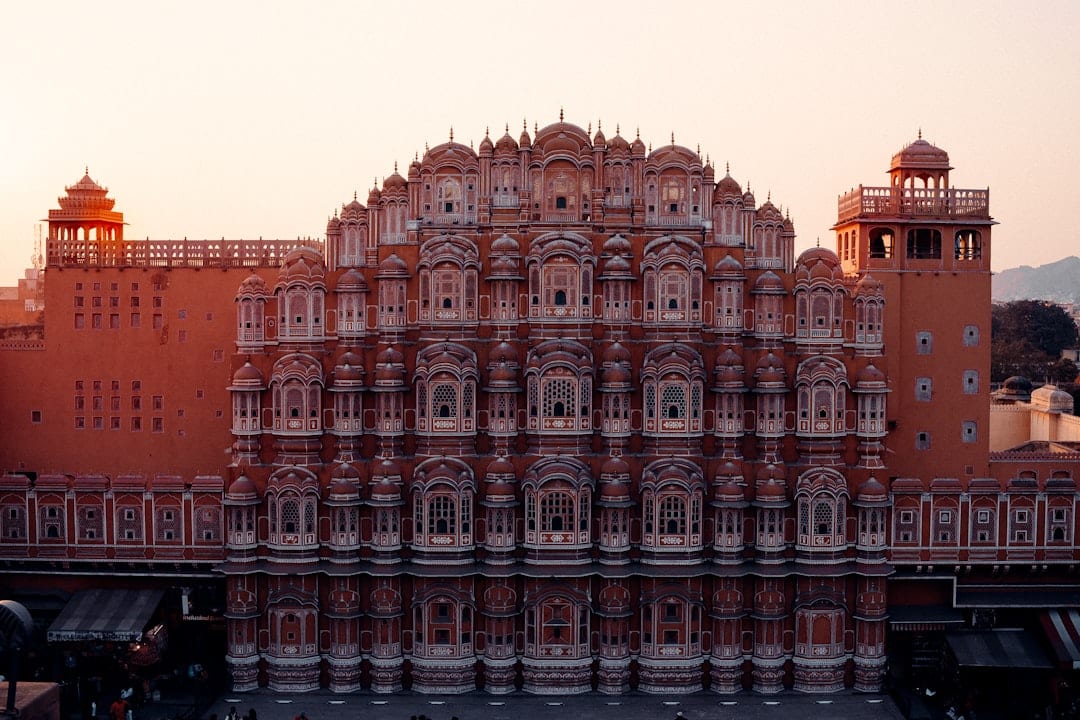
There is a moment, early on a winter morning in Jaipur, when the sun angles itself just so against the eastern façade of Hawa Mahal and the entire structure seems to catch fire — 953 windows glowing amber, the sandstone blushing pink, the street below already humming with flower sellers and chai vendors who have been setting up their stalls beneath this wall for generations. In that moment, you understand something that no guidebook quite prepares you for: Hawa Mahal is not a monument you visit. It is a monument that visits you — again and again, in memory, long after you have left Jaipur behind.
A Palace Born from Wind and Devotion
Hawa Mahal — the Palace of Winds — was commissioned in 1799 by Maharaja Sawai Pratap Singh, a poet-king and devoted worshipper of Lord Krishna. The structure was designed by the architect Lal Chand Ustad. Its distinctive profile, rising five storeys and tapering at the top like a crown or, as many have observed, like the headdress of Lord Krishna himself, was deliberate. Every curve was intentional, every latticed screen both a theological statement and an engineering solution. The palace stands on Siredeori Bazaar in the heart of the old city, its elaborate façade facing east to receive the morning sun — an orientation that reflects the king's devotion and his architect's astronomical knowledge.
The genius of the building lies in its jali work — the latticed screens carved from pink and red sandstone that perforate the palace's face. These screens accomplish two things at once: they allow the desert breeze to circulate through the interior, creating a natural cooling system of remarkable efficiency in a city where summer temperatures can be ferocious, and they give the palace its unmistakable aesthetic identity. Rajput architecture had long understood that a wall need not be a barrier; it can be a filter, a veil, a conversation between inside and outside. Hawa Mahal is the fullest expression of that understanding.
The Architecture of Dignity
The palace's original purpose is worth considering, because it tells us something important about the civilisation that produced it. Hawa Mahal was built primarily so that the women of the royal household — who observed purdah and did not appear in public — could watch the processions, festivals, and daily life of the city below without being seen. The jali screens were their eyes on the world. This was not confinement dressed up in stone; it was a pragmatic, even compassionate, architectural response to the social codes of its time. The palace gave the women of the zenana access to the city's vitality, its colour, its noise, its humanity. They could see the elephant processions during festivals, watch the market traders below, feel the wind come off the Thar desert — all while remaining within the world the palace defined for them.
For the modern visitor, this history adds a layer of poignancy to every window you lean through. You are standing where they stood. The same breeze finds you.
What the Visitor Experiences
Entering Hawa Mahal from the rear — the front façade offers no public entrance — you step into a courtyard that opens the building's interior in ways the street view never suggests. The palace is surprisingly shallow; much of it is, effectively, a screen. Narrow corridors and small chambers rise through the floors, connected by ramps rather than stairs, designed so that women in elaborate dress could ascend without difficulty. Each floor offers a different vantage point over the city, and the view from the upper chambers — across the rooftops of the pink city to the distant Aravalli hills — is one of those views that lodges permanently in the memory.
A small museum within the complex houses royal artefacts, paintings, and ceremonial objects that fill in the human story behind the stone. The objects are modest by the standards of larger palace museums, but they ground you in the world that Hawa Mahal was built to serve.
For the full experience, arrive before the crowds and before the heat. Stand on the pavement across the street and look up at the façade in the early light. Then walk around and enter. Then, if time allows, return at dusk when the sandstone turns to copper and the bazaar below is at its most alive. Three visits, one palace, three completely different conversations.
You can learn more about planning your visit through the official Hawa Mahal page on Incredible India, the Ministry of Tourism's authoritative guide to the destination.
India's Civilisational Continuity, Written in Stone
What makes Hawa Mahal remarkable in the context of India's heritage story is that it has never been frozen in amber. The bazaar that runs beneath its walls has been continuously trading since the palace was built. The craftsmen who carve jali screens in Jaipur's workshops today trace their lineage — craft lineage, if not always blood lineage — directly to the artisans who built this palace. The festivals that once drew royal women to these windows still fill the streets of Jaipur with colour and noise each year. Hawa Mahal is heritage as living practice, not heritage as museum exhibit. India, at its best, understands this better than almost any other civilisation on earth.
Practical Travel Guide
Best Time to Visit: October through March is the ideal window. Rajasthan winters are crisp, clear, and enormously pleasurable — days of warm sunshine, cool evenings, and festival energy. The summer months (April through June) bring intense heat, and while the palace's wind corridors remain ingenious, the mercury outside can be formidable. The monsoon months of July and August bring a different kind of beauty to the region, with the landscape greening and the light turning luminous, though humidity rises.
How to Reach Jaipur: Jaipur is supremely well connected. Jaipur International Airport receives flights from major Indian cities as well as select international routes. The city is also on the main rail network, with excellent train connections from Delhi (around four to five hours), Mumbai, and other major centres. By road, the Delhi–Jaipur expressway makes the journey from the capital smooth and relatively swift. Once in Jaipur, Hawa Mahal sits in the heart of the old city — auto-rickshaws, cycle rickshaws, and app-based cabs all serve the area well.
Nearby Attractions: Jaipur is a city that rewards slow travel. Within the old city, the City Palace complex and Jantar Mantar — the extraordinary astronomical observatory built by Maharaja Sawai Jai Singh II and a UNESCO World Heritage Site — are both within easy walking distance of Hawa Mahal. The Amber Fort, a short drive from the city, is essential. For those with more time, the ghost city of Bhangarh and the lakes of Pushkar are within day-trip reach. The bazaars around Johari Bazaar, just steps from Hawa Mahal, offer some of the finest gem, textile, and craft shopping in India.
A final note: Hawa Mahal is a working part of a living city. Treat it accordingly — with the respectful curiosity of a guest, not the entitled gaze of a consumer. The palace, the bazaar, and the people below its windows are all part of the same continuous story. Your visit, at its best, becomes a small part of that story too.