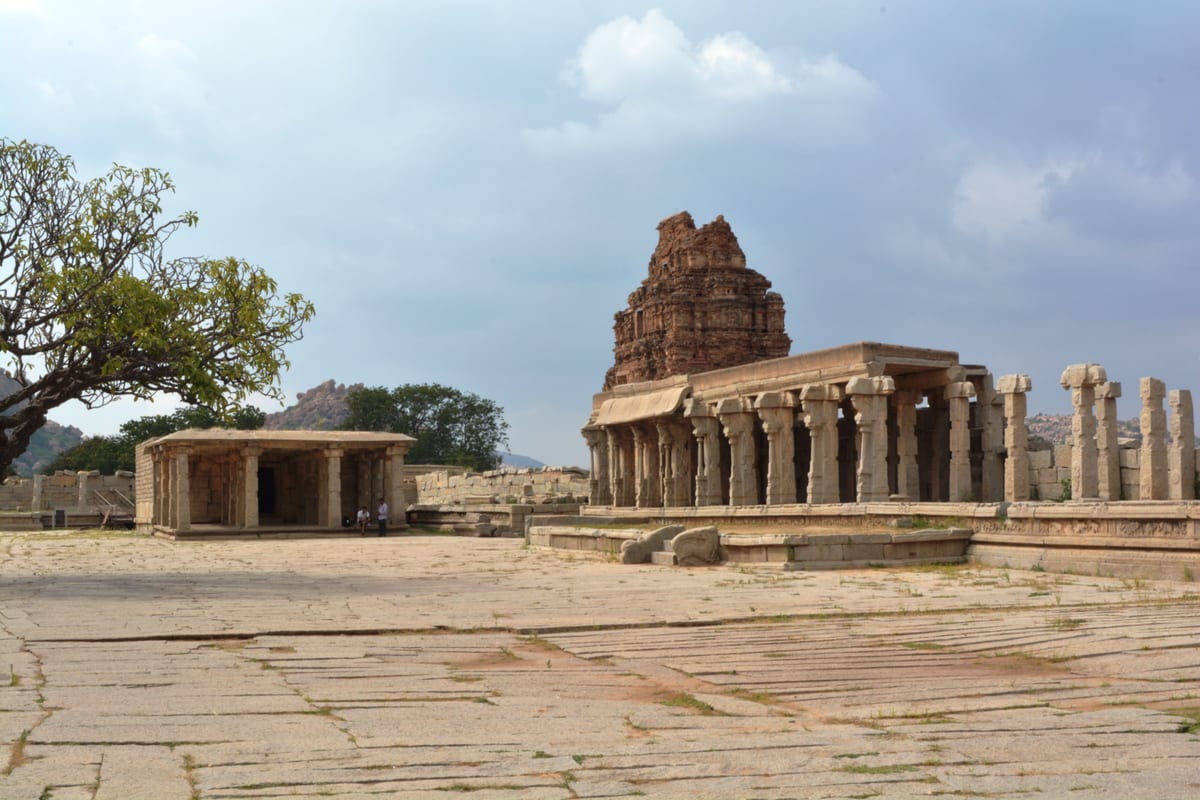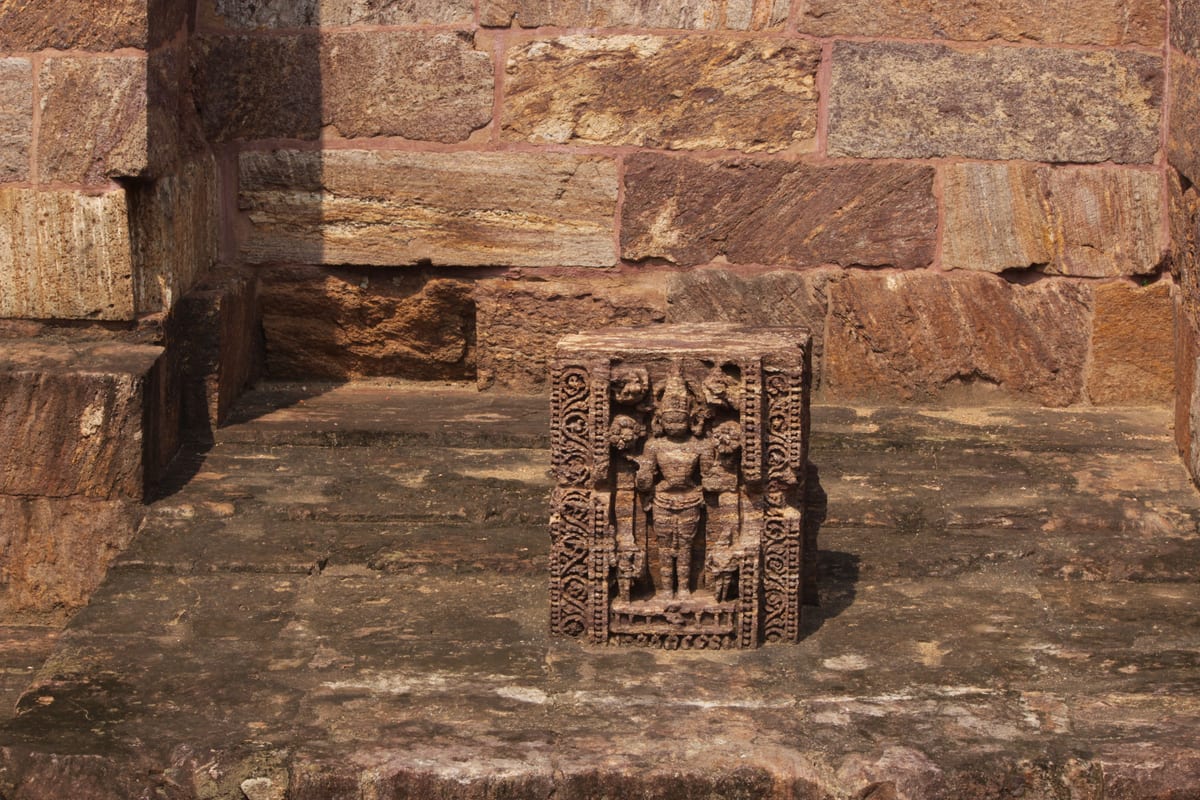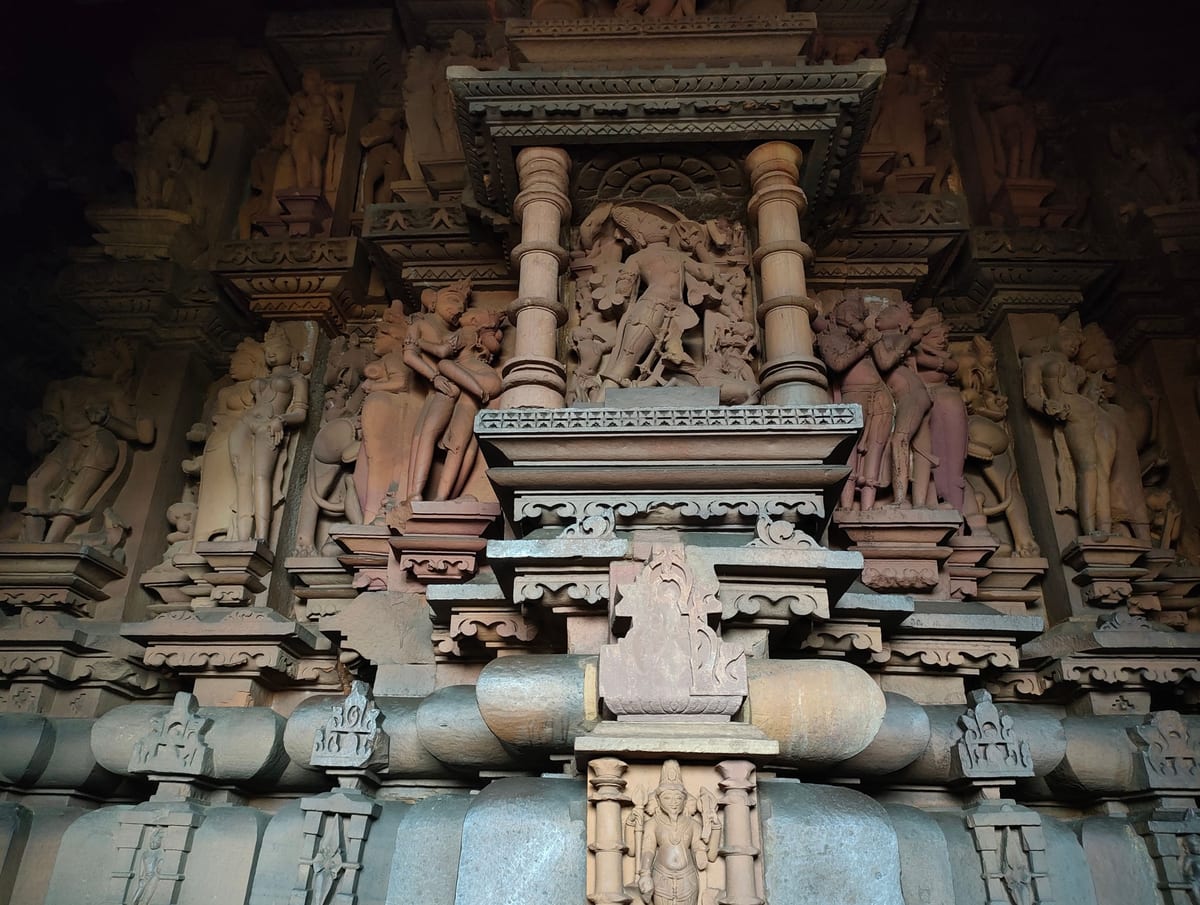
There is a moment, it arrives without warning, usually somewhere between the car park and the first granite panel, when Mahabalipuram stops being a destination and becomes an argument. An argument, quietly and irresistibly made in stone, that civilisation is not something that rises, falls, and gets excavated. It is something that simply continues.
A City Born at the Edge of the World
Mahabalipuram, also known as Mamallapuram, sits on the Coromandel Coast of Tamil Nadu, roughly 60 kilometres south of Chennai. For the Pallava kings who ruled this coastline from roughly the third to the ninth centuries CE, it was a flourishing port. Spices and silk moved between India and Southeast Asia through its harbours. Royal ambition expressed itself not in conquest alone but in the extraordinary act of carving an entire theological universe out of natural rock outcroppings.
The town takes its popular name from Mahabali, the mythological demon-king subdued by Vamana, the dwarf avatar of Vishnu. Its historical name, Mamallapuram, honours the Pallava king Narasimhavarman I, whose epithet was Mamalla, the great wrestler. Both names carry weight. Both are still used. That easy coexistence of myth and history is a distinctly Indian sensibility.
The Monuments: A Civilisation Speaking in Stone
The Incredible India page for Mahabalipuram identifies this coastal township as one of India's most important heritage destinations. The UNESCO World Heritage designation it earned in 1984 reflects global recognition: what the Pallavas built here belongs to humanity's finest artistic inheritance.
The centrepiece is Arjuna's Penance, a bas-relief panel carved across two enormous boulders, measuring nearly 30 metres wide and 15 metres high. It is one of the largest open-air rock reliefs in the world. The panel depicts either Arjuna performing penance to receive the Pashupatastra from Shiva, or the descent of the Ganga from the heavens. Scholars have debated this for decades, and the ambiguity feels intentional, as though the Pallava sculptors wanted the stone to hold multiple truths simultaneously. Every surface is animated: gods, demi-gods, nagas, elephants, ascetics, and ordinary humans all move toward a central cleft in the rock through which water once flowed, simulating the sacred river's descent. To stand before it is to see that seventh-century India was producing genuine art, work of conceptual sophistication that rivals anything contemporaneous in the world.
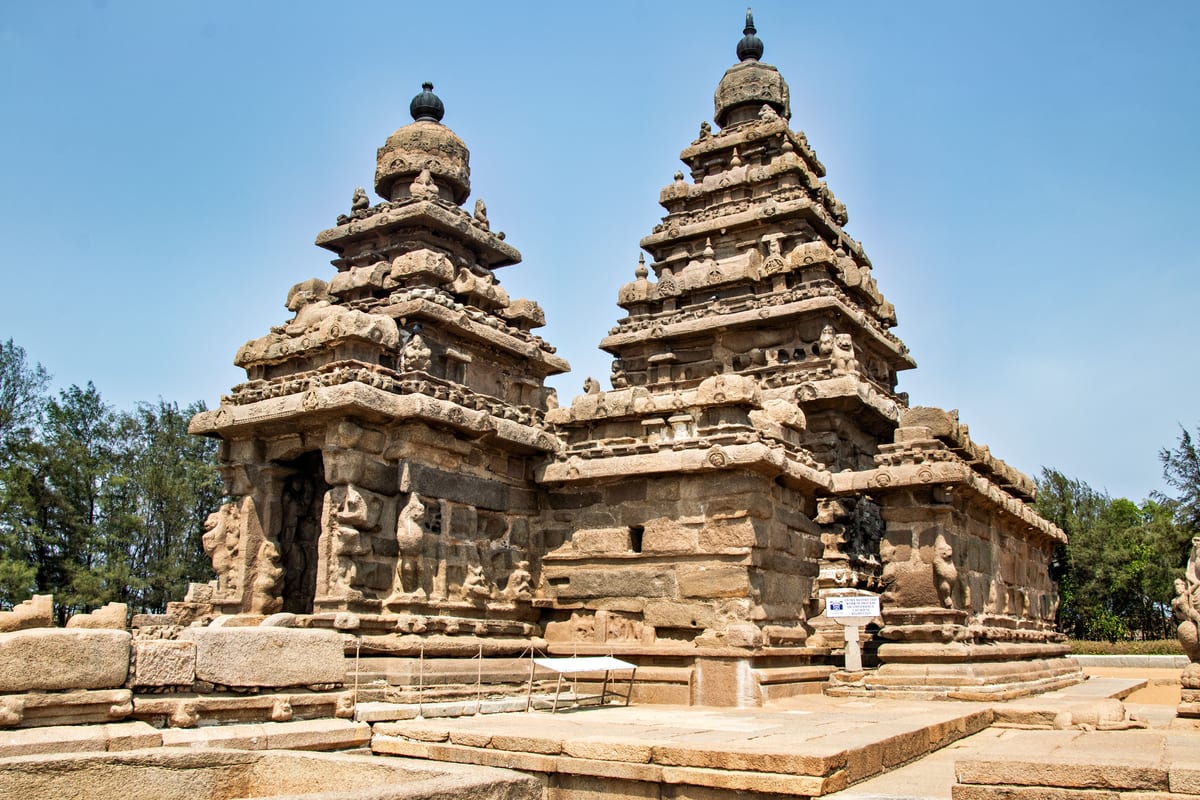
The Shore Temple, rising in tiered granite spires directly above the Bay of Bengal, is perhaps the most photographed structure in Tamil Nadu. Built during the reign of Rajasimha in the early eighth century, it is one of the oldest stone temples in South India. It is dedicated simultaneously to Shiva and Vishnu, another Pallava statement about inclusion within devotion. Waves have weathered its carvings for over twelve hundred years, softening detail without extinguishing meaning. At sunrise, when the light comes off the water and catches the stone at a low angle, the temple seems less like a building and more like a natural formation, as though the coast itself arranged these stones in an act of worship.
The Pancha Rathas, Five Chariots, are monolithic temples carved from single granite outcroppings, each styled after a different architectural typology. The Pallava masters appear to have been cataloguing the full vocabulary of South Indian temple form in one location. Named after the Pandava brothers and Draupadi, they were never used for active worship. They seem to have been architectural experiments, a royal design school carved in permanent material. Today they stand slightly apart from the main township, guarded by a life-sized stone elephant and a lion, carrying the peculiar dignity of ideas that were always meant to outlast their makers.
The Living Tradition: Mahabalipuram's Sculptors Today
What elevates Mahabalipuram above most heritage sites is this: the tradition has not died. The town is home to a thriving community of stone sculptors working in the same granite, with tools that differ only in degree from those their ancestors used. Workshops line the road into town, and the sound of chisel on rock greets you before you see a single ancient monument. Idols of Ganesha, Nataraja, and Murugan are being finished for temples across India and across the world. Students from government art colleges study the ancient panels and carry those proportions and mudras into contemporary work. Heritage is practice here, not preservation. The Pallavas are not in a museum. They are in the hands of a young sculptor in a dust-covered workshop on East Raja Street.
Nearby Attractions
Visitors with an extra day should consider the Tiger Cave, a rock-cut shrine about 4 kilometres north of town, whose entrance is framed by carved yali heads, mythological lion-creatures, with arresting theatrical energy. The Crocodile Bank, established by herpetologist Romulus Whitaker, sits just north of Mahabalipuram and is one of Asia's most important reptile conservation centres. The coastal road south toward Pondicherry is among the most scenic drives in Tamil Nadu, lined with casuarina groves, fishing villages, and the quiet salt-smell of the Coromandel.
When to Visit and How to Get There
The best time to visit Mahabalipuram is between October and March, when the coastal heat relents and the light is clear without being punishing. Mornings are especially beautiful, the Shore Temple at dawn, with fishing boats returning from the night's work in the middle distance, is one of those sights that rearranges something quietly inside you. December and January bring the Mahabalipuram Dance Festival, an outdoor classical dance event staged against the backdrop of the monuments themselves, extending the living tradition of this place in the most direct way imaginable.
Chennai International Airport is the most convenient gateway, approximately 60 kilometres north. Regular bus services connect Chennai Mofussil Bus Terminus to Mahabalipuram in roughly 90 minutes to two hours. Taxis and app-based cabs from Chennai are comfortable and widely available. The town itself is compact and best explored on foot or by bicycle.
Why Mahabalipuram Matters
India has thousands of heritage sites. Mahabalipuram is one of the handful that compresses the entire argument for India's civilisational continuity into a single afternoon's walk. A medieval king's theological ambition became public art. That art survived invasion, colonial indifference, and the patient erosion of the sea. Now, in the same town, the same tradition produces new work, ships it to new temples, trains new hands. The stone is the same. The intention is the same. Only the calendar has changed.
Come to Mahabalipuram not as a tourist visiting ruins, but as a reader encountering a text that has been continuously written for thirteen centuries and is not yet finished.