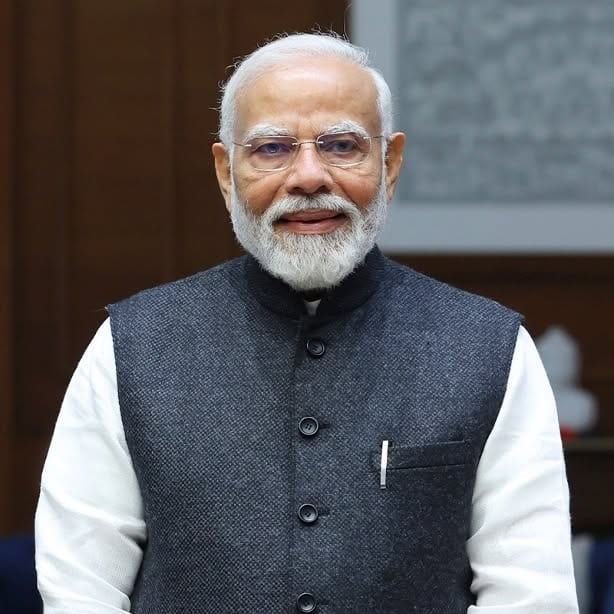
Prime Minister Narendra Modi received a phone call from US Vice President JD Vance on Saturday, during which the two leaders discussed ways to further deepen the India-US Comprehensive Global Strategic Partnership across key areas. The call, confirmed by Modi in a post on X, also carried a personal note, the Prime Minister congratulated Vance and the Second Lady on the birth of their son and conveyed best wishes to the family.
The timing is significant. The same week, Vance told Fox News that Washington is working to establish a route allowing commercial ships to safely pass through the Strait of Hormuz, even as the US continues to pressure Iran. Speaking on 'Saturday in America', Vance said the plan includes an Iranian commitment not to fire on commercial ships, but added that Washington does not trust Tehran's assurances, a tension that sits directly in India's energy supply lines. And on Friday, the US Senate passed the Lindsey O. Graham Sanctioning Russia and Iran Act of 2026 by an overwhelming 86-11 vote, authorising the US president to levy tariffs of up to 100 percent on imports from the top five buyers of Russian crude oil or natural gas, a list that includes India.
What the Call Actually Does
Diplomatic phone calls between heads of government produce no binding commitments. What they do produce is political insulation, a signal to bureaucracies on both sides that the relationship commands attention at the top, and that friction generated at the working level should not calcify into deadlock. That is the function this call serves.
According to LiveMint, it was not immediately clear whether the proposed India-US bilateral trade agreement was discussed during the call. That ambiguity itself is instructive. The trade deal, aimed at a first tranche of deliverables, is the most consequential near-term test of the partnership's depth. If the call did not advance it, it at least maintained the political environment in which such an advance remains possible.
Vance occupies a particular position in this bilateral architecture. Within the current US administration, he has emerged as a substantive interlocutor on South Asia and Indo-Pacific strategy, not merely a ceremonial deputy. His receptivity to framing India as a civilisational counterweight to China, rather than as a transactional ally to be managed, gives New Delhi a useful channel that runs alongside, and sometimes ahead of, the formal State Department track. Keeping that channel active is statecraft.
The iCET Gap, Where Politics and Paperwork Diverge
The India-US relationship has been elevated at the rhetorical level for years. The Comprehensive Global Strategic Partnership designation, the iCET framework covering semiconductors, artificial intelligence, and advanced defence technologies, these represent real institutional architecture. The problem, as analysts at the Observer Research Foundation have argued, is that the distance between political intent and actual technology transfer remains wide, and it narrows only when leaders push the bureaucracies from above.
The iCET agenda carries specific weight here. Semiconductor supply chain cooperation and AI governance alignment are not abstract agenda items, they are live negotiations where US export-control review processes have consistently moved slower than the political temperature would suggest. A fighter engine co-production arrangement, advanced drone platforms, dual-use manufacturing, each runs into the same structural bottleneck: export-control bureaucracy that has not caught up with the partnership's stated ambitions. Leader-level calls do not rewrite those regulations. But they signal to relevant agencies that delays have political costs, and that signal has operational consequences.
The window is not indefinite. As the US election cycle moves toward its peak in late 2026, Washington's bandwidth for complex bilateral deliverables will compress. Congressional attention will turn inward. Agencies that might otherwise finalise an ITAR waiver or approve a co-production proposal will find reasons to defer. India's leverage, its defence procurement decisions, its technology investment choices, its positioning as the preferred Indo-Pacific partner, is at its highest precisely when political engagement is active and orders are in play simultaneously. The Modi-Vance call sustains that leverage for another cycle.
The Russia Sanctions Overhang
The Senate's Russia sanctions bill is the sharpest structural complication in the current bilateral landscape, and it arrives in the same week as the Modi-Vance call. The legislation, as IWE has previously reported, would grant the US president discretionary authority to impose tariffs of up to 100 percent on imports from the world's top five buyers of Russian crude oil or natural gas. India's energy procurement from Russia has grown substantially since 2022, making it a direct target of the bill's architecture.
New Delhi's formal position holds that energy procurement decisions are sovereign economic choices, not diplomatic concessions to be traded for American approval. That position is consistent with the broader doctrine of multi-alignment, engaging all major powers from a position of strategic autonomy, not choosing between them. The Senate bill does not change that doctrine; it raises the cost of maintaining it.
What the Modi-Vance call does, in this context, is create a diplomatic record. India's concerns about the legislation, its extraterritorial reach, its effect on energy security, its treatment of bilateral trade as collateral in a conflict India did not initiate, can now be raised through the VP channel before the bill reaches the House and then the President's desk. Whether Trump exercises his discretionary authority under the act, should it become law, will depend partly on political calculations that involve India's overall posture toward the administration. High-level personal rapport is one input into that calculation. It is not the only one, but it matters.
Vance also flagged separately that Washington is seeking an Iranian commitment to allow maximum oil and gas flow through the Strait of Hormuz, a waterway through which a significant portion of India's imported energy transits. The Indian government did not comment publicly on that dimension of Vance's remarks. But India's stake in Hormuz stability is direct and material, and the VP's acknowledgement that Washington is actively managing that corridor, even while not fully trusting Tehran, is information that matters to Indian energy planners.
The Personal and the Structural
Modi's congratulations to Vance on the birth of his son is the kind of detail that gets noted and filed. It marks a relationship that operates across registers, strategic, economic, and personal. That texture is not trivial. Diplomacy between large democracies involves thousands of moving parts, and the parts move faster when the people at the top regard each other with warmth rather than merely with professional courtesy.
India has invested in building that warmth with deliberate consistency. The pattern, Modi-Trump meetings, Modi-Vance calls, sustained engagement through the iCET framework, defence co-production discussions, reflects a strategic judgment that relationships with American principals pay dividends that relationships with American institutions alone cannot replicate, particularly in an administration that prizes personal loyalty and directness over multilateral process.
The real test of this diplomatic investment will not be measured in phone calls. It will show up in whether an engine co-production approval clears the interagency review it has been circling for years; whether a semiconductor partnership moves from memorandum to factory floor; whether India's trade deal delivers a substantive first tranche before Washington's political calendar makes everything harder. The call was the opening move in that pressure campaign. What follows it, in the next several months, before the US election cycle consumes the room, will determine whether the warmth at the top produced anything durable below it.