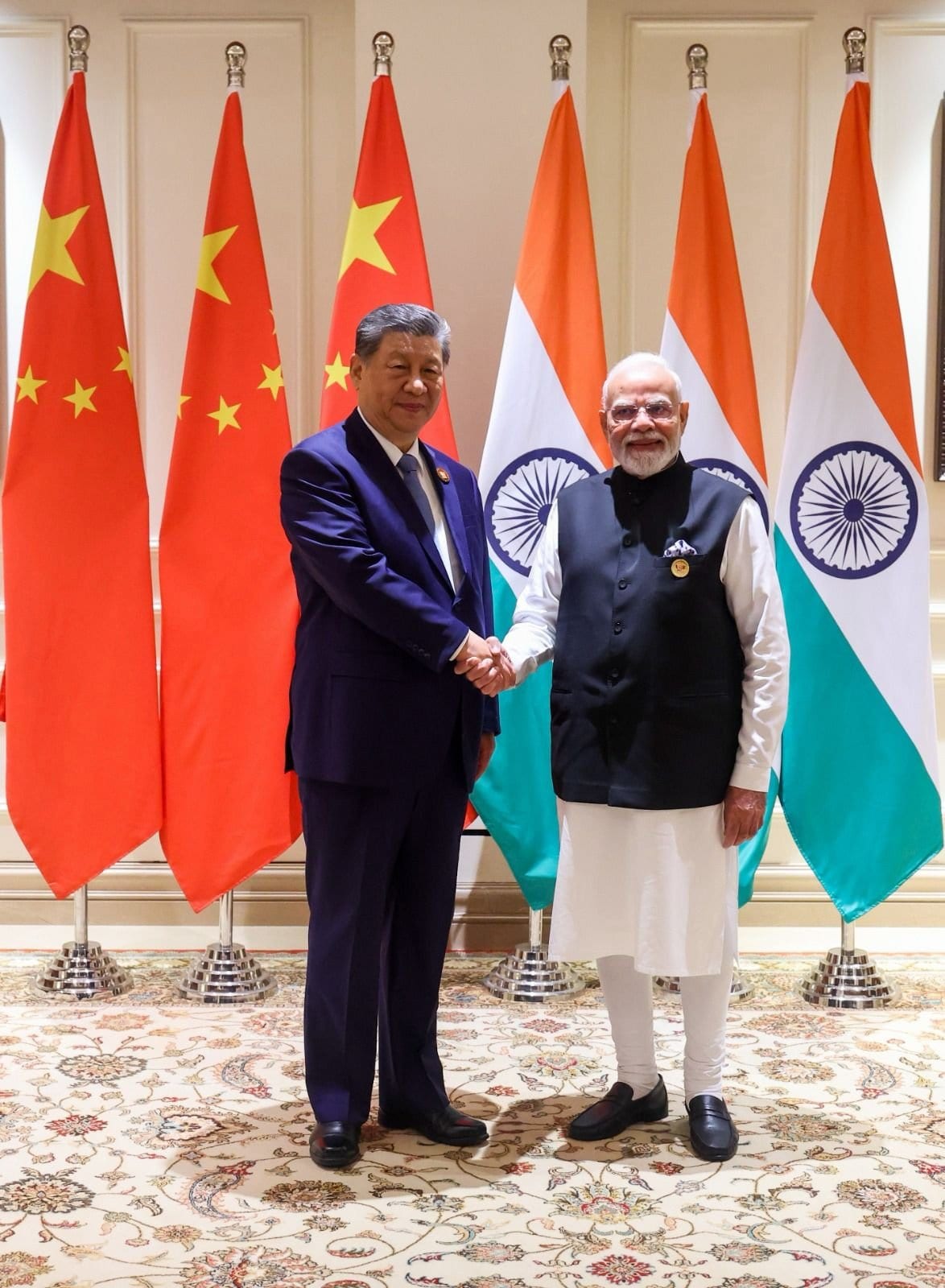
New Delhi: Prime Minister Narendra Modi stood between Russian President Vladimir Putin and Chinese President Xi Jinping in the official BRICS family photograph on the second day of the summit in the capital, as the 11-nation grouping issued a joint statement calling for calm in the Middle East. The photograph, released on Saturday, captured the leaders after a day of plenary and bilateral sessions that had tested the bloc's ability to find common language on West Asia.
The joint statement, reported by NDTV, overcame earlier divisions among members including China, Russia, Iran and India. Iranian President Masoud Pezeshkian and Indonesian Prime Minister Prabowo Subianto also appeared in the frame, according to another NDTV report.
Modi published the photograph on social media, drawing immediate attention to the seating order. The image records who attended and their placement. Modi between Putin and Xi sends a message: India intends to keep all its strategic channels open.
The optics of adjacency
India's foreign policy has treated high-level optics as an instrument. A photograph placing Modi between the Russian and Chinese presidents reinforces New Delhi's repeated position since the early days of the grouping: India engages multiple power centres from a position of strength, not necessity. The frame does not signal a tilt toward any single bloc. It signals that India is present in all rooms and deliberate in that presence.
India chairs BRICS this year. The summit in Delhi gave New Delhi the opportunity to shape the agenda. The family photograph records India's convening power. The bloc now spans a large share of the world's population and a substantial portion of global output. To lead that table is to shape the conversation.
The placement does not indicate alignment. Indian diplomacy does not operate on the logic of choosing between Washington, Moscow and Beijing. It operates on widening options. The photograph with Putin and Xi is a single frame in a larger sequence that includes Quad engagements, Indo-Pacific frameworks and deep technology and defence ties with Western partners. None of these cancel the others.
A joint statement, a broker's hand
The joint call for calm in the Middle East matters beyond the communiqué. India's energy supply chains run through the Gulf. Iraq, Saudi Arabia and the United Arab Emirates remain among its most significant crude suppliers, and a large share of India's overseas workforce lives in the region. Any escalation in West Asia affects Indian fuel prices, remittance flows and evacuation planning.
New Delhi's ability to bring Iran, Saudi Arabia and the UAE to a common formulation has been one of the quieter achievements of this summit. The India Today report framed the photograph as a moment of warmth despite continuing India-China tensions. That tension remains, yet the two leaders shared the same platform and the same communiqué. The photograph did not end the border standoff; it set it aside while work continued on the common agenda.
The joint statement succeeded because it stayed narrow. It called for de-escalation in West Asia without naming a villain or endorsing a party. India can live with that formulation. It shows how a consensus built on shared interest rather than shared ideology can hold. It also protects the Indian position that BRICS should not become an anti-Western bloc.
China in the frame
The India-China border standoff did not disappear because both leaders smiled for a camera. What the BRICS platform provides is a channel independent of the border impasse. India can press its security concerns in bilateral meetings while cooperating on multilateral language in the plenary. The two tracks run in parallel.
This is where India's strategic autonomy matters. A country that refused to sit with China in any forum would forfeit the ability to shape the grouping's language on terrorism, trade and energy. New Delhi has chosen otherwise, and the family photograph documents that choice. Beijing has used the platform to signal reasonableness without yielding on the Line of Actual Control. The two postures coexist because BRICS does not require them to resolve.
Where BRICS fits in India's arc
BRICS membership does not dilute India's other partnerships. The Quad, the Indo-Pacific frameworks and the growing technology and defence ties with Western partners continue. India no longer treats these relationships as mutually exclusive. It moves between them with the same deliberate cadence.
There is a view from Delhi that BRICS is a tool for reforming multilateral institutions rather than an alliance against anyone. The group's expansion to eleven members has made it unwieldy but also more representative of the Global South's voice. India's task within that larger table is to keep the agenda focused on development, energy security, digital public infrastructure and counterterrorism, not on bloc confrontation. The emphasis on these themes is consistent with the approach New Delhi has taken in earlier BRICS declarations, where concrete outcomes matter more than rhetorical alignment.
What India must now do is operationalise the statement. Diplomatic engagement with both Israel and Iran will be necessary to protect the diaspora and energy interests that gave the communiqué its urgency. The photograph will fade. The follow-through will not.