There is a moment, somewhere on the winding road up from the plains of Kerala, when the air changes. The heat of the lowlands releases its grip, a cool dampness settles on your skin, and the world turns an improbable, saturated green. You have entered Munnar, and nothing you have read quite prepares you for it.
Tucked into the Idukki district of Kerala, bordered by the grand ridgelines of the Anamalai Hills and the aromatic Cardamom Hills, Munnar is a hill station and tea country, but also something deeper. The landscape carries the memory of ancient tribes, colonial ambition, ecological wonder, and the quiet, persistent spirit of Kerala's people. To travel here is to read several centuries of Indian history written not in stone or scripture, but in soil, mist, and leaf.
A History Rooted in the Land
Long before the first British surveyor set foot on these hills, Munnar belonged to the Muthuvans and the Odiyas, indigenous communities who understood this terrain with an intimacy that no map could capture. They moved through these forests, read the seasons, and held the hills in a relationship of mutual respect. Their presence here is not incidental to Munnar's story; it is the opening chapter.
In the 19th century, British colonial enterprise arrived with an eye for commercial possibility. Recognising the region's cool climate and fertile, well-watered slopes as ideal for Camellia sinensis, they established tea plantations that reshaped the landscape permanently. Munnar became a flourishing centre of the colonial tea industry, a fact that carries both a complicated legacy and undeniable economic consequence that persists today. What is remarkable is how completely Kerala has absorbed and made its own that history. The tea estates no longer feel like a foreign imposition. They are Munnar itself.
The Landscape That Defines a Region
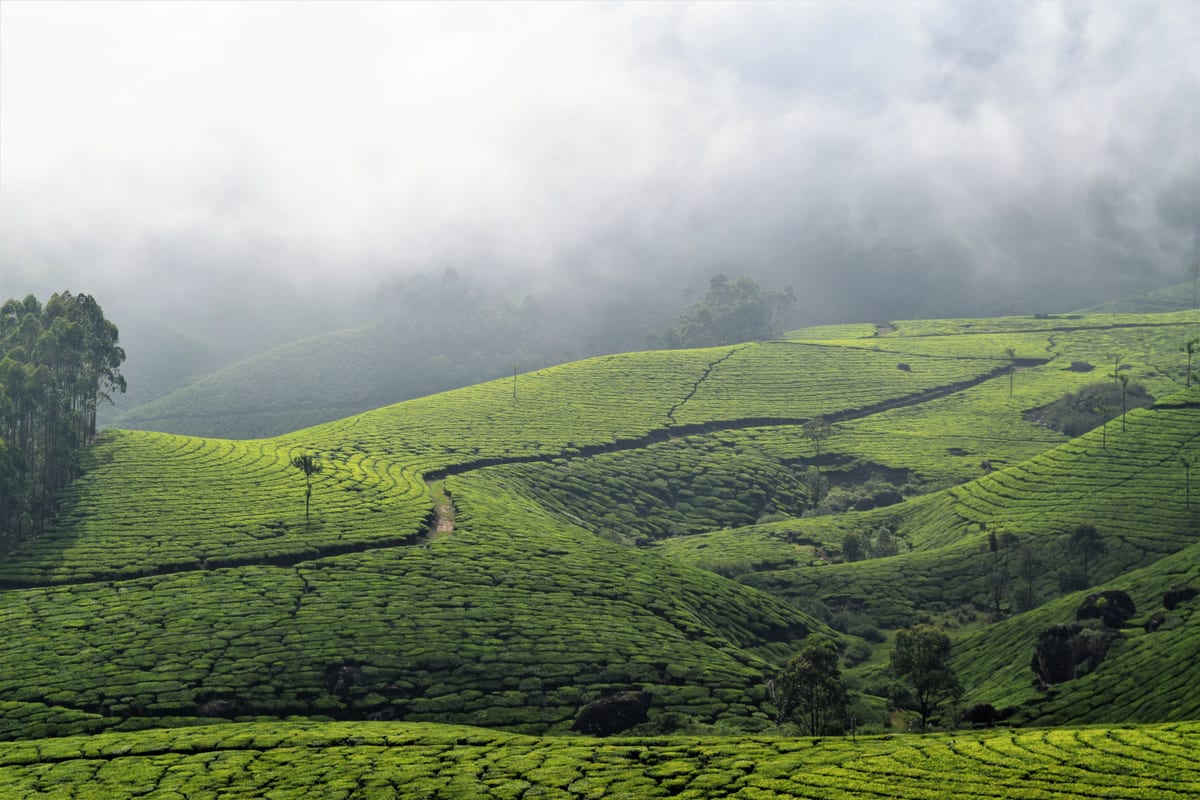
The geography of Munnar is its greatest argument. Rolling hills carpeted in the precise, manicured rows of tea bushes stretch as far as the eye can reach, interrupted by cascading waterfalls, dense shola forests, and the silver threads of streams that feed the valleys below. The region experiences temperatures between 5°C and 25°C throughout the year, a cool, temperate embrace that feels like a gift in a tropical country.
The monsoon, arriving between June and September, drapes the hills in heavy mist and driving rain, turning every stream into a torrent and every hillside into a deeper shade of green. The winter months, December through February, bring clear skies, cool mornings, and light that makes photographers grateful to be alive. This is Munnar at its most inviting: crisp, luminous, and impossibly beautiful.
Viewpoints like Mattupetty, Top Station, and Echo Point offer panoramic vistas across the valley systems below, landscapes so vast and layered that they remind you how small and lucky you are to be standing in them.
Tea: More Than a Commodity
To visit Munnar and not reckon seriously with tea would be negligent. The sprawling tea estates that carpet these hillsides are not merely agricultural infrastructure, they are the visible form of a civilisational negotiation between a colonial past and an independent present. Walking through a working tea garden, watching the careful rhythm of the pluck, two leaves and a bud, always, you understand that this is skilled, intimate labour. It demands knowledge, patience, and a relationship with the plant that is almost conversational.
The Tea Museum at Munnar traces the journey from colonial plantation to Kerala's own thriving tea culture. The region produces some of India's finest high-grown teas, and drinking a cup here, in the hills where it was grown, reorganises your understanding of a simple daily ritual.
Biodiversity and the Living Forest
Munnar sits at the heart of one of the world's biodiversity hotspots. The Eravikulam National Park, home to the endangered Nilgiri Tahr, lies within reach. The shola grassland ecosystems unique to the Western Ghats, ancient, fragile, and extraordinary, survive here in some of their finest forms. The Neelakurinji flower, which blankets the hills in a rare blue bloom once every twelve years, has become something close to a symbol of Munnar's mysterious, unhurried time.
This ecological richness is central to Munnar's heritage. India's civilisational relationship with nature has never been extractive at its deepest level; it has been custodial. The indigenous communities of these hills understood that instinctively. Modern conservation efforts, however imperfect, attempt to recover that understanding.
Planning Your Journey
Best Time to Visit: October through March offers the clearest skies and most comfortable temperatures. The post-monsoon months of October and November bring a lush, washed landscape that is particularly striking. Avoid the peak monsoon period if you are sensitive to road conditions, though the rains themselves have their own dramatic beauty.
Getting There: The nearest airports are Cochin International Airport (COK) and Coimbatore International Airport (CJB), both within reasonable driving distance of Munnar. If you prefer rail, the nearest railway stations are Aluva (AWY), Ernakulam Town (ERN), and Ernakulam South Junction (ERS), all well connected to major Indian cities, with onward road travel to Munnar taking approximately three to four hours through spectacular scenery.
Nearby Attractions: Beyond the tea estates and viewpoints, consider visiting Eravikulam National Park, Attukal Waterfalls, the Chinnar Wildlife Sanctuary, and the serene Mattupetty Dam. Each adds a different texture to the Munnar experience.
Why Munnar Matters
India's heritage is not stored exclusively in temples, forts, or classical manuscripts, though these matter enormously. It is alive in landscapes like Munnar, where the relationship between people and place has been continuously negotiated across centuries. The Muthuvan communities are still here. The tea gardens are still tended by human hands. The forests are still standing, though under pressure. The mist still rolls in each morning as if the hills are exhaling.
Munnar asks its visitors to pay attention, not just to the view, but to the story behind it. The best travel does this. It shows you a place and what that place has survived, and what it still holds. For more information and official travel guidance, visit the Incredible India page for Munnar.